


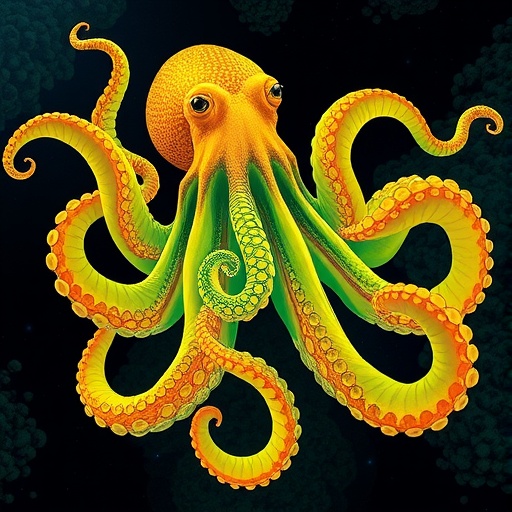
Octopuses have long fascinated scientists and the public alike with their extraordinary intelligence and problem-solving abilities. This intrigue was spectacularly highlighted by Inky the Octopus’s daring 2016 escape from the National Aquarium of New Zealand, where the cephalopod exhibited remarkable spatial awareness by navigating a drainpipe to freedom. Building upon the recognition of octopus cognition, a groundbreaking study conducted at Dartmouth College has unveiled that octopuses can leverage mirrors as tools to locate food sources that lie beyond their direct line of sight, demonstrating advanced spatial cognitive skills previously unconfirmed in invertebrates.
Published in the esteemed journal Current Biology, this novel research details how California two-spot octopuses (Octopus bimaculoides) were trained to interpret mirror reflections not merely as visual curiosities but as practical guides to uncover hidden prey. Such behavior underscores a complex level of environmental processing, akin to what has traditionally been ascribed only to vertebrates such as primates and certain avian species. Lead author Mary Kieseler, formerly a PhD candidate at Dartmouth’s Department of Psychological and Brain Sciences and now a postdoctoral researcher at the University of Fribourg, remarked on the significance of the findings: “Our work reveals for the first time that an invertebrate can utilize a mirror to understand spatial relationships in its environment, a skill that challenges previous assumptions about the cognitive divide between vertebrates and invertebrates.”
The experimental paradigm involved acclimating octopuses to mirrors installed in their tanks and training them to resist attacking the mirror image of a crab, instead encouraging them to infer the actual position of the prey hidden behind their backs. By associating the virtual appearance of a crab in the mirror with the subsequent presence of a live crab reward located around a corner, the octopuses demonstrated the ability to mentally map and act upon information conveyed via reflections. This task required the animals to perform precise spatial reasoning: they needed to transform the mirror image into real-world coordinates—a process that entails sophisticated sensorimotor integration.
This mirror-based task was carefully designed to exclude reliance on chemosensory cues, as octopuses possess chemoreceptors allowing them to “taste” their surroundings by touch. By projecting the crab stimulus virtually from behind, the researchers ensured that the octopuses’ decision-making was grounded solely in their interpretation of visual input from the mirror. Impressively, the cephalopods succeeded approximately 73% of the time in navigating correctly to the location of the hidden reward, signifying robust understanding rather than random exploration.
The methodology involved a start box open from above and the front, where octopuses faced the mirror showing the virtual crab image projected from either the left or right side behind them. Rather than swimming directly toward the reflection, the octopus had to execute a 180-degree turn to reach the actual location from which the crab reward was delivered. The experimental observations also noted adaptive problem-solving behaviors; some octopuses climbed over the enclosure rather than swimming around it, indicating flexible motor strategies to achieve the goal efficiently.
Senior author Peter Tse, a cognitive neuroscientist at Dartmouth, likened the octopuses’ learning process to how humans learn to use rearview mirrors in driving: initially unfamiliar, mirrors become indispensable aids for inferring spatial relationships beyond direct vision. He emphasized that octopuses are capable of internalizing how mirrors relay spatial information, akin to vertebrate species. This parallel is especially striking considering the vast evolutionary divergence between humans and octopuses, which last shared a common ancestor with a worm-like organism hundreds of millions of years ago.
The implications of these findings extend beyond demonstrating mirror usage; they hint at the existence of internal spatial maps in octopuses that enable them to navigate and hunt with precision in their intricate marine habitats. Coral reefs and seafloors present complex three-dimensional environments where swift and accurate prey capture confers critical survival advantages. As predators, octopuses must balance stealth and speed, akin to terrestrial hunters such as felines, underscoring an evolutionary premium on sophisticated spatial cognition.
Moreover, these results suggest convergent cognitive evolution, whereby distantly related species independently develop analogous neural mechanisms to overcome similar ecological challenges. The octopuses’ ability to repurpose visual feedback from mirrors to inform their actions reveals cognitive flexibility that rivals many vertebrates, challenging simplistic views of intelligence distribution in the animal kingdom.
While the researchers are cautious about overinterpreting the data, they propose that future studies should explore the neural underpinnings and extent of spatial representation in octopus brains. Crucial questions remain about whether their spatial awareness constitutes a form of mental mapping comparable to that documented in mammals and birds, a discovery that would revolutionize our understanding of invertebrate cognition.
This pioneering research not only adds to the growing body of evidence that octopuses possess remarkable cognitive skills but also opens new avenues in the study of animal intelligence and sensory ecology. By demonstrating an invertebrate’s capacity to interpret complex visual cues for spatial problem-solving, the study invites reevaluation of the cognitive capabilities across phyla and offers fascinating insights into the evolutionary trajectories of intelligence.
Mary Kieseler is available for further commentary and inquiries at Marie-luise.Kieseler@dartmouth.edu.
News Publication Date: 3-Jun-2026.
Web References:
- Current Biology Article
- Inky the Octopus escape story: New York Times
Cite Scienmag News
Violet Maxwell. (June 3, 2026). New Study Reveals Octopuses’ Remarkable Spatial Navigation Skills. Scienmag. https://scienmag.com/new-study-reveals-octopuses-remarkable-spatial-navigation-skills/
Violet Maxwell. "New Study Reveals Octopuses’ Remarkable Spatial Navigation Skills." Scienmag, 3 June 2026, https://scienmag.com/new-study-reveals-octopuses-remarkable-spatial-navigation-skills/. Accessed 3 September 2026.
Violet Maxwell. "New Study Reveals Octopuses’ Remarkable Spatial Navigation Skills." Scienmag. June 3, 2026. https://scienmag.com/new-study-reveals-octopuses-remarkable-spatial-navigation-skills/


