


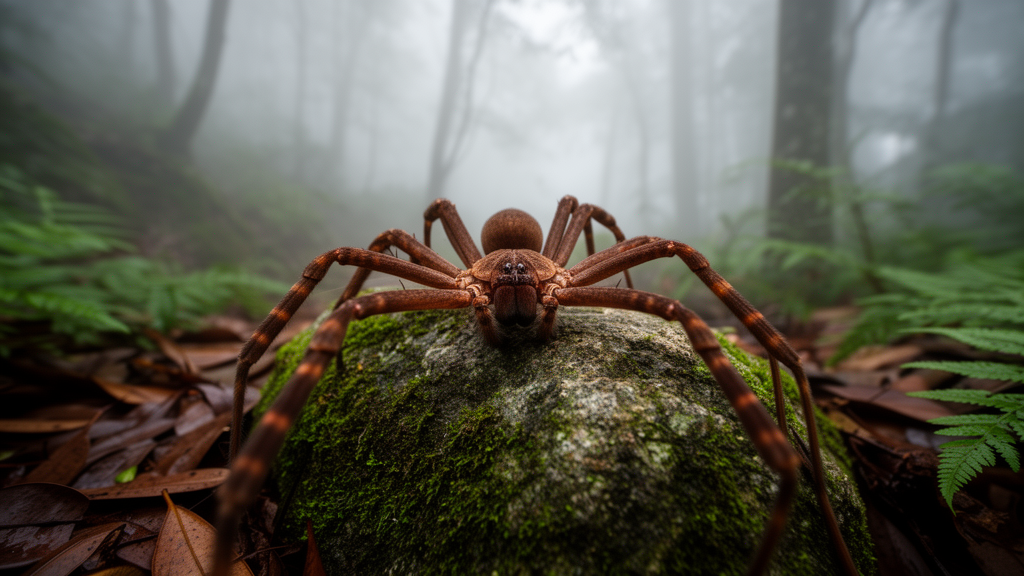
A morphological taxonomic study described three previously unknown species of the spider genus Pseudopoda from China: Pseudopoda chengkouensis, P. liyihangi and P. maolanensis. The new species were established from preserved male and female specimens collected in 2025 in Chongqing Municipality, Shaanxi Province and Guizhou Province, respectively. Each species is currently known only from its type locality, so the study does not establish their broader geographic ranges.
Pseudopoda is the most species-rich genus in the family Sparassidae, with 271 described species, 168 of which have been recorded from China. Its members occur mainly in East, South and Southeast Asia, and many are considered to have restricted distributions. The authors describe the genus as still insufficiently known in China. Their study follows a comprehensive 2023 revision that added 99 species from East, South and Southeast Asia and several reports of additional Chinese species published in 2024 and 2025.
The researchers examined specimens preserved in absolute alcohol under an Olympus SZX7 stereomicroscope and photographed them with a Leica M205 C stereomicroscope. Male palps and female epigynes were dissected for examination, with epigynes treated in warmed 0.1 mg/ml Protease K solution before study. Morphological measurements were reported in millimetres, and positions of tegular appendages were assigned clock-face coordinates from the left male palp in ventral view. The examined material was deposited at Xingtai University, abbreviated XTU.
Pseudopoda chengkouensis was described from Chengkou County in Chongqing Municipality. Its male holotype came from Lianfeng Village, Nacaigou, at an elevation of 1,284 metres and was collected on 4 April 2025. The type series also included males and females from two other separate locations: Chuangziping in Liaozi Township at 1,376 metres, where collections were made on 3 April 2025, and Huajiaowan in Heyu Township at 1,926 metres, sampled on 5 April 2025. The holotype male measured 7.2 mm in body length, while the measured female measured 8.3 mm; both were classified as small-sized.
The male of P. chengkouensis resembles P. yintiaoling in having a broad retrolateral tibial apophysis with two subtriangular marginal projections on its ventral part. It differs through a narrower distal embolus that tapers to a pointed tip, a shorter embolic projection resembling a small hump, a slightly bulged ventral proximal tegulum and a shorter, sharper ventral branch of the apophysis. The female resembles P. kunmingensis, but differs in its curved anterior lateral-lobe margins and a nearly round spermatheca that is covered by the lateral lobes and first winding in dorsal view.
Pseudopoda liyihangi was established from a male holotype and female paratype collected in Taiziling Village, Liuba County, Shaanxi Province, at 2,000–2,100 metres. The holotype was collected on 24 June 2025. Its male has a body length of 8.0 mm and is classified as small-sized, whereas the female measures 11.1 mm and is classified as medium-sized. The male resembles P. dao in having a long, filiform embolus with a loop at its distal end, but differs in the embolus arising from the tegulum at the 9 o’clock position, a visible subtegulum in prolateral view, a straight sperm duct in retrolateral view and an unbranched retrolateral tibial apophysis narrower than the tibia. The female resembles P. qingxiensis in having a reticulate vulvar region and twisted spermatheca, while the median portions of its anterior lateral-lobe margins are straight rather than V-shaped.
Pseudopoda maolanensis was described from Maolan National Nature Reserve in Libo County, Guizhou Province. The holotype male was collected at an elevation of 560 metres on 19 July 2025, together with a male and a female paratype. The male measured 9.9 mm in body length and was classified as small-sized; the female measured 10.8 mm and was classified as medium-sized. The male resembles P. titan in having a digitiform dorsal branch of the retrolateral tibial apophysis, a broad embolic base and an embolic tip bending almost 90 degrees in ventral view. It differs through an embolic projection with an irregular margin, an apophysis arising from the median part of the tibia and a ventral branch almost 1.5 times wider than the dorsal branch. The female differs from P. rufosulphurea in having posterior lateral-lobe portions nearly parallel to the anterior portions and touching each other, as well as an anterior first winding wider than the posterior part.
The paper also documents coloration and a notable variation in P. maolanensis. The dorsal shield of P. chengkouensis is yellow to orange-yellow with dark-brown spots and radial lines. P. liyihangi has a yellow dorsal shield with black spots and radial lines and a brownish-purple dorsal opisthosoma with two pairs of median brown spots. P. maolanensis has an orange dorsal shield with brown radial lines and a brownish-purple dorsal opisthosoma bearing two posterior yellow spots. In its paratype male, the dorsal branch of the palpal apophysis is nearly as wide as the ventral branch and almost twice as long.
The names P. chengkouensis and P. maolanensis derive from their type localities, while P. liyihangi honours Yihang Li, who collected the holotype. These descriptions are based on morphological examination and comparison with previously described species. Because the material was limited to the reported type localities and the study supplied no wider distributional sampling, the documented distributions remain restricted to the areas where the new species were collected.
Subject of Research: Morphological description of three new Pseudopoda spider species from China
Article Title: Three new species of the genus Pseudopoda Jäger, 2000 ( Araneae , Sparassidae , Heteropodinae ) from China
Article References: Zhang, H., Cao, F., Wang, L.-Y., Liu, J., & Hu, C. (2026). Three new species of the genus Pseudopoda Jäger, 2000 (Araneae, Sparassidae, Heteropodinae) from China. ZooKeys, 1292, 141-157. https://doi.org/10.3897/zookeys.1292.196539
Image Credits: AI Generated
DOI: 10.3897/zookeys.1292.196539
Keywords: Pseudopoda, spider taxonomy, new species, Sparassidae, Heteropodinae, morphological analysis, Chongqing, Shaanxi, Guizhou, arachnology, Three, species
Cite Scienmag News
Drew Townsend. (October 20, 2026). Morphological study describes three new Pseudopoda spider species from Chongqing, Shaanxi and Guizhou. Scienmag. https://scienmag.com/morphological-study-describes-three-new-pseudopoda-spider-species-from-chongqing-shaanxi-and-guizhou/
Drew Townsend. "Morphological study describes three new Pseudopoda spider species from Chongqing, Shaanxi and Guizhou." Scienmag, 20 October 2026, https://scienmag.com/morphological-study-describes-three-new-pseudopoda-spider-species-from-chongqing-shaanxi-and-guizhou/. Accessed 20 October 2026.
Drew Townsend. "Morphological study describes three new Pseudopoda spider species from Chongqing, Shaanxi and Guizhou." Scienmag. October 20, 2026. https://scienmag.com/morphological-study-describes-three-new-pseudopoda-spider-species-from-chongqing-shaanxi-and-guizhou/


