


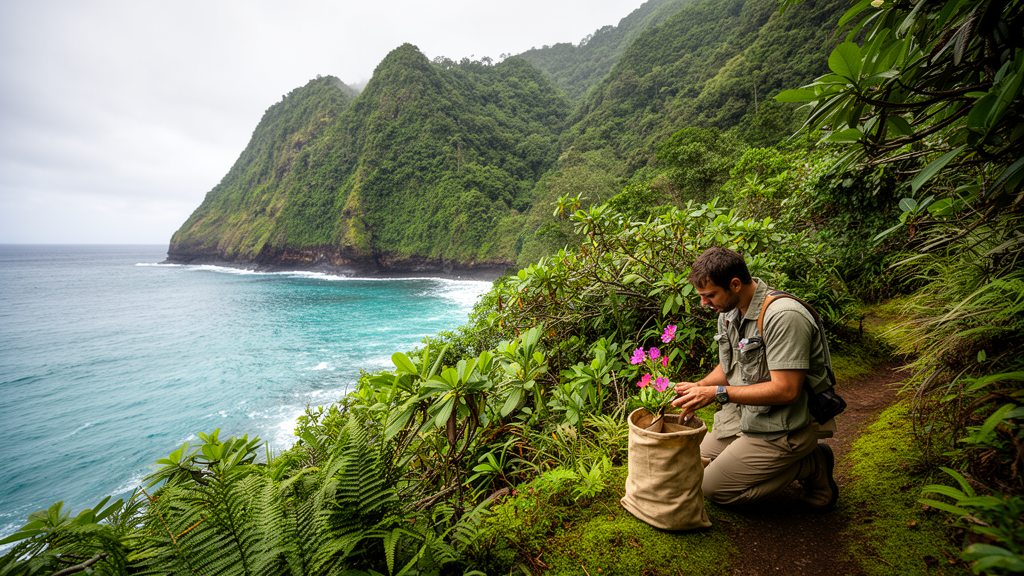
A botanical field inventory identified 89 wild alien spermatophyte species on Isla del Coco, Costa Rica, representing 45.2% of the island’s 197 assessed wild plant taxa. The study classified another 78 species as native and 30 as cryptogenic, meaning their origins could not be determined confidently. Among the wild alien flora, 48 species were casual, 34 were naturalised, five were invasive and two could not be assigned an invasion status.
Isla del Coco is a 24 km² volcanic island in the eastern Pacific, about 492 km from mainland Costa Rica and 781 km from the Galápagos Archipelago. Its rugged terrain, with sea cliffs around most of the coast and a highest point of 575 m above sea level, limits access. The study examined records compiled from earlier floras, herbarium specimens, photographs and written testimony, together with fieldwork conducted in 2005–2008 and 2024.
The researchers developed a binary decision tree to determine whether each spermatophyte was native, a wild alien or cryptogenic. Its questions considered endemism, native range, the earliest comprehensive botanical records, associations with disturbed or ruderal habitats, human uses, and whether a species occurred beyond the accessible northern bays or depended ecologically on bay-shore vegetation. Taxonomic names were standardised against the Catalogue of Life. Cultivated plants without evidence of escape were recorded separately and excluded from the wild alien inventory.
Five wild alien species were classified as invasive: Calophyllum inophyllum, Coffea arabica, Megathyrsus maximus, Terminalia catappa and Urena lobata. The researchers based these classifications on expert assessments of observed abundance, dense stands, local dominance and displacement of native vegetation. They noted that no empirical study had quantified the ecological effects of alien plants on Isla del Coco, so the impacts and invasion status of these species require field evaluation.
Among the 88 wild alien species for which distribution could be classified, 75.0% were punctual, occurring in only one or two surveyed sites, while 25.0% were scattered across three or more sites. Of 85 species assigned an abundance category, 83.5% were considered scarce and 16.5% abundant. Most species were herbs, accounting for 64.0% of the wild alien flora, followed by trees at 22.5%, shrubs at 9.0% and vines at 4.5%. The most frequent native realms were the Neotropics and Indomalayan region.
Global risk classifications did not correspond significantly with the invasion categories assigned on the island. Sixteen species had low global risk, 22 medium risk, 19 high risk and three extreme risk, while 29 lacked scores. A Fisher’s exact test found no significant association between the global risk categories and observed invasion status on Isla del Coco, with p greater than 0.05. The authors therefore considered global scores inadequate for predicting invasion at the island’s finer spatial scale, while retaining them as a precautionary planning tool.
The site-based approach changed the classification of numerous plants in earlier checklists. Of 34 species previously treated as native, 22 became cryptogenic, 11 were classified as alien and one as cultivated. Among 10 taxa previously classified as either alien or cultivated, two shifted from alien to native and eight from alien to cryptogenic. The study also documented 31 species absent from the two principal earlier checklists: 15 cultivated species, 15 wild alien species and one purportedly native species, Scleria gaertneri, whose status the researchers said requires further confirmation.
Several limitations constrain the inventory. Fieldwork focused mainly on settlements, established trails, accessible forest, riparian areas and cliff zones; recent landslides, offshore islets and southern parts of the island were not surveyed. Some records could not be verified to species level or were considered doubtful. The decision tree may misclassify alien species present before the 1912 botanical survey, native ruderal plants overlooked by earlier collectors, or aliens introduced through atypical pathways. Targeted ecological, biogeographic and population-genetic studies were therefore considered necessary for uncertain cases.
The authors concluded that Isla del Coco’s alien flora represents a moderate level relative to its small area and that regular, targeted botanical surveys and stronger biosecurity associated with transport from the mainland remain important. They also identified the need to assess invasive-plant impacts, clarify cryptogenic species, develop locally tailored risk assessment, monitor vegetation after the removal of introduced mammals, and investigate the understudied alien status of pteridophytes, lycophytes and bryophytes.
Subject of Research: Site-based inventory and classification of alien spermatophytes on Isla del Coco, Costa Rica
Article Title: Cataloguing the alien spermatophyte flora of a remote tropical island: Methods and insights from Isla del Coco, Costa Rica
Article References: Orbea, B., Vega Vargas, L. C., Patiño, J., Campos, J. A., Acosta-Vargas, L. G., Nualart, N., Madriz-Masis, J. P., & López-Pujol, J. (2026). Cataloguing the alien spermatophyte flora of a remote tropical island: Methods and insights from Isla del Coco, Costa Rica. NeoBiota, 106, 309-337. https://doi.org/10.3897/neobiota.106.168397
Image Credits: AI Generated
DOI: 10.3897/neobiota.106.168397
Keywords: Isla del Coco, alien plants, spermatophytes, plant inventory, island biogeography, biological invasions, cryptogenic species, Costa Rica, field botany, biosecurity, Cataloguing, alien
Cite Scienmag News
Margaret Porter. (October 20, 2026). Island plant inventory identifies 89 wild alien species on Costa Rica’s Isla del Coco. Scienmag. https://scienmag.com/island-plant-inventory-identifies-89-wild-alien-species-on-costa-ricas-isla-del-coco/
Margaret Porter. "Island plant inventory identifies 89 wild alien species on Costa Rica’s Isla del Coco." Scienmag, 20 October 2026, https://scienmag.com/island-plant-inventory-identifies-89-wild-alien-species-on-costa-ricas-isla-del-coco/. Accessed 20 October 2026.
Margaret Porter. "Island plant inventory identifies 89 wild alien species on Costa Rica’s Isla del Coco." Scienmag. October 20, 2026. https://scienmag.com/island-plant-inventory-identifies-89-wild-alien-species-on-costa-ricas-isla-del-coco/


