

Tuesday, October 20, 2026
Science
No Result
View All Result
  • Login
  • HOME
  • SCIENCE NEWS
  • CONTACT US
  • HOME
  • SCIENCE NEWS
  • CONTACT US
No Result
View All Result
Scienmag
No Result
View All Result
Home Science News Medicine

Study links workplace noise, psychological distress and menstrual abnormalities

October 20, 2026
in Medicine
Ophelia Keating
By Ophelia Keating Scienmag Editorial Profile - Health Services Research
Reading Time: 3 mins read
0
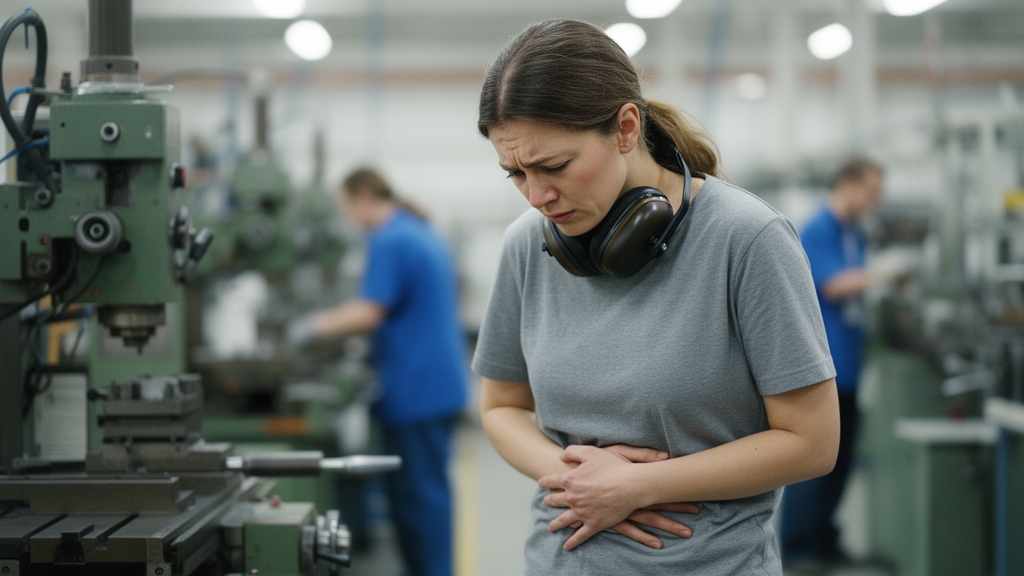
Study links workplace noise, psychological distress and menstrual abnormalities

Study links workplace noise, psychological distress and menstrual abnormalities

65
SHARES
587
VIEWS
Share on FacebookShare on Twitter
ADVERTISEMENT

Psychological distress accounted for more than half of the modeled association between occupational noise exposure and menstrual abnormalities in an observational study of 1,108 female workers in Chongqing, China. The researchers enrolled participants in 2024 and 2025 and combined machine learning with structural equation modeling to examine potential relationships among workplace noise, mental health and menstrual health. Among the participants, 334, or 30.1%, experienced menstrual abnormalities, according to the study.

The investigators first used univariate logistic regression to screen variables associated with the reported outcome. In that analysis, the duration of daily occupational noise exposure, noise sensitivity and noise annoyance were each positively associated with menstrual abnormalities at a significance level below 0.05. The team then used XGBoost, a machine-learning algorithm, to identify important predictors.

Its three highest-ranked predictors were use of hearing-protection devices, age and sleep duration. The study reported that hearing-protection use and sleep duration were negatively associated with menstrual abnormalities, while age was positively associated with the outcome. These statistical associations do not establish that hearing protection, age or sleep duration caused the reported differences.

To examine how the measured variables might be connected, the researchers built a structural equation model with daily occupational noise exposure as the independent variable and menstrual abnormalities as the dependent variable. Psychological distress was specified as a mediator, while hearing loss, sleep duration, noise sensitivity and noise annoyance were specified as potential moderators of the pathway between noise exposure and psychological distress. The model fit was described as good.

Its estimated total effect of noise exposure on menstrual abnormalities was statistically significant, with a standardized coefficient of 0.424 and a P value of 0.006. After psychological distress was included in the model, the direct effect of occupational noise exposure was no longer statistically significant. The indirect effect through psychological distress remained significant, with an estimated value of 0.243 and a P value of 0.029, and represented 57.3% of the total effect.

The pattern means that the model attributed the largest measured portion of the exposure-outcome association to a statistical pathway involving distress. It does not demonstrate a biological mechanism or prove that noise produced the distress or that distress caused menstrual abnormalities. The supplied findings also do not report confidence intervals, effect-size ranges or detailed estimates for every model variable.

Noise sensitivity, sleep duration and hearing loss significantly modified the pathway from occupational noise exposure to psychological distress. Noise annoyance was not reported as a significant moderator in the abstract, but its omission from that statement does not establish that it had no moderating role in the full model. Notably, the abstract reports associations rather than a tested intervention: it does not show that changing sleep duration, increasing hearing-protection use or reducing workplace noise would alter menstrual outcomes.

Subject of Research: Associations among occupational noise exposure, psychological distress and menstrual abnormalities in female workers

Article Title: Effects of occupational noise exposure on menstrual abnormalities among female workers: a path analysis based on XGBoost and structural equation modeling

Article References: Chen, F., Guo, X., Tao, Y., Zhang, L., Gong, D., Yu, C., Zhang, M., Yang, D., & Ye, M. (2026). Effects of occupational noise exposure on menstrual abnormalities among female workers: a path analysis based on XGBoost and structural equation modeling. BMC Public Health. https://doi.org/10.1186/s12889-026-29560-x

Image Credits: AI Generated

DOI: 10.1186/s12889-026-29560-x

Keywords: occupational noise, menstrual abnormalities, female workers, psychological distress, XGBoost, structural equation modeling, sleep duration, hearing protection, noise sensitivity, workplace health, Effects, occupational

Cite Scienmag News

Ophelia Keating. (October 20, 2026). Study links workplace noise, psychological distress and menstrual abnormalities. Scienmag. https://scienmag.com/study-links-workplace-noise-psychological-distress-and-menstrual-abnormalities/


Ophelia Keating. "Study links workplace noise, psychological distress and menstrual abnormalities." Scienmag, 20 October 2026, https://scienmag.com/study-links-workplace-noise-psychological-distress-and-menstrual-abnormalities/. Accessed 20 October 2026.

Ophelia Keating. "Study links workplace noise, psychological distress and menstrual abnormalities." Scienmag. October 20, 2026. https://scienmag.com/study-links-workplace-noise-psychological-distress-and-menstrual-abnormalities/

Tags: Effectsenvironmental noise and women's healthfemale workershearing protectionimpact of occupational environment on female workersmachine learning in health researchmenstrual abnormalitiesmental health and reproductive healthnoise sensitivitynoise sensitivity and menstrual abnormalitiesOccupationaloccupational noiseoccupational noise exposure effectspredictors of menstrual irregularitiespsychological distresspsychological distress in occupational settingssleep durationsleep duration and reproductive healthstructural equation modelingstructural equation modeling in epidemiologyuse of hearing protection and menstrual healthworkplace healthWorkplace noise and menstrual healthXGBoost
Share26Tweet16
Previous Post

Morphological and COI analysis documents first Chinese Lepidosira and four new species

Next Post

Medieval abbot may have occupied Westminster Abbey’s reused Roman sarcophagus

Related Posts

Pharmaceutical Marketing: How Psychology, Neuromarketing, and Regulation Shape Patient Behavior
Medicine

Research report: Theoretical, psychological, and regulatory dimensions of modern pharmaceutical marketing: implications for patient behavior and healthcare systems

October 20, 2026
Astaxanthin Supplement Lowers Inflammation Enzyme in Abdominal Obesity Trial
Medicine

Four-week astaxanthin trial measures serum myeloperoxidase in adults with abdominal obesity

October 20, 2026
Finerenone halves albuminuria in small real-world diabetic kidney disease cohort
Medicine

Finerenone initiation linked to lower albuminuria in small retrospective diabetic kidney disease cohort

October 20, 2026
Japan’s inpatient rehabilitation provision varies geographically, nationwide study finds
Medicine

Japan’s inpatient rehabilitation provision varies geographically, nationwide study finds

October 20, 2026
Research report: Association between an ITHBC theory-based nursing pathway and discharge readiness among mothers of preterm infants: a non-randomized controlled study with a historical control group
Medicine

Research report: Association between an ITHBC theory-based nursing pathway and discharge readiness among mothers of preterm infants: a non-randomized controlled study with a historical control group

October 20, 2026
Worsening sleep linked with later anxiety and depression in children
Medicine

Worsening sleep linked with later anxiety and depression in children

October 20, 2026
Next Post
Medieval abbot may have occupied Westminster Abbey’s reused Roman sarcophagus

Medieval abbot may have occupied Westminster Abbey’s reused Roman sarcophagus

  • Mothers who receive childcare support from maternal grandparents show more optimized

    Mothers who receive childcare support from maternal grandparents show more parental warmth, finds NTU Singapore study

    27656 shares
    Share 11059 Tweet 6912
  • University of Seville Breaks 120-Year-Old Mystery, Revises a Key Einstein Concept

    1061 shares
    Share 424 Tweet 265
  • Bee body mass, pathogens and local climate influence heat tolerance

    682 shares
    Share 273 Tweet 171
  • Researchers record first-ever images and data of a shark experiencing a boat strike

    546 shares
    Share 218 Tweet 137
  • Groundbreaking Clinical Trial Reveals Lubiprostone Enhances Kidney Function

    531 shares
    Share 212 Tweet 133
Science

Embark on a thrilling journey of discovery with Scienmag.com—your ultimate source for cutting-edge breakthroughs. Immerse yourself in a world where curiosity knows no limits and tomorrow’s possibilities become today’s reality!

RECENT NEWS

  • Summer fish communities differ between Zostera japonica beds and nearby bare ground in one Japanese estuary
  • SpecLLM feature-based VNIR representations improve selected LLM classification tasks
  • Morphological study describes three new Pseudopoda spider species from Chongqing, Shaanxi and Guizhou
  • Medieval abbot may have occupied Westminster Abbey’s reused Roman sarcophagus

Categories

  • Agriculture
  • Anthropology
  • Archaeology
  • Athmospheric
  • Biology
  • Biotechnology
  • Blog
  • Bussines
  • Cancer
  • Chemistry
  • Climate
  • Earth Science
  • Editorial Policy
  • Marine
  • Mathematics
  • Medicine
  • Pediatry
  • Policy
  • Psychology & Psychiatry
  • Science Education
  • Science News
  • Social Science
  • Space
  • Technology and Engineering

Subscribe to Blog via Email

Enter your email address to subscribe to this blog and receive notifications of new posts by email.

Join 5,150 other subscribers

© 2025 Scienmag - Science Magazine

Welcome Back!

Login to your account below

Forgotten Password?

Retrieve your password

Please enter your username or email address to reset your password.

Log In
No Result
View All Result
  • HOME
  • SCIENCE NEWS
  • CONTACT US

© 2025 Scienmag - Science Magazine

Discover more from Science

Subscribe now to keep reading and get access to the full archive.

Continue reading