


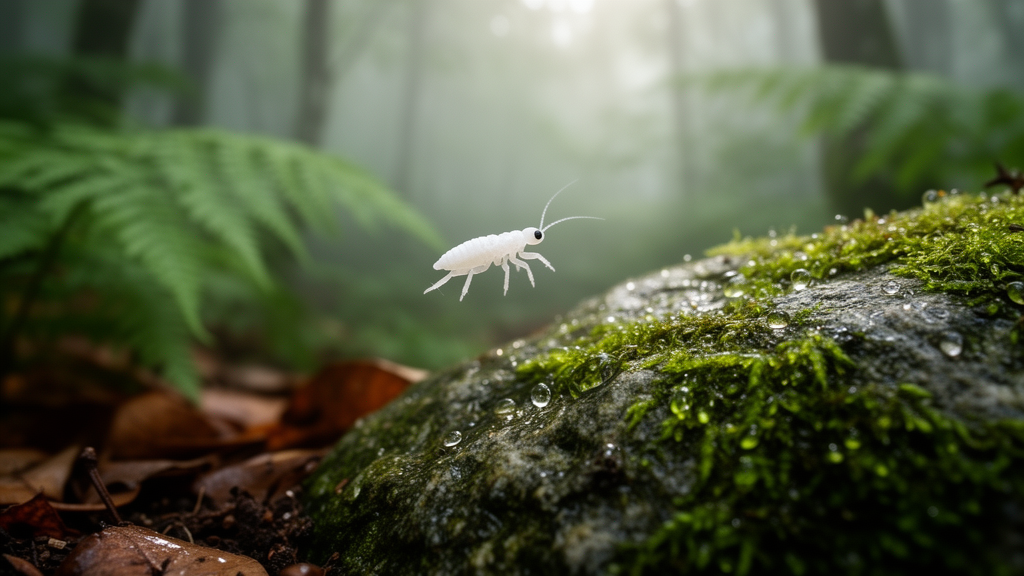
A morphological and mitochondrial COI analysis documents the first reported occurrence of the springtail genus Lepidosira in China and describes four new species from leaf litter in Yintiaoling National Nature Reserve, Chongqing Municipality. The study also transfers two previously described Willowsia species to Lepidosira and proposes a replacement name for a junior homonym.
Before this work, 57 species of Lepidosira had been described worldwide, about 40 of them from Oceania. Other reported species occurred in Brazil, India, Indonesia, Japan, Vietnam, Rwanda and Burundi. Many of the earlier descriptions lacked detailed body chaetotaxy and relied substantially on color pattern, while the genus is distinguished by features including ciliate scales, polymacrochaetotic dorsal chaetotaxy, a specialized microchaeta on abdominal segment I, a manubrial plate without blunt chaetae, and a bidentate mucro with a basal spine.
The researchers collected specimens with an aspirator from leaf litter in Yintiaoling National Nature Reserve, a 22,000-hectare area in northeastern Chongqing with an average annual temperature of about 10 °C and average annual precipitation of 1,500 mm. Specimens were preserved in 99% alcohol, mounted on slides in Marc André II solution and examined with a Leica DM2500 phase-contrast microscope. Type specimens were deposited in the School of Life Sciences at Nantong University in Jiangsu, China.
For molecular analysis, the team extracted genomic DNA and amplified a 658-base-pair fragment of the mitochondrial COI gene. PCR products were checked by agarose gel electrophoresis, purified, and sequenced on an ABI 3730XL DNA Analyzer. Sequences were assembled in Sequencher 4.5, aligned with ClustalW in MEGA 5.1, and compared using the Kimura 2-parameter model. A neighbor-joining tree was then constructed from the COI sequences. The analysis included the Chinese material, newly deposited sequences for several identified species, and sequences for L. calolepis and L. neotropicalis.
The four newly described species are Lepidosira apigmenta, L. similis, L. wuxiensis and L. chongqingensis. Their descriptions were based on detailed observations of color pattern, body chaetotaxy, scales, antennae, legs, ventral tube, manubrium, dentes and mucro. The holotypes and paratypes were collected at sites between 1,129.10 and 2,168.92 metres above sea level, and the authors recorded the new species from litter in subtropical forests.
L. apigmenta and L. wuxiensis shared a holotype locality at the Guanshan Protection Station, while L. similis and L. chongqingensis were collected at the Hongqi Protection Station. The researchers distinguished the new forms using combinations of pigmentation and chaetotaxy. For example, the four species had four, three, four and four macrochaetae on abdominal segment I, respectively, while L. apigmenta and L. chongqingensis differed in the number of central macrochaetae on abdominal segment II.
In the COI comparison of seven Lepidosira species, the shortest reported mean interspecific distances were 13.9–15.6% between L. apigmenta and L. wuxiensis, while the longest were 23.8–25.0% between L. wuxiensis and L. calolepis. The researchers reported that these distances exceeded barcoding gaps previously reported for species of Tomocerus and Coecobrya, and that the molecular differences coincided with observed morphological divergences. The COI analysis therefore provided support consistent with the proposed separation of the four new species.
Examination of type material also led the authors to move Willowsia flava Zhou, Pan & Ma, 2021 into Lepidosira under the replacement name Lepidosira baojiensis, because the original name was a junior homonym of Lepidosira flava Salmon, 1938. They also transferred Willowsia trifascia Zhou & Ma, 2022 to Lepidosira trifascia comb. nov. Both transfers were based on the presence of scales on the dentes and the absence of blunt chaetae on the manubrial plate.
The findings represent a taxonomic and molecular study of specimens from one nature reserve in Chongqing, rather than a survey of Lepidosira across China. The reported COI tree was based on seven species, and the authors presented molecular distances as corroborating observed morphological differences. The study therefore expands the recorded Chinese diversity and formal taxonomy of the genus, while its geographic sampling and molecular taxon coverage remain limited.
Subject of Research: Taxonomic description of Chinese Lepidosira springtails using morphology and mitochondrial COI sequences
Article Title: First report of Lepidosira ( Collembola , Entomobryidae ) from China, with description of four new species under the aid of COI barcoding
Article References: Qian, X., Jing, M., & Ma, Y. (2025). First report of Lepidosira (Collembola, Entomobryidae) from China, with description of four new species under the aid of COI barcoding. Deutsche Entomologische Zeitschrift, 72(2), 341-365. https://doi.org/10.3897/dez.72.153961
Image Credits: AI Generated
Keywords: Lepidosira, Collembola, Entomobryidae, China, Chongqing, taxonomy, new species, COI barcoding, morphology, Yintiaoling, First, report
Cite Scienmag News
Drew Townsend. (October 20, 2026). Morphological and COI analysis documents first Chinese Lepidosira and four new species. Scienmag. https://scienmag.com/morphological-and-coi-analysis-documents-first-chinese-lepidosira-and-four-new-species/
Drew Townsend. "Morphological and COI analysis documents first Chinese Lepidosira and four new species." Scienmag, 20 October 2026, https://scienmag.com/morphological-and-coi-analysis-documents-first-chinese-lepidosira-and-four-new-species/. Accessed 20 October 2026.
Drew Townsend. "Morphological and COI analysis documents first Chinese Lepidosira and four new species." Scienmag. October 20, 2026. https://scienmag.com/morphological-and-coi-analysis-documents-first-chinese-lepidosira-and-four-new-species/


