


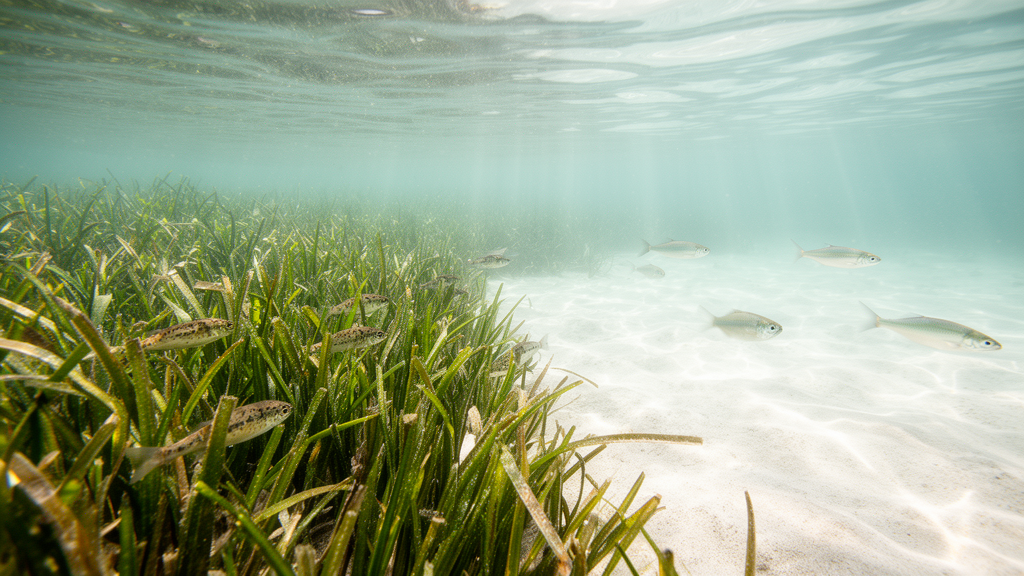
A field study in the Tomouchi River estuary in southern Japan found that summer fish communities differed between Zostera japonica seagrass beds and adjacent bare sand and mud. The researchers sampled the upper reaches of the small estuary in Nobeoka City, northern Miyazaki Prefecture, Kyushu. The Tomouchi River branches from the lower Kita River, extends approximately 1.6 km, measures 15–100 m in width, and rejoins the mainstream near the mouth.
The sampled area covered about 5,500 m², roughly half of it occupied by relatively dense colonies of Z. japonica. The maximum tidal range was nearly 2 m; the beds were submerged at high tide and partly exposed at low tide. Z. japonica is classified as near-threatened in Miyazaki Prefecture, where it has declined because of habitat and water-quality degradation.
The site was selected during environmental assessment surveys because the seagrass remained present locally and quantitative fish sampling was possible. Because the water was extremely shallow and sometimes turbid, the investigators used a small seine rather than the visual census they considered preferable for conservation-focused monitoring. The seine had a 2-mm mesh, two wings each 2.3 m long and 0.78 m high, and a 2.55-m-long, 0.92-m-wide bunt.
Each haul covered 30 m² after the net was towed 10 m while held open to a width of 3 m. Four hauls were conducted in each habitat in each sampling year, providing 40 m of seining per habitat annually. Sampling occurred in daylight around low tide in August 2015, July 2016 and August 2019.
These three summer surveys coincided with periods of relatively high seasonal Z. japonica density and generally lower precipitation. Across 24 hauls, the researchers collected 1,288 fish with a combined biomass of 317.0 g. The catch represented 32 species, including two unidentified taxa, from 11 families.
Water temperature and salinity did not differ significantly between the habitats. Most measures of the fish assemblages tended to be higher in the seagrass beds, although total abundance, biomass and Simpson’s diversity index did not differ significantly between habitats. Species richness was significantly greater in the beds (P < 0.001), as was the abundance of R. bikolanus (P < 0.01).
This goby occurred in both habitats during every sampling year and accounted for more than half of each habitat’s catch in 2015 and 2019. Its standard length did not differ significantly between habitats, although the 2016 analysis was omitted because of a limited sample size. Within each sampled year, however, fish from the seagrass beds covered a broader size range that included larger individuals.
Permutation multivariate analysis of variance detected a significant difference in abundance-based species composition between the habitats (P < 0.01), based on 999 permutations and the Chao method. The non-metric multidimensional scaling showed only weak visual separation. Similarity percentages analysis identified R. bikolanus as the largest contributor to compositional dissimilarity, with a contribution of 0.50, followed by Gymnogobius breunigii at 0.20 and Gerres japonicus at 0.07.
Counts of R. bikolanus in seagrass beds versus bare ground were 306 versus 30 in 2015, 22 versus 2 in 2016, and 294 versus 110 in 2019. G. japonicus numbered 118 versus 3 in 2015 but was absent in 2016 and 2019, while G. breunigii showed the opposite pattern, with 2 versus 15 in 2015 and 0 versus 195 in 2016. Several low-dominance species were found only in the seagrass beds, including Hippichthys heptagonus, Lates japonicus, Nuchequula nuchalis, Gerres equulus and Rhynchopelates oxyrhynchus, all of which have been associated with seagrass habitats during their life cycles.
Gymnogobius uchidai and Pseudogobius masago were also restricted to the beds despite their usual association with tidal flats or sand and mud bottoms, suggesting possible seasonal use of the two habitat types. All collected G. japonicus were immature and measured 8.1–23.0 mm in standard length, indicating that the beds may function as nursery habitat for this species, although confirmation would require comparisons across additional habitats, including marine environments. The observations show that adjacent bare ground was ecologically distinct rather than interchangeable with Z. japonica beds.
G. breunigii, which inhabits and breeds in estuarine sand and mud substrates, was almost exclusively captured over bare ground even where seagrass was present. Based on these results, the authors advocate identifying original seagrass distribution areas in restoration projects while also recognizing the ecological functions of neighboring sand and mud ground. The conclusions apply to summer conditions at one small estuary; the study did not assess other seasons or other estuaries, and it did not experimentally establish the mechanisms behind fish habitat selection.
Subject of Research: Comparative field assessment of summer fish communities in Zostera japonica beds and adjacent bare ground in a Japanese estuary
Article Title: Comparing ichthyofaunal composition between Zostera japonica beds ( Plantae , Alismatales , Zosteraceae ) and adjacent bare ground within a small temperate estuary in southern Japan
Article References: Ota, Y., Sakamoto, R., Ogata, Y., Kurihara, T., & Murase, A. (2025). Comparing ichthyofaunal composition between Zostera japonica beds (Plantae, Alismatales, Zosteraceae) and adjacent bare ground within a small temperate estuary in southern Japan. Acta Ichthyologica et Piscatoria, 55, 385-392. https://doi.org/10.3897/aiep.55.168507
Image Credits: AI Generated
Keywords: Zostera japonica, seagrass beds, fish communities, estuarine ecology, ichthyofauna, Tomouchi River estuary, Miyazaki Prefecture, habitat composition, Redigobius bikolanus, species richness, Comparing, ichthyofaunal
Cite Scienmag News
Margaret Porter. (October 20, 2026). Summer fish communities differ between Zostera japonica beds and nearby bare ground in one Japanese estuary. Scienmag. https://scienmag.com/summer-fish-communities-differ-between-zostera-japonica-beds-and-nearby-bare-ground-in-one-japanese-estuary/
Margaret Porter. "Summer fish communities differ between Zostera japonica beds and nearby bare ground in one Japanese estuary." Scienmag, 20 October 2026, https://scienmag.com/summer-fish-communities-differ-between-zostera-japonica-beds-and-nearby-bare-ground-in-one-japanese-estuary/. Accessed 20 October 2026.
Margaret Porter. "Summer fish communities differ between Zostera japonica beds and nearby bare ground in one Japanese estuary." Scienmag. October 20, 2026. https://scienmag.com/summer-fish-communities-differ-between-zostera-japonica-beds-and-nearby-bare-ground-in-one-japanese-estuary/


