


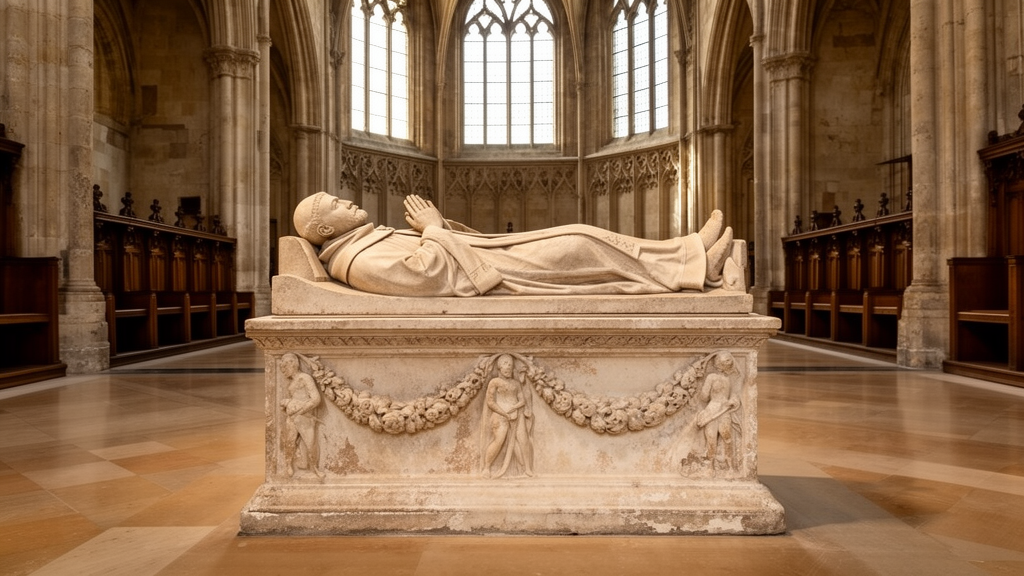
A new archaeological analysis suggests that a skeleton found in a Roman sarcophagus at Westminster Abbey probably belonged to a high-ranking medieval monk, with two former abbots identified as the leading candidates. The limestone coffin was excavated in 1869 with an inscription naming Valerius Amandinus, a wealthy Briton who lived in the city around AD 300–400. However, a Latin cross sculpted on its lid dates to approximately the 10th or 11th century, indicating that the Roman burial container was reused for a later interment.
The identity of the medieval occupant has remained uncertain throughout more than 150 years of investigation. The peer-reviewed observational study, published in the Journal of the British Archaeological Association by Westminster Abbey consultant archaeologist Warwick Rodwell, concludes that Aelfwig is the most likely occupant. Aelfwig died around 1020 after serving as abbot of Westminster Abbey, then a Benedictine monastery.
His successor, Wulnoth, died in 1049 and is presumed to have been buried at the abbey, making him another viable contender. Rodwell said both men could fit the available evidence if they assumed the abbacy in their early twenties and died close to age 50. Aelfwig’s earlier status as a monk at Westminster may favor him, but the study cannot establish a definitive identity because the birth dates of both abbots are unknown.
The interpretation draws on archaeological, osteological and radiocarbon-dating evidence assembled through earlier research and a present-day excavation connected with construction of the King Charles III Sacristy. Human bone specialist James Young Langthorne of Pre-Construct Archaeology examined the skeleton and estimated that the deceased was a man aged between 35 and 49 and about 5 feet 9 inches tall. This differed from a 19th-century assessment describing the remains as those of a robust young man, around 5 feet 7 inches tall and no more than 30 years old.
A bone sample tested at the Scottish Universities Environmental Research Centre by carbon dating produced a date range of AD 987–1052. That result is consistent with burial during the late Saxon period and with reuse of the Roman sarcophagus centuries after its original use. Physical evidence supports the conclusion that the sarcophagus was repurposed.
The deceased was placed first in a wooden coffin and then enclosed within the older stone burial casket, an arrangement Rodwell characterized as a possible early example of recycling. The lid was subsequently reworked to feature a large Latin cross. Before researchers opened the stone coffin at a conservation studio in 2016, the skeleton was believed to have been lost.
Lifting the lid instead revealed an almost-complete set of human remains. Researchers also identified a rectangular outline inside the sarcophagus, marked by white residue left by lime, a substance traditionally used in burials. Although no physical traces of the original container survived, Rodwell argued that the outline could only have been formed by a timber coffin, which completely decayed during the roughly seven centuries the sarcophagus remained buried in the sacristy courtyard.
The sarcophagus was first uncovered accidentally by workmen in 1820, when its lid was smashed into six pieces, and was repaired before its official excavation in 1869. Investigations of the surrounding area have included Channel 4’s Time Team in 2009, while Pre-Construct Archaeology completed the present-day excavation in 2025. The evidence narrows the likely date and status of the occupant, but it does not conclusively distinguish between Aelfwig and Wulnoth.
The Roman sarcophagus and its medieval afterlife nevertheless show how an ancient burial container was transformed into a high-status burial within Westminster Abbey’s Benedictine abbey. The sarcophagus is now on public display in the Queen’s Diamond Jubilee Galleries.
Subject of Research: Archaeological identification of a medieval monk buried in a reused Roman sarcophagus at Westminster Abbey
Article Title: Mystery skeleton found in Roman sarcophagus at Westminster Abbey may finally have an identity
Article References: Mystery skeleton found in Roman sarcophagus at Westminster Abbey may finally have an identity. Original publication (Bibliographic details unavailable.)
Image Credits: AI Generated
DOI: Not provided
Keywords: Westminster Abbey, Roman sarcophagus, medieval archaeology, Aelfwig, Wulnoth, radiocarbon dating, human remains, osteological analysis, monastic burial, archaeological reuse, Mystery, skeleton
Cite Scienmag News
Courtney Benton. (October 20, 2026). Medieval abbot may have occupied Westminster Abbey’s reused Roman sarcophagus. Scienmag. https://scienmag.com/medieval-abbot-may-have-occupied-westminster-abbeys-reused-roman-sarcophagus/
Courtney Benton. "Medieval abbot may have occupied Westminster Abbey’s reused Roman sarcophagus." Scienmag, 20 October 2026, https://scienmag.com/medieval-abbot-may-have-occupied-westminster-abbeys-reused-roman-sarcophagus/. Accessed 20 October 2026.
Courtney Benton. "Medieval abbot may have occupied Westminster Abbey’s reused Roman sarcophagus." Scienmag. October 20, 2026. https://scienmag.com/medieval-abbot-may-have-occupied-westminster-abbeys-reused-roman-sarcophagus/


