


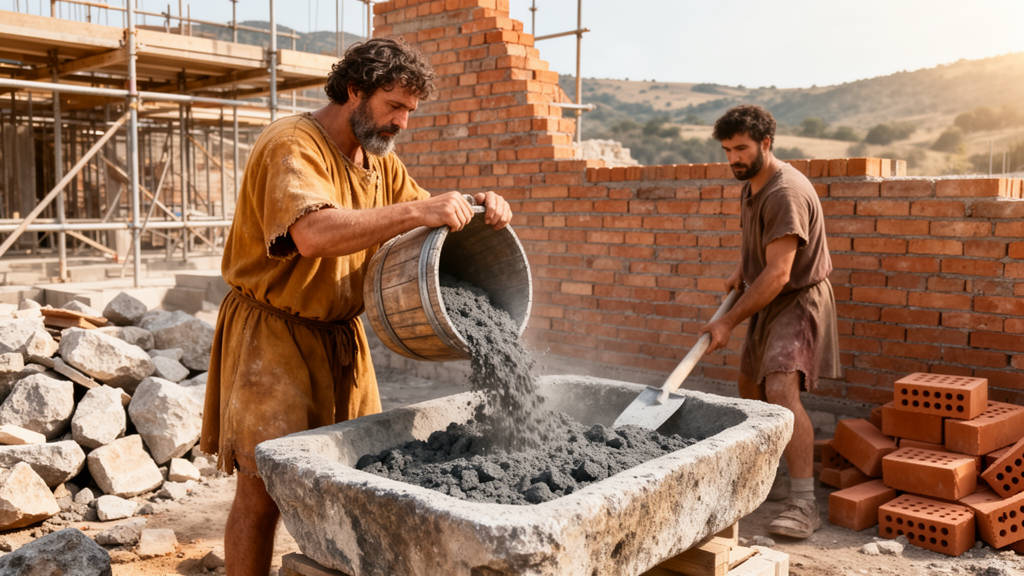
The secret behind Rome’s legendary harbors, thermal baths and cisterns has always seemed to rest on a single volcanic powder. Vitruvius, writing in the first century BC, described “a type of powder with marvelous properties found in the locality of Baia,” a fine ash quarried near the ancient city of Puteoli, modern Pozzuoli. Roman engineers called it pulvis puteolana, and they mixed it with slaked lime to build maritime concrete that hardened even underwater. For centuries, archaeologists and geologists assumed that this revolutionary building material came exclusively from one eruption: the Neapolitan Yellow Tuff, a colossal explosive event that blanketed the Phlegraean Fields roughly 15,000 years ago. A new study published in Archaeological and Anthropological Sciences now upends that tidy story, showing that Roman builders drew on a much wider palette of volcanic ashes from the same restless caldera.
The research, led by Martina Mercurio and Concetta Rispoli of the University of Naples Federico II together with colleagues from several Italian institutions, took a fresh look at the pozzolana deposits of the Campi Flegrei, the volcanic district west of Naples. The team collected samples from historical quarries that the Romans themselves are known to have exploited, extending from Naples to Bacoli. One sample, labeled SAV, came from an ancient tuff quarry in Marano di Napoli and represents pozzolana in the strict sense, the unconsolidated facies of the Neapolitan Yellow Tuff. Two others, labeled CL and LP, were collected near Baia, close to the Pontile Lubrano, an area where Imperial-age ceramics and artifacts testify to intense Roman maritime activity. Crucially, these two deposits belong to eruptions that occurred after the Neapolitan Yellow Tuff event, within the caldera’s later Epoch II activity.
The geological setting explains why this region is so rich in reactive ash. The Campi Flegrei caldera took shape through two cataclysmic collapses: the Campanian Ignimbrite eruption about 40,000 years ago, which ejected between roughly 60 and 300 cubic kilometers of phonolitic-trachytic material and ranks as the largest eruption in the Mediterranean over the past 200,000 years, and the Neapolitan Yellow Tuff eruption about 15,000 years ago, which produced around 50 cubic kilometers. After that second caldera-forming event, more than 70 eruptions occurred within the caldera, grouped into three epochs, the most recent ending with the Monte Nuovo eruption in AD 1538. These later eruptions, mostly explosive events of intermediate to Plinian scale, scattered cones and ash deposits across the entire territory. The magmas are potassic-alkaline in character, dominated by trachytic and trachy-phonolitic compositions, with clinopyroxene, plagioclase, sanidine, biotite and magnetite as the principal mineral phases.
To determine whether these post-Neapolitan Yellow Tuff deposits could genuinely serve as hydraulic binders, the researchers deployed a battery of modern analytical techniques. Polarized optical microscopy revealed the texture of pumice fragments and their crystal cargo; X-ray powder diffraction identified the mineral assemblage, including the zeolites phillipsite and analcime that form when hot reactive glass interacts with hydromagmatic fluids; field-emission scanning electron microscopy coupled with energy-dispersive spectroscopy delivered precise chemical analyses of individual volcanic glass fragments; and X-ray fluorescence characterized the whole-rock composition. Laser particle-size analysis measured the grain-size distribution of the fine fractions, the portion Roman craftsmen would have crushed or selected deliberately, since finer particles expose more reactive surface area. The samples proved remarkably similar in texture and mineralogy, all containing fresh volcanic glass, pumice fragments with elongated vesicles, and the zeolitic association typical of Phlegraean pyroclastic products.
The chemistry told the most compelling story. On the standard Total Alkali versus Silica classification diagram, the whole-rock compositions of CL and LP plot as trachyte while SAV falls in the latite field. But the decisive evidence came from individual point analyses of the glass component itself, which bypasses the diluting influence of crystals, lithic fragments and alteration products. Glass from CL and LP overlaps the compositional fields of the Baia-Fondi di Baia eruption, a small multievent eruption that occurred 9,500 to 9,600 years ago on the western side of Pozzuoli, while SAV glass matches the Neapolitan Yellow Tuff field. The potassium-to-sodium ratio proved a particularly sharp discriminator: CL and LP glasses show ratios of two or higher, excluding the low-ratio Averno eruption, whereas SAV aligns with the Neapolitan Yellow Tuff. These geochemical attributions agree with the official geological cartography of the sampling sites.
The team then confronted their quarry samples with published glass analyses of pozzolanic aggregates extracted from actual Roman mortars across the Mediterranean. The dataset spanned local Campanian monuments, including the Baths of Baia, the Flavian Amphitheater of Pozzuoli and the vast Piscina Mirabilis cistern, as well as distal sites: Roman structures in the Venice Lagoon, the Roman theater of Aquileia in northeastern Italy and the ancient city of Hippo Regius in Algeria. The glass compositions from these mortars fall within the compositional range of the Neapolitan Yellow Tuff and, tellingly, match the variability of Baia-Fondi di Baia products as well. Some anomalies in calcium oxide and sodium oxide values for the Venice and Aquileia samples reflect severe post-depositional alteration in underwater environments rather than original compositions. The pattern suggests that Roman builders did not confine themselves to a single eruption but exploited multiple Phlegraean deposits as pulvis puteolana.
A machine-learning tool added statistical rigor to the visual comparisons. Discriminant analysis, a supervised multivariate method suited to datasets with overlapping chemical features, assigned the quarry samples and mortar aggregates to specific eruptions with high probabilities. CL samples matched the Baia-Fondi di Baia eruption with probabilities from about 93 to 100 percent, LP from nearly 100 percent, and SAV, despite its geological mapping to the Neapolitan Yellow Tuff, was classified as Baia-Fondi di Baia with 95.6 to 100 percent probability, reflecting the genuine chemical overlap shared by several Phlegraean products. The literature mortar data showed primary affinity with Baia-Fondi di Baia followed by the Neapolitan Yellow Tuff, with a minor subset pointing to Monte Spina and Averno. The authors note that these probabilistic attributions rest on major-element chemistry alone and that trace-element data could sharpen future provenance assignments.
The technological test came from the Fratini test, a European standard method developed more than fifty years ago that measures how much calcium hydroxide a blended cement can consume over fifteen days of curing at 40 degrees Celsius. All three samples plotted below the calcium hydroxide solubility curve, proving genuine pozzolanic activity. The SAV sample showed the highest calcium oxide reduction at 38.6 percent, followed by CL at 30.3 percent and LP at 29.2 percent. The authors are careful to frame these results as complementary evidence: the Fratini test was designed for modern cementitious systems, and the hypothesis that Romans deliberately selected specific Phlegraean materials rests mainly on the convergence of historical quarry locations, petrographic features, reactive glass content and the geochemical match between deposits and mortar aggregates.
Why did these particular ashes work so well? The answer lies in the polymerization of the volcanic glass network. Glasses with moderate silica content, characteristic of part of the Neapolitan Yellow Tuff and Baia-Fondi di Baia products, are less polymerized and therefore dissolve more readily, accelerating the pozzolanic reaction in which silica and alumina react with calcium hydroxide at room temperature to form calcium-aluminum-silicate-hydrate gel. This C-A-S-H gel is what gives Roman hydraulic mortars their ability to harden underwater and their exceptional mechanical strength. Silica-rich glasses, by contrast, are less reactive. The shared compositional variability of the two eruptions in terms of silica content may thus be the key factor behind high-performance hydraulic mortars, and it may explain why the Romans favored these deposits without ever knowing the chemistry behind them.
The study establishes a first reference database of glass analyses for Phlegraean pozzolana, offering archaeologists a powerful tool for tracing the provenance of mortar aggregates in monuments across the former Roman Empire. It also reframes the scale of Roman resource management: the expansion of Puteoli’s harbor made the ash a strategic commodity, exported along grain-ship ballast routes to Ostia, Alexandria, Caesarea Maritima and beyond, and even carried to Constantinople, as the fifth-century historian Sidonius Apollinaris documented in his Panegyricus. Roman craftsmen, the authors conclude, possessed an advanced empirical knowledge of the raw materials of their territory, recognizing the value of many pyroclastic deposits rather than a single one. That legacy, encoded in mortars that have survived two millennia of seawater, may yet inform modern sustainable cement formulations seeking to rediscover what the Romans knew by practice alone.
Subject of Research: Provenance and selection of Roman hydraulic pozzolana from the Phlegraean Fields
Article Title: On the tracks of Pulvis Puteolana: provenance and selection of Roman hydraulic materials
Article References: Mercurio, M., Montesano, G., Cappelletti, P., Petrosino, P., Graziano, S. F., Campanile, A., Liguori, B., & Rispoli, C. (2026). On the tracks of Pulvis Puteolana: provenance and selection of Roman hydraulic materials. Archaeological and Anthropological Sciences, 18(11), Article 217. https://doi.org/10.1007/s12520-026-02582-7
Image Credits: AI Generated
DOI: 10.1007/s12520-026-02582-7
Keywords: tracks, Pulvis, Puteolana, provenance, selection, Roman, hydraulic, materials, scientific research
Cite Scienmag News
Courtney Benton. (October 17, 2026). Roman builders tapped more volcanic ash than we thought, new study shows. Scienmag. https://scienmag.com/roman-builders-tapped-more-volcanic-ash-than-we-thought-new-study-shows/
Courtney Benton. "Roman builders tapped more volcanic ash than we thought, new study shows." Scienmag, 17 October 2026, https://scienmag.com/roman-builders-tapped-more-volcanic-ash-than-we-thought-new-study-shows/. Accessed 17 October 2026.
Courtney Benton. "Roman builders tapped more volcanic ash than we thought, new study shows." Scienmag. October 17, 2026. https://scienmag.com/roman-builders-tapped-more-volcanic-ash-than-we-thought-new-study-shows/


