


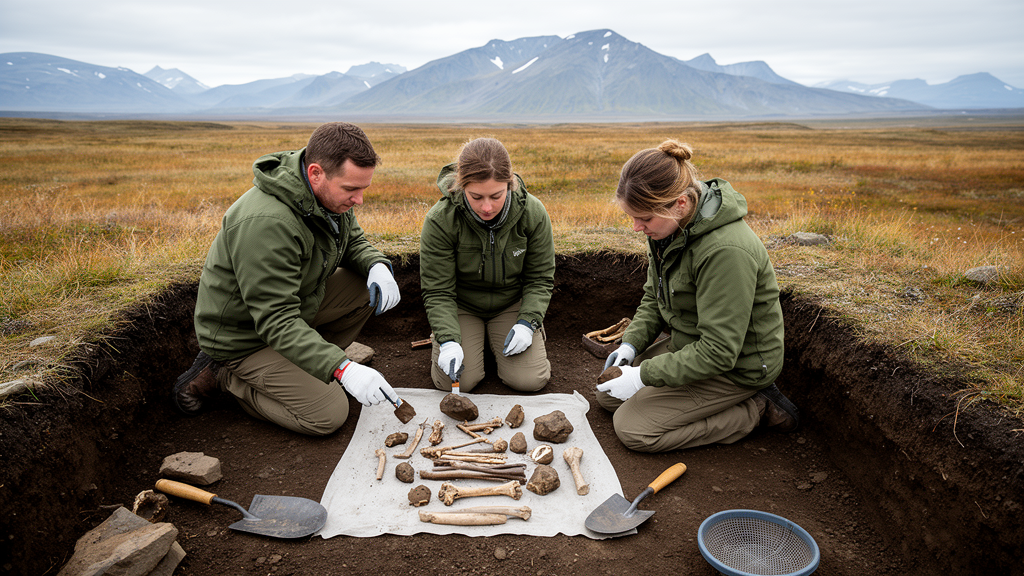
A small ridge overlooking the Tanana River in central Alaska is rewriting what scientists know about how the first Americans settled into life at the far northern edge of a newly inhabited continent. At a site called Shég’ Xdaltth’i’, pronounced shehg xuh-tuhl-th’ee, a name meaning “they were there” in Alaska Native Athabascan, archaeologists have uncovered three distinct early occupations dating to roughly 13,800, 13,000 and 12,700 years ago. The evidence, published in the journal Science Advances, offers an unusually detailed portrait of late-glacial base camp life in Beringia, the vast land and maritime region that once connected Asia to North America.
The research was led by Kelly Graf, professor of anthropology at the University of Kansas, who co-wrote the paper with Ted Goebel, KU professor of anthropology and department chair, doctoral student Mia Harbort, undergraduate Mason Sewing, and other colleagues from the United States and Europe. Graf began traveling to the site in 2013 and returned every year until the COVID-19 pandemic interrupted fieldwork, with subsequent seasons in 2021, 2023 and 2025. As director of the excavation project, she secured several National Science Foundation grants totaling 400,000 dollars to support the work. The effort has yielded more than 80,000 archaeological specimens, an assemblage that includes a unique hafted-biface form, tools made from bone and antler, a diverse array of animal remains, and remarkably well-preserved activity areas where ancient camp tasks can still be read from the ground.
To understand why the site matters, it helps to picture the world of the late Pleistocene. The Bering Land Bridge formed about 35,000 years ago, when sea levels dropped far enough to expose the continental shelf between Siberia and Alaska, and it remained above water until rising seas submerged it around 12,000 years ago. During that window, a region larger than many modern countries served as both a corridor and a homeland. Today the area around the Shég’ Xdaltth’i’ site is cloaked in spruce forest, but during the final millennia of the Ice Age it was covered in shrub-tundra vegetation, a cold, open landscape in which hardy plants, large herbivores and the people who hunted them coexisted along the Tanana River, one of the major river systems of interior Alaska.
The faunal record from the site shows that its residents were skilled hunters of Ice Age megafauna. Mammoth, bison and horse, all three of which are now extinct, appear in the assemblage alongside caribou, a species that survives today and remains a critically important resource for Indigenous communities across Alaska. Graf noted that caribou has always been a vital resource for the region’s Indigenous peoples, a continuity that stretches back to the very occupations her team has excavated. The combination of extinct and extant prey in a single site illustrates the breadth of the late-glacial subsistence economy and the flexibility hunters needed to survive in a subarctic environment where seasons were extreme and resources patchy.
Among the most evocative discoveries is a large stone anvil found within a dwelling feature. Around it, the excavators found bison bones that had been deliberately broken apart, along with numerous quartz and quartzite hammerstones, the tools used to fracture the bone. Graf explained that the pattern suggests people were using these stones to fully process the bones in order to extract marrow and likely to render grease, a calorie-rich food product that would have been essential in a northern winter. All of this activity, she said, was taking place near a large earth oven, a heated pit used for slow cooking. Together, the anvil, the hammerstones, the shattered bones and the oven preserve a frozen moment of camp life: a group processing an animal carcass into fat and marrow, likely sharing the results around a hearth.
Other key finds point to the sophistication of the site’s inhabitants. Bird bones were fashioned into needles, evidence of tailored clothing sewn from hides, an indispensable technology for people enduring Ice Age winters in a treeless landscape. The team also recovered numerous diamond-shaped bifacial points, which Graf suggested may have served as the sharpened tips of weapons. The shape is distinctive: she said it is the only site in Alaska that features this clear diamond form, and the only other places from this period with such points in a northern context lie on the Russian side of the land bridge. That distribution carries a striking implication. As Graf put it, it suggests people traveled across the Bering Land Bridge to, and possibly from, this location, making the site a potential waypoint in the back-and-forth movements that ultimately populated two continents.
Technically, the site contributes to a long-running debate about how and when humans moved from Asia into the Americas. Beringian archaeological occupations are concentrated in an area only slightly larger than the U.S. state of Maryland, which makes each well-documented site disproportionately valuable. The three components at Shég’ Xdaltth’i’, separated by roughly a thousand years, span the transition from the late-glacial period into the early Holocene, capturing what researchers describe as settling-in behavior: the process by which newly arrived populations learned the geography, established recurring camps, and developed the toolkits and food-processing strategies suited to a far northern setting. The presence of a dwelling feature, organized activity areas and repeated occupations indicates that this was a base camp, a place to which people returned, rather than a brief hunting stop.
The publication, titled “Highlights from an early base camp in Beringia 13,800 years ago: Shég’ Xdaltth’i’ and the Late Pleistocene Peopling of Alaska,” appears in Science Advances, a peer-reviewed journal. The research is an observational study of the archaeological record, and the authors declare no competing interests. For Graf, who has been at the University of Kansas since 2022 and specializes in Ice Age archaeology, environmental archaeology and the peopling of the Americas, the fascination began in an undergraduate North American archaeology class. She recalled falling in love with the Bering Land Bridge concept: people hunting megafauna and traveling from one massive continent to another across exposed continental shelf, studying extinct animals and the tools hunters used to take them. She described getting caught up in the wonder of that vision.
Beyond the individual artifacts, Graf frames the work as part of a larger effort to understand human evolution and adaptation. What began as a mere handful of individuals in a small region has expanded to more than 8 billion people in a fraction of geological time, a trajectory she finds remarkable given humanity’s meager beginnings as hunter-gatherers. Studying how early Beringians coped with the exigencies of Ice Age life, she argues, informs how humans have always adapted and responded to challenges. The more we learn about the evolution of the Homo sapiens species, she said, the more we can understand ourselves today. In that sense, the broken bison bones, the sewing needles and the diamond-shaped points on an Alaskan ridge are not just relics of a distant past but evidence of the problem-solving capacities that carried our species across a vanished land bridge and, eventually, around the entire world.
For now, the Shég’ Xdaltth’i’ site stands as one of the clearest windows into the lives of the people who stood at the threshold of the Americas nearly 14,000 years ago. Its 80,000-plus specimens continue to be analyzed, and each field season adds detail to the picture of a community that hunted mammoth and caribou, rendered grease from bone beside earth ovens, sewed tailored clothing with bone needles, and carried weapon technology across a land bridge that no longer exists. The name given to the site by Alaska Native Athabascan speakers, “they were there,” proves an apt summary of what the archaeology shows: a resilient group of hunter-gatherers, present on that ridge through centuries of change, leaving behind the material record of how they lived.
Subject of Research: Late Pleistocene archaeology of a 13,800-year-old base camp in Beringia, Alaska, and its evidence for the peopling of the Americas
Article Title: Bering Land Bridge base camp reveals what life was like nearly 14,000 years ago
Article References: Bering Land Bridge base camp reveals what life was like nearly 14,000 years ago. (n.d.). Original publication
Image Credits: AI Generated
DOI: Not provided
Keywords: Bering Land Bridge, Beringia, Alaska archaeology, Shég’ Xdaltth’i’, Pleistocene, megafauna, hunter-gatherers, peopling of the Americas, Tanana River, Science Advances, University of Kansas, late-glacial
Cite Scienmag News
Courtney Benton. (October 15, 2026). Ancient Alaskan Base Camp Reveals How Hunter-Gatherers Lived 13,800 Years Ago. Scienmag. https://scienmag.com/ancient-alaskan-base-camp-reveals-how-hunter-gatherers-lived-13800-years-ago/
Courtney Benton. "Ancient Alaskan Base Camp Reveals How Hunter-Gatherers Lived 13,800 Years Ago." Scienmag, 15 October 2026, https://scienmag.com/ancient-alaskan-base-camp-reveals-how-hunter-gatherers-lived-13800-years-ago/. Accessed 15 October 2026.
Courtney Benton. "Ancient Alaskan Base Camp Reveals How Hunter-Gatherers Lived 13,800 Years Ago." Scienmag. October 15, 2026. https://scienmag.com/ancient-alaskan-base-camp-reveals-how-hunter-gatherers-lived-13800-years-ago/


