

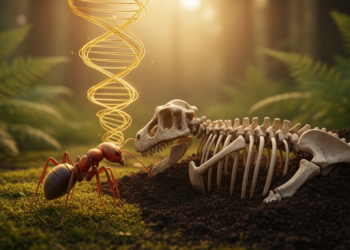
Jumping Genes Fueled the Rise of Ants After the Dinosaurs Died
New research shows that bursts of transposable element activity in ant genomes after the dinosaur extinction fueled the chemical communication ...
New research shows that bursts of transposable element activity in ant genomes after the dinosaur extinction fueled the chemical communication ...

Excavations at the Shég’ Xdaltth’i’ site in Alaska reveal a 13,800-year-old Beringian base camp where hunter-gatherers processed bison, sewn clothing ...
A new study of the Kikai-Akahoya eruption reveals that prehistoric Japanese societies responded to the catastrophe with divergent demographic outcomes, ...
New research shows that brief physical contact between healthy and bleached corals can transfer symbiotic algae through tissue fusion, restoring ...
A 13,800-year-old base camp in interior Alaska with more than 80,000 artifacts shows cultural ties linking eastern Beringia to western ...
Salk Institute scientists discovered that the plant cell surface receptor SRF3 coordinates iron homeostasis and immune responses through ubiquitin-dependent reorganization, ...
A 6,000-year analysis of more than 2,300 burials in China's Central Plain shows that social inequality was embedded in relational ...
Researchers at the University of Edinburgh and EPCC have developed an algorithm that lets ordinary computers run quantum simulations once ...
A new Science Advances analysis finds that 55.9% of the global population faced rising co-exposure to heatwaves and landscape fire ...
A twenty-year Monash University study published in Science Advances finds that 916 million people each year now face heatwaves and ...

Embark on a thrilling journey of discovery with Scienmag.com—your ultimate source for cutting-edge breakthroughs. Immerse yourself in a world where curiosity knows no limits and tomorrow’s possibilities become today’s reality!