


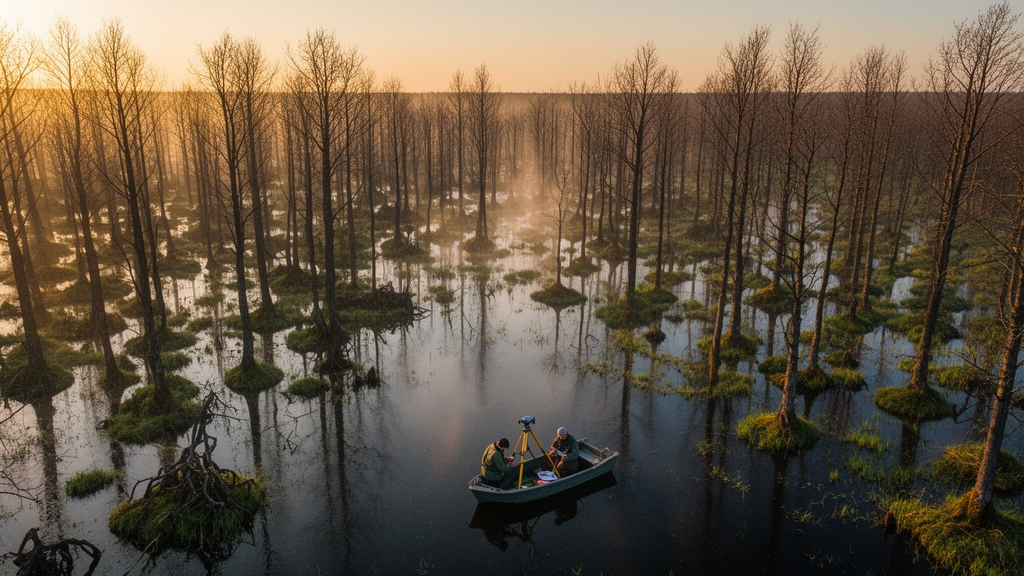
Deep in the floodplains of Ukraine’s rivers, where the water table sits high and the ground never quite dries out, grow some of Europe’s least understood forests. These swamp woods, dominated by black alder and downy birch, have now been given their most rigorous accounting yet. A team of Ukrainian researchers has analyzed nearly a thousand vegetation plots from across the country and concluded that the national classification of this habitat, which had ballooned to more than a dozen named plant communities, actually contains just six distinct associations. The finding, published in the journal Vegetation Classification and Survey, strips away decades of accumulated synonyms and local mislabels, replacing them with a data-driven scheme anchored in measurable ecological gradients.
The vegetation in question belongs to the phytosociological class Alnetea glutinosae, a group of swamp forests that develops on periodically flooded, waterlogged soils in shallow depressions, old river channels, mire margins, and the banks of lakes and ponds. Unlike the surrounding zonal forests, whose species composition shifts noticeably with climate, these azonal communities are shaped primarily by the hydrological regime. Black alder, Alnus glutinosa, and downy birch, Betula pubescens, form monospecific or mixed stands above a herb layer that weaves together wetland reeds, sedges, ferns, and grassland species. The alternation of waterlogged hollows and drier hummocks creates a microtopographic mosaic that packs remarkable floristic complexity into small areas, often topped by a well-developed moss layer of bryophytes with sharply different ecological affinities.
Ecologically, these forests punch far above their area. Swamp forests are recognized as biodiversity hotspots and provide crucial ecosystem services, from nutrient retention and erosion prevention to carbon fixation and the stabilization of hydrological regimes across whole landscapes. European policy reflects this: birch swamp forests are listed under habitat code 91D0 of the EU Habitats Directive as Habitats of Community Interest, the European Red List of Habitats categorizes them as Vulnerable, and they sit on the priority list of the EU Biodiversity Strategy for 2030. Yet their chief threats are not the forestry and clearance that menace other forest types, but hydrological disruption, including canalization, water diversion, river modification, water abstraction, pollution, and eutrophication, compounded by climate change, fragmentation, and increasingly by Phytophthora infections and alien plant invasions.
Ukraine’s own phytosociological tradition, however, had left the classification of this class in disarray. Early surveys relied on a dominant-species approach, and later Braun-Blanquet syntheses, including a 2008 national overview that lumped alder and willow carrs together and a 2019 prodrome listing ten alder carr associations plus one birch association, were built largely from literature sources. Those reviews did not strictly follow the International Code of Phytosociological Nomenclature and did not apply modern numerical techniques, so many syntaxonomic decisions carried only local validity. The new study set out to fix this by assembling a representative national dataset: 5,818 vegetation plots of floodplain forests, alder carr, and birch woods, sampled in the field between 2014 and 2022 and digitized from literature sources, all stored in the Ukrainian Wetland Database and the Database of the Floodplain Forests of Ukraine.
Filtering was deliberately strict. Only plots with more than 25 percent cover of Alnus glutinosa or Betula pubescens were accepted, plot sizes were restricted to 100 to 400 square meters to minimize bias in species constancy, and records not identified to species level were removed. The final matrix contained 1,826 plots spanning the period from 1952 to 2022. Classification proceeded in two steps using agglomerative beta-flexible clustering with a beta value of minus 0.3 and the Bray-Curtis dissimilarity index on square-root-transformed percentage covers. The first run separated riparian alder forests, which were excluded, from true swamp vegetation. The second run, guided by the OptimClass1 method for selecting the optimal number of clusters, converged on seven clusters, which the researchers merged into six associations based on expert judgment and comparison with the original diagnoses of each name.
The six associations fall within three alliances. Three belong to the alliance Alnion glutinosae, representing a gradient from oligotrophic to eutrophic alder carr. Thelypterido palustris-Alnetum glutinosae describes nutrient-poor, strongly acidic peaty carrs of the northern forest zone, with a moss layer rich in Sphagnum squarrosum and other bryophytes. Carici elongatae-Alnetum glutinosae groups meso- to eumesotrophic carrs on peat-clay soils, where hummocks up to a meter high alternate with waterlogged hollows hosting aquatic plants, and where the marsh fern Thelypteris palustris and the sedge Carex elongata are highly diagnostic. Carici acutiformis-Alnetum glutinosae, the most frequent alder swamp forest in Ukraine, covers eutrophic, muddy floodplain swamps across all physiographic zones, with tall sedges, stinging nettle, common hop, and hedge bindweed marking its species-rich herb layer.
The remaining three associations are birch swamp forests, a group the study formally transfers into Alnetea glutinosae from the separate class Molinio-Betuletea pubescentis, following the EuroVegChecklist. Salici pentandrae-Betuletum pubescentis represents basiphilous birch woods on carbonate-enriched mesotrophic mires, diagnosed by Molinia caerulea and Agrostis canina. Thelypterido palustris-Betuletum pubescentis and Eriophoro vaginati-Betuletum pubescentis are acidophilous birch forests on waterlogged peaty soils, the latter dominated by Eriophorum vaginatum, Rhododendron tomentosum, and a suite of bog specialists including Vaccinium oxycoccos, Andromeda polifolia, and Sphagnum magellanicum. Both acidophilous types are restricted to the northernmost forest zone, replacing the single birch association previously recognized in the national prodrome.
Ordination and indicator-value analysis revealed the environmental architecture behind this classification. Non-metric multidimensional scaling separated birch forests from alder carr along the first axis, driven largely by the proportion of acidophilous species. Ellenberg indicator values, tested with distance-based redundancy analysis and modified permutation ANOVA, showed that soil reaction, nutrients, light availability, and soil moisture are the significant gradients. Birch forests occupy more acidic, nutrient-poor sites where stagnant moisture prevents a closed productive canopy, leaving them more open and better lit than alder carr. Notably, the associations differ significantly in soil moisture only at the alliance level, not between individual associations, reflecting the broad ecological amplitude of many hygrophilous species that recur across all alder carr communities.
The nomenclatural consequences are sweeping. The study synonymizes seven previously listed associations, excludes two from the class, and corrects several long-standing author citations. The name Thelypterido palustris-Alnetum glutinosae, proposed by Klika in 1939 to 1940, takes priority over later names for oligotrophic carr, while Carici elongatae-Alnetum glutinosae is credited to Schwickerath 1933 rather than the invalid 1931 publication by Tüxen. Two associations previously placed in Alnetea glutinosae, Urtico dioicae-Alnetum glutinosae and Syringo josikaeae-Alnetum glutinosae, are reassigned to the riparian alliance Alnion incanae because their floristic composition aligns with floodplain forests. The researchers also confirmed the presence in Ukraine of the alliance Salici pentandrae-Betulion pubescentis, first documented there in 2016 but previously based only on physiognomic similarity rather than numerical evidence.
Geographically, the class reaches from the Marusia river floodplain in the Lviv region in the west to the Oskil river in the Kharkiv region in the east, with its southernmost localities in the Dnipro estuary within protected areas of the Kherson and Mykolayiv regions. Birch swamp forests are confined to the forest zone, and the study does not support earlier claims of a broader southern range for the basiphilous alliance. The southern limit is set by increasing aridity, aggravated by twentieth-century reclamation and hydroelectric construction that altered river regimes. Field research in Crimea and in large parts of the occupied forest zone is currently impossible for security reasons, leaving gaps that only future work can fill. The authors argue that their revised scheme, with clearly defined diagnostic, constant, and dominant species for each association, provides the baseline needed for conservation planning, habitat monitoring, and mapping, and a step toward a formalized classification of Ukraine’s vegetation grounded in consistent, nationally representative data.
Subject of Research: Syntaxonomy of the class Alnetea glutinosae in Ukraine: a critical revision
Article Title: Syntaxonomy of the class Alnetea glutinosae in Ukraine: a critical revision
Article References: Iemelianova, S., & Borsukevych, L. (2025). Syntaxonomy of the class Alnetea glutinosae in Ukraine: a critical revision. Vegetation Classification and Survey, 6, 13-36. https://doi.org/10.3897/vcs.122617
Image Credits: AI Generated
DOI: 10.3897/VCS.122617
Keywords: Syntaxonomy, class, Alnetea, glutinosae, Ukraine, critical, revision, scientific research
Cite Scienmag News
Gavin Prescott. (October 17, 2026). Alder swamps of Ukraine remapped in sweeping national vegetation revision. Scienmag. https://scienmag.com/alder-swamps-of-ukraine-remapped-in-sweeping-national-vegetation-revision/
Gavin Prescott. "Alder swamps of Ukraine remapped in sweeping national vegetation revision." Scienmag, 17 October 2026, https://scienmag.com/alder-swamps-of-ukraine-remapped-in-sweeping-national-vegetation-revision/. Accessed 17 October 2026.
Gavin Prescott. "Alder swamps of Ukraine remapped in sweeping national vegetation revision." Scienmag. October 17, 2026. https://scienmag.com/alder-swamps-of-ukraine-remapped-in-sweeping-national-vegetation-revision/

