


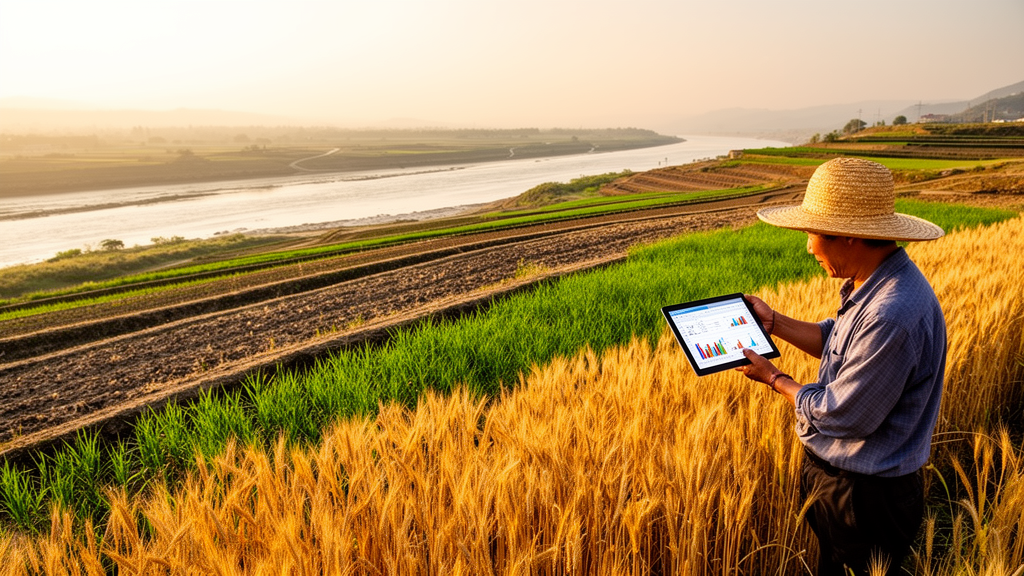
When summer temperatures spike across China’s Yellow River Basin, the damage reaches far beyond scorched fields. A new study of nine provinces finds that severe temperature extremes erode not just crop yields but the entire capacity of grain-producing regions to withstand, recover from, and adapt to climate shocks. The research, published in Frontiers in Agricultural Science and Engineering, offers some of the clearest evidence yet that heat extremes undermine the multidimensional resilience of grain systems—and that digital tools may help buffer the blow.
The study, led by researchers examining the 2013-2023 period across the Yellow River Basin, China’s second-largest grain-producing region, measured resilience across three dimensions: the ability of regions to resist temperature shocks, to recover from them, and to adapt over time. The findings show that each additional extreme temperature day significantly reduces all three capacities, with the effects persisting even after accounting for agricultural endowments, market conditions, production scale, consumption capacity, and urbanization.
What makes the research distinctive is its focus on resilience rather than yield alone. Previous studies have documented how heat stress cuts harvests, but the new work argues that such shocks destabilize the entire production system. When temperatures spike, farmers divert resources from long-term investments toward immediate survival, weakening the infrastructure, technology, and institutions that would otherwise support future harvests. The result is a spiral in which each shock leaves the system more vulnerable to the next.
The evidence is stark. Field experiments cited in the study show that heat stress during the flowering period of summer maize can reduce yields by more than 30 percent, with the damage concentrated in the grain-filling stage. But the broader consequences reach further: heat extremes disrupt planting schedules, increase water demand, and strain the irrigation and storage infrastructure that grain regions depend upon. In the Yellow River Basin, where water scarcity already constrains production, these pressures compound existing vulnerabilities.
Not all regions are equally exposed. The study finds that the negative effects of temperature extremes are concentrated in areas with weaker agricultural infrastructure and lower economic capacity. Regions with stronger irrigation systems, better storage facilities, and deeper digital penetration show significantly greater capacity to withstand shocks. In areas where digital infrastructure is well developed, the damage from temperature extremes is measurably reduced, suggesting that connectivity, early warning systems, and digital finance can buffer climate impacts.
The digital dimension is among the most intriguing findings. The researchers measured digital development across the basin using indicators of internet penetration, mobile coverage, and digital finance depth. Their analysis shows that each unit increase in digital development significantly reduces the negative effect of temperature extremes on grain resilience. The mechanism, they argue, operates through several channels: digital platforms deliver early warnings of incoming heat waves, allowing farmers to adjust planting and irrigation schedules; digital finance provides emergency credit when harvests fail; and online agricultural services connect farmers to technical advice and market information that would otherwise be unavailable.
The findings carry significant implications for climate adaptation policy. The researchers argue that building resilience requires more than expanding irrigation or improving crop varieties—it demands strengthening the digital, financial, and institutional infrastructure that allows grain regions to absorb shocks. In areas where digital infrastructure is weak, the study suggests, targeted investment in connectivity and digital services could deliver outsized adaptation benefits. The researchers also emphasize that adaptation strategies must account for regional differences in economic capacity, since the damage from temperature extremes is concentrated in areas least able to afford it.
The study’s evidence is robust across multiple specifications. The researchers tested their findings using lagged control variables to address potential simultaneity, matched specifications to address endogeneity, and alternative measures of temperature extremes to ensure the results were not driven by particular definitions. The negative relationship between temperature extremes and grain resilience persisted across all tests, with the coefficient remaining statistically significant at the 1 percent level. The researchers also found that the effects were stronger in areas with weaker agricultural infrastructure, confirming that the damage from climate shocks is concentrated where adaptive capacity is lowest.
What the research does not yet establish is the precise mechanism through which digital tools buffer climate impacts. The researchers acknowledge that their evidence shows correlation rather than causation, and that targeted experiments would be needed to isolate the specific channels through which connectivity, early warning, and digital finance operate. They also note that their measure of digital development captures breadth rather than depth, and that future research should examine how specific digital services—such as precision agriculture platforms or weather-indexed insurance—deliver adaptation benefits.
For the Yellow River Basin, the findings arrive at a critical moment. The region faces intensifying temperature extremes, deepening water scarcity, and growing pressure to maintain grain output for national food security. The study suggests that the path forward requires strengthening not just physical infrastructure but the digital and financial systems that allow grain regions to absorb shocks. In areas where connectivity is weak, targeted investment in digital services could deliver adaptation benefits that physical infrastructure alone cannot match. The researchers argue that building resilience demands a comprehensive approach—one that integrates irrigation, crop varieties, digital platforms, financial services, and institutional capacity into a single adaptation strategy.
Subject of Research: Agricultural Science
Article Title: Extreme temperature, digital rural development, and grain production resilience in the Yellow River Basin
Article References: Wang, W., Yu, Y., Yang, Y., & Zhang, Y. (2026). Extreme temperature, digital rural development, and grain production resilience in the Yellow River Basin. Frontiers in Sustainable Food Systems, 10, Article 1912640. https://doi.org/10.3389/fsufs.2026.1912640
Image Credits: AI Generated
DOI: 10.3389/fsufs.2026.1912640
Keywords: climate change, grain production, resilience, digital infrastructure, Yellow River Basin, extreme heat, agricultural adaptation, Extreme, temperature, digital, rural, development
Cite Scienmag News
Violet Maxwell. (October 17, 2026). Extreme heat and digital tools shape grain resilience in China’s Yellow River Basin. Scienmag. https://scienmag.com/extreme-heat-and-digital-tools-shape-grain-resilience-in-chinas-yellow-river-basin/
Violet Maxwell. "Extreme heat and digital tools shape grain resilience in China’s Yellow River Basin." Scienmag, 17 October 2026, https://scienmag.com/extreme-heat-and-digital-tools-shape-grain-resilience-in-chinas-yellow-river-basin/. Accessed 17 October 2026.
Violet Maxwell. "Extreme heat and digital tools shape grain resilience in China’s Yellow River Basin." Scienmag. October 17, 2026. https://scienmag.com/extreme-heat-and-digital-tools-shape-grain-resilience-in-chinas-yellow-river-basin/


