


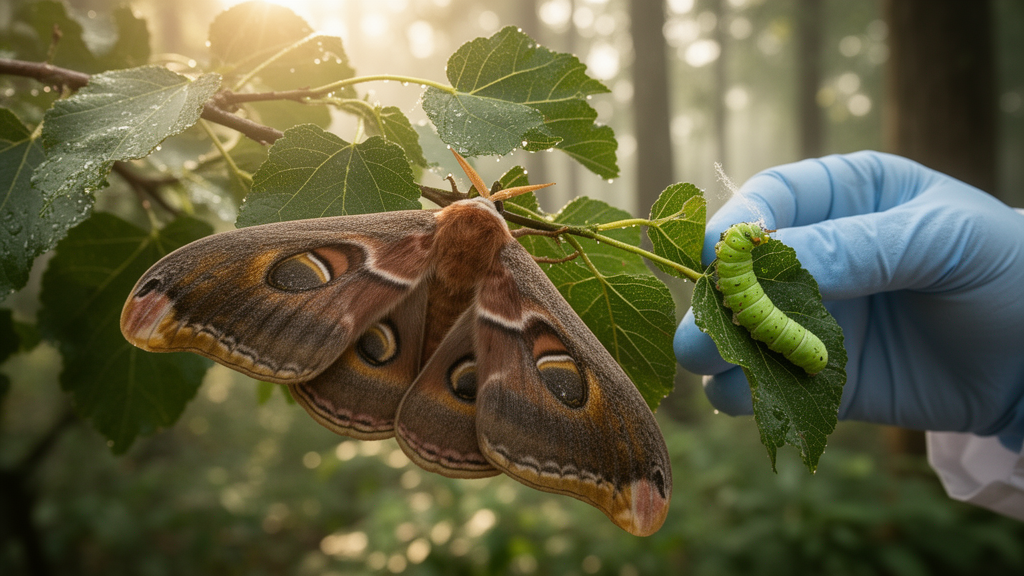
High in the misty broadleaf forests of southern China, some of the world’s most spectacular giant silkmoths are quietly revealing their dietary secrets. A new study published in Nota Lepidopterologica compiles nearly two decades of field observations on the genus Samia, the group that includes the famous ailanthus and eri silkworms, and maps for the first time which plants its five wild Chinese species really feed on in nature. The findings, drawn from observations made between 2006 and 2025 across most Chinese provinces, suggest that the evolutionary story of these moths and their hostplants runs far deeper than any single species, potentially reaching back to the origins of an entire tribe of giant silkworms.
The genus Samia belongs to the tribe Attacini, the lineage that also contains the colossal Atlas moth. Its members are large, maroon to olive-toned moths whose forewings bear a striking submarginal eyespot between the veins R5 and M1, a feature some researchers have suggested mimics the head of a snake or other vertebrate. Each wing also carries a crescentic, scale-free window on the distal part of the discoidal cell. The caterpillars are equally distinctive: newly hatched larvae are yellowish with black dots or stripes, and the bases of the paired dorsal scoli on the eighth abdominal segment are fused. Mature larvae turn green, white or bluish, their elongated spine-like scoli dusted with a waxy white powder that experiments have suggested may deter tachinid flies from laying their eggs on the larval surface.
Despite the economic fame of Samia, ecological records for its wild members have long been fragmentary. The most recent systematic revision, published in 2003, listed six species in China but flagged the near-total absence of reliable hostplant data. The new study set out to close that gap by combining the authors’ direct field sightings with records contributed by Chinese colleagues, carefully filtering out unreliable observations such as wandering mature larvae found away from food plants. The team also reared the complete life histories of all six Chinese species in the laboratory, allowing wild specimens to be identified by matching their morphology and collection sites against laboratory-reared standards, and in doubtful cases by rearing larvae on the very plants where they were found or by letting cocoons emerge indoors.
The results paint a picture of remarkable dietary breadth in most of the genus. Samia cynthia, the type species and the famous ailanthus silkworm of northern China, was documented feeding on the tree of heaven itself, Ailanthus altissima, as well as on prickly ash Zanthoxylum bungeanum, the amur corktree Phellodendron amurense, and the tetradium tree Tetradium daniellii. Records span coastal Liaoning, Beijing’s suburban forests, and cultivated Zanthoxylum plantations in Shandong, where roughly thirty mature larvae were once counted across individual trees. Historically, this species anchored a cottage silk industry in rural Shandong, its hand-spun yarn prized until the trade collapsed after China’s economic reforms around 1978.
Its southern sister species, Samia wangi, proved even more versatile. Field records from Jiangsu, Shanghai, Zhejiang, Taiwan, Fujian, Hunan, Sichuan, Guangdong and Hainan document larvae on Picrasma quassioides, camphor trees, Chinese tallow, Litsea species, several Zanthoxylum species, Hovenia acerba, and even the holly Ilex asprella in Taiwan’s Yangmingshan. Females lay small clusters of fewer than ten eggs in single or double layers on leaf undersides, a pattern matching the behaviour of the related Japanese species Samia pryeri. The species flies two or more generations a year across its subtropical range, overwintering as a pupa, and its peduncled brown cocoons are still collected from camphor trees, with pupae now sold online as food for pet birds.
Further south and higher up, Samia kohlli, the largest species in the genus, was observed in Yunnan on Zanthoxylum armatum, Coriaria nepalensis, camphor relatives, Litsea rubescens, Hovenia acerba and Lagerstroemia tomentosa, from the hills of Kunming at over 2,100 metres to the tropical lowlands of Xishuangbanna. Its final-instar larvae are instantly recognisable by red-tipped dorsal scoli on the ninth abdominal segment. Meanwhile, the wild eri silkmoth Samia canningi, confirmed as the wild progenitor of the domesticated eri silkworm Samia ricini through morphological, breeding and genomic evidence, was recorded on Zanthoxylum in Pu’er and Xishuangbanna, with summer and winter larvae suggesting at least two generations a year. The domesticated S. ricini itself, an artificial hybrid with no wild populations, remains farmed mainly in Guangdong and Guangxi on castor bean, cassava and Coriaria.
The most surprising dietary specialist is Samia watsoni, the sister species to all other members of the genus. Unlike its polyphagous relatives, S. watsoni was documented in the mountains of Zhejiang laying eggs exclusively on the upper surfaces of leaves of two closely related trees: Pterostyrax corymbosus and Stewartia gemmata, members of the snowbell and tea families respectively. Rearing trials added a twist: larvae from Guangxi refused multiple Styracaceae species and died before their second moult, but readily accepted sweetleaf, Symplocos paniculata, racing to the next instar. From that cohort, three adult males eventually emerged, and all displayed an unusual melanic, nearly black phenotype unlike their reddish-brown mother, leading the authors to preliminarily hypothesize a diet-induced colour shift that awaits further testing.
Placing these observations in a phylogenetic context yields the study’s most provocative insight. The three known hostplant families of S. watsoni, Styracaceae, Theaceae and Symplocaceae, are all members of the plant order Ericales and sit on adjacent branches of its family tree, with Styracaceae and Symplocaceae as sister taxa and Theaceae sister to them. Because S. watsoni represents the deepest branch of Samia, and because the Nearctic relatives Callosamia and Hyalophora have also been recorded on Styracaceae, Symplocaceae and Theaceae, the authors suggest that the snowbell family may represent an ancestral host choice for the entire genus, later abandoned by the polyphagous core species in favour of rutaceous, simaroubaceous, euphorbiaceous, lauraceous and coriariaceous plants.
The evolutionary story extends beyond Samia altogether. A mature larva of Archaeoattacus edwardsii, another attacine giant, was found in the wild on Macaranga pustulata, a euphorb, in Yunnan’s Yingjiang County in 2023, joining the long-known association of the Atlas moth with Chinese tallow. Together, these records point to Euphorbiaceae as a possible ancestral host for the tribe Attacini, which originated in Asia. Even more tellingly, a first-instar larva of Rhodinia cf. newara, the sister group of all other attacine genera, was discovered feeding on a camphor relative, Camphora glandulifera, in Gongshan County in April 2024, alongside earlier records of Rhodinia on birch, rose, walnut, beech, willow and rue family plants.
Lauraceae emerges as a recurring thread through this entire phylogenetic tapestry, supporting a hypothesis that the camphor and laurel family was the host of the last common ancestor of the entire subfamily Saturniinae. For conservationists, the practical implications are immediate: protecting the broadleaf forests where these wild silkworms persist means protecting a specific botanical community, from tree of heaven and prickly ash in the north to camphor and snowbell trees in the subtropical south. For sericulture, the mapping of natural hosts offers a roadmap for developing new captive food plants. And for evolutionary biologists, the caterpillars of China’s giant silkmoths have become living archives, their menus preserving echoes of host choices made millions of years before humans ever spun a thread.
Subject of Research: Natural hostplants and ecology of the silkmoth genus Samia in China
Article Title: Ecological observations on the genus Samia Hübner, 1819 ( Lepidoptera , Saturniidae ) of China, especially the natural hostplants
Article References: Wu, Y., Peigler, R. S., & Liu, Z. (2025). Ecological observations on the genus Samia Hübner, 1819 (Lepidoptera, Saturniidae) of China, especially the natural hostplants. Nota Lepidopterologica, 48, 251-268. https://doi.org/10.3897/nl.48.150262
Image Credits: AI Generated
DOI: 10.3897/nl.48.150262
Keywords: Samia, Saturniidae, wild silkworms, hostplants, Lepidoptera, Attacini, China, eri silkworm, ailanthus silkmoth, larval ecology, Styracaceae, Lauraceae
Cite Scienmag News
Gavin Prescott. (October 17, 2026). China’s Wild Silkworms Reveal Ancient Hostplant Secrets of Giant Moths. Scienmag. https://scienmag.com/chinas-wild-silkworms-reveal-ancient-hostplant-secrets-of-giant-moths/
Gavin Prescott. "China’s Wild Silkworms Reveal Ancient Hostplant Secrets of Giant Moths." Scienmag, 17 October 2026, https://scienmag.com/chinas-wild-silkworms-reveal-ancient-hostplant-secrets-of-giant-moths/. Accessed 17 October 2026.
Gavin Prescott. "China’s Wild Silkworms Reveal Ancient Hostplant Secrets of Giant Moths." Scienmag. October 17, 2026. https://scienmag.com/chinas-wild-silkworms-reveal-ancient-hostplant-secrets-of-giant-moths/


