


For decades, the story of how early humans acquired and butchered animals has been told almost entirely from western Eurasian sites such as Boxgrove in England, Schöningen in Germany, Gran Dolina in Spain and Qesem Cave in Israel. Those assemblages have revealed systematic carcass processing, marrow extraction and even the use of bones as tools, painting a detailed picture of Middle Pleistocene subsistence. East Asia, by contrast, has long remained a blurry corner of that map, with faunal collections reported but rarely analyzed at comparable resolution. A new review published in Asian Archaeology by Yuwei Du and Chunxue Wang of Jilin University now pulls together the published zooarchaeological evidence from China and places it, for the first time, within a broader Eurasian comparative framework, and the results suggest that Chinese Middle Pleistocene hominins were running their own sophisticated animal-exploitation playbook.
The Middle Pleistocene, spanning roughly 780,000 to 130,000 years ago, was a transformative period in human evolution. It was during this interval that the genus Homo spread across much of the Old World, hunting technology advanced, and meat eating became a central pillar of the human diet. Understanding how hominins exploited animal resources is therefore essential for reconstructing their subsistence strategies and ecological adaptations. Zooarchaeology, the study of animal remains from archaeological sites, provides the key technical toolkit: analysts examine cut marks left by stone tools, percussion marks from breaking bones open, tooth marks from carnivores, mortality profiles of the prey species, and the anatomical distribution of bone fragments to determine who got to the carcass first and what they did with it.
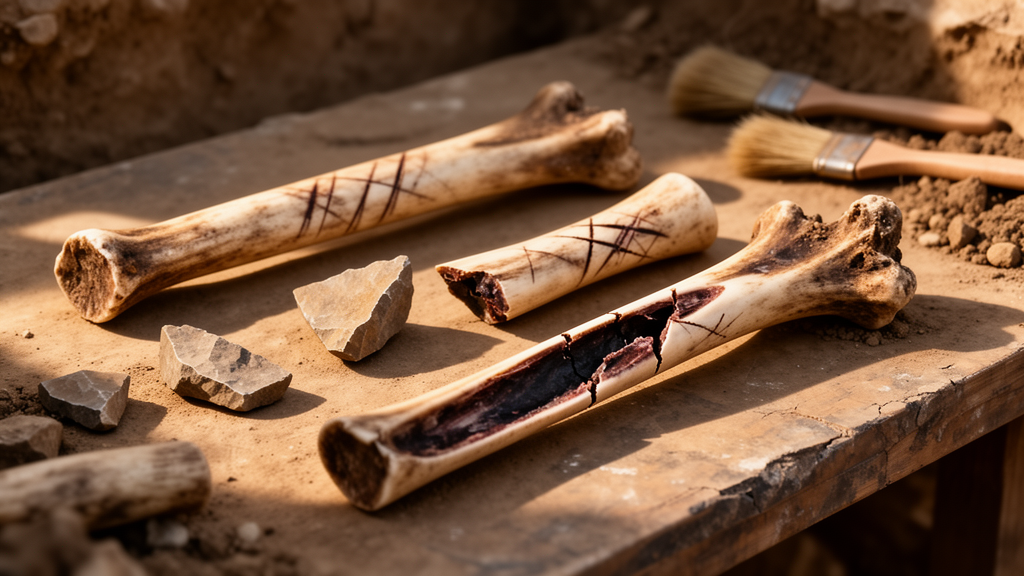
Du and Wang synthesized this kind of evidence from published Chinese assemblages to evaluate patterns of carcass acquisition, processing and utilization. The review identifies several recurring patterns across the Chinese record. The most fundamental is the exploitation of medium- to large-sized ungulates, the hoofed mammals such as horses, deer and rhinoceroses that dominate the faunal spectra. Alongside this prey focus, the evidence points to systematic carcass processing involving the removal of soft tissue, the extraction of nutrient-rich marrow from long bones, and, in some cases, the reuse of broken bones as expedient tools. These are the same hallmarks of detailed butchery sequences documented at flagship western Eurasian sites, suggesting that the behavioral repertoire of East Asian hominins was more elaborate than the region’s sparse analytical record had implied.
To organize this evidence, the authors summarize carcass utilization in a three-stage framework. The first stage concerns acquisition, whether animals were hunted directly or scavenged from carnivore kills, a question that taphonomists address by reading the sequence of surface modifications on bones. The second stage covers processing, the systematic disarticulation and defleshing of carcasses and the deliberate breakage of long bones to reach the marrow cavity. The third stage involves utilization, the consumption of meat and marrow and the secondary use of bones as raw material. This framework mirrors the analytical logic applied at European and Levantine sites, allowing Chinese assemblages to be compared stage by stage with their western counterparts rather than treated as an isolated regional curiosity.
Shared processing practices, however, coexist with striking regional variation. The taxa exploited differed across habitats, from the open steppe settings of northern China to the subtropical karst caves of the south, and the use of osseous materials, bones as technological resources, varied regionally as well. At Panxian Dadong in Guizhou Province, southwestern China, Middle Pleistocene hominins interacted intensively with rhinoceroses and stegodonts, extinct relatives of elephants, and even fashioned tools from rhinoceros teeth, an unusual osseous technology with few parallels elsewhere. At Zhoukoudian near Beijing, the famous cave of Peking Man, decades of debate over the faunal remains, including pointed critiques by Lewis Binford and colleagues in the 1980s, have given way to a more nuanced view in which large carnivores such as hyenas contributed to bone accumulations alongside hominin activities, and recent work has documented hominin use and maintenance of fire at the site.
The strongest evidence for detailed processing sequences comes from a small number of sites, particularly in northern China. The Nihewan Basin, a rift landscape west of Beijing packed with Paleolithic localities, has emerged as the analytical heartland of the review. At sites such as Xujiayao, equid prey acquisition has been analyzed in detail, revealing archaic Homo adaptability in exploiting horses. Newer work by the same research group, including taphonomic analyses at Jijiazhuang and the Caijiagou site in the Yuxian Basin, has applied modern bone-surface modification protocols to Middle Pleistocene assemblages, documenting cut marks, percussion damage and mortality patterns at a resolution that finally matches western Eurasian standards. These northern Chinese sites show that hominins were not passive scavengers trailing behind carnivores but active participants in carcass acquisition and processing.
Southern Chinese and Tibetan Plateau assemblages broaden the ecological range of the comparison considerably. The subtropical cave sites of the south, with their rhinoceroses, stegodonts and gaurs, demonstrate that hominins adapted to very different prey communities than the equid- and deer-dominated assemblages of the north. At Hualongdong in Anhui Province, recent studies of gaur teeth have been interpreted as evidence of hunting behavior, and the site has also yielded archaic human remains documenting Middle Pleistocene human continuity and variation in China. On the Tibetan Plateau, the Denisovan-bearing Baishiya Karst Cave has produced faunal evidence of Middle and Late Pleistocene subsistence at high altitude, extending the geographic and ecological scope of animal exploitation to environments once thought marginal for Pleistocene hominins.
The review does not shy away from the constraints on interpretation. Sample sizes remain limited, data collection is uneven across regions, and analytical protocols are inconsistent, with different studies applying different standards for recording cut marks, percussion marks and mortality profiles. This unevenness matters because interpretations of hunting versus scavenging hinge on fine-grained taphonomic details, such as whether cut marks overlie tooth marks, indicating hominin first access, or the reverse. The authors are careful to note that the documented patterns characterize the Chinese assemblages reviewed here rather than the entire East Asian record, and they present their synthesis as a basis for evaluating regional adaptations within East Asia, not a final verdict.
Even with those caveats, the synthesis carries real weight for the Eurasian big picture. The three-stage framework of acquisition, processing and utilization aligns the Chinese record with the analytical standards of western Eurasian zooarchaeology, and the recurring patterns, medium- to large-sized ungulate prey, systematic butchery, marrow extraction and expedient bone tool use, suggest that Middle Pleistocene hominins across Eurasia shared a core behavioral repertoire for exploiting animal resources. At the same time, the regional variation in exploited taxa, habitat settings and osseous technology, from rhinoceros tooth tools in Guizhou to equid processing in the Nihewan Basin, underscores that this shared repertoire was flexibly adapted to local ecologies. Meat made us human, as the evolutionary catchphrase goes, and the Chinese record now shows that the meat-eating revolution reached the eastern edge of the hominin world with full force.
For a field long dominated by western Eurasian narratives, the review marks a turning point. It demonstrates that East Asian zooarchaeology has matured to the point where regional syntheses can be built and compared, and it identifies precisely where the analytical gaps lie, in sample size, in data collection and in protocol standardization. As new excavations in the Nihewan Basin, southern China and the Tibetan Plateau apply modern taphonomic methods, the resolution of the East Asian record will only improve, and the interactions between hominins and animals during the Middle Pleistocene will come into focus as a genuinely Eurasian story, told from both ends of the continent.
Subject of Research: Paleoanthropology
Article Title: The interactions between hominins and animals: Subsistence strategies of Middle Pleistocene hominins in China
Article References: Du, Y., & Wang, C. (2026). The interactions between hominins and animals: Subsistence strategies of Middle Pleistocene hominins in China. Asian Archaeology. https://doi.org/10.1007/s41826-026-00135-4
Image Credits: AI Generated
DOI: 10.1007/s41826-026-00135-4
Keywords: zooarchaeology, Middle Pleistocene, hominins, China, subsistence strategies, Nihewan Basin, Zhoukoudian, Panxian Dadong, taphonomy, bone tools, interactions, between
Cite Scienmag News
Courtney Benton. (October 19, 2026). Meat, Marrow and Bone Tools: How Middle Pleistocene Hominins in China Exploited Animals. Scienmag. https://scienmag.com/meat-marrow-and-bone-tools-how-middle-pleistocene-hominins-in-china-exploited-animals/
Courtney Benton. "Meat, Marrow and Bone Tools: How Middle Pleistocene Hominins in China Exploited Animals." Scienmag, 19 October 2026, https://scienmag.com/meat-marrow-and-bone-tools-how-middle-pleistocene-hominins-in-china-exploited-animals/. Accessed 19 October 2026.
Courtney Benton. "Meat, Marrow and Bone Tools: How Middle Pleistocene Hominins in China Exploited Animals." Scienmag. October 19, 2026. https://scienmag.com/meat-marrow-and-bone-tools-how-middle-pleistocene-hominins-in-china-exploited-animals/


