


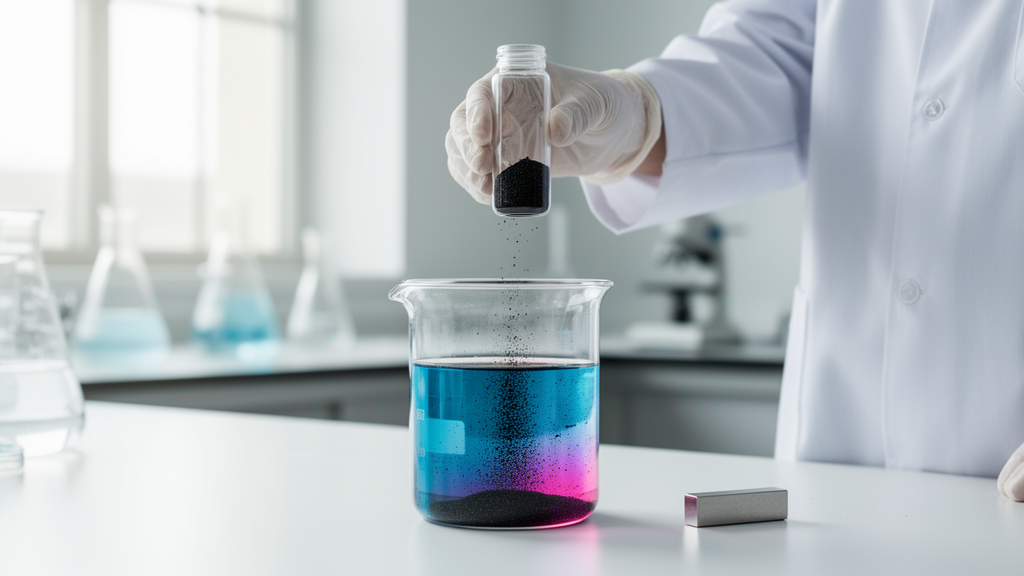
A team of researchers from the Indian Institute of Technology BHU, the Bhabha Atomic Research Centre, and CSIR-Indian Institute of Chemical Technology has unveiled a magnetic nanocomposite that can strip a stubborn synthetic dye out of water with remarkable speed. The material, described in Environmental Science and Pollution Research, combines two technologically celebrated classes of oxides in a single particle: a fluorite-structured cerium dioxide phase and a spinel-structured high-entropy oxide of the form M3O4, where the metal sites are shared among manganese, iron, cobalt, nickel, and cerium. In tests, the composite degraded roughly 92 percent of methylene blue, a common model dye pollutant, within 60 minutes of photo-Fenton treatment, and mass spectrometry of the solution after 90 minutes indicated that the dye had been completely mineralised rather than merely broken into smaller fragments.
The significance of that last point is easy to underestimate. Many photocatalytic treatments succeed at decolourising water while leaving behind colourless but still hazardous intermediates. Confirming total mineralisation by mass spectrometry means the dye molecule has been dismantled all the way down to simple, benign end products. For textile and dye-manufacturing industries, whose effluents are among the most visually obvious and chemically persistent sources of water pollution, a catalyst that finishes the job rather than half of it could make a meaningful difference to treatment outcomes.
What makes the new material distinctive is the way it merges two complementary catalytic philosophies. Cerium dioxide has long been prized in catalysis, sensors, fuel cells, and environmental remediation because of the rapid Ce4+/Ce3+ redox cycling that its fluorite crystal lattice permits. That cycling allows ceria to store and release oxygen on demand, a property that underpins its famous oxygen-storage capability and makes it a tireless participant in oxidation reactions. High-entropy oxides, by contrast, are a newer entry in the materials toolbox. By distributing four or more cations across a single crystallographic site in near-equimolar proportions, these compounds gain tailorable bandgaps, improved charge separation, and a dense landscape of redox-active sites, all of which favour catalytic activity.
The researchers did not simply mix the two phases after synthesis. Instead, the fluorite and spinel phases were formed in situ, growing together during preparation so that the two crystal structures coexist in intimate contact within the nanocomposite. Structural confirmation came from x-ray diffraction, which revealed reflections belonging to both the CeO2 fluorite phase and the M3O4 spinel phase, while transmission electron microscopy provided morphological evidence that the two components coexist at the nanoscale. The oxidation states of the constituent cations were verified by x-ray photoelectron spectroscopy, a surface-sensitive technique that resolves the chemical states of manganese, iron, cobalt, nickel, and cerium in their respective lattices.
The catalytic performance was assessed in a photo-Fenton reaction, an advanced oxidation process that couples light activation with Fenton chemistry to generate highly reactive hydroxyl radicals. In classical homogeneous Fenton systems, dissolved iron salts catalyse the decomposition of hydrogen peroxide into these radicals, but the process works best at acidic pH and generates an iron sludge that must be disposed of. Heterogeneous photo-Fenton catalysts replace the dissolved salts with a solid catalyst, allowing the reaction to run over a wider pH range while keeping the metal confined to a recoverable solid phase. The multiple redox-active cations in the high-entropy spinel, together with the oxygen-buffering ceria phase, appear to make the composite an especially effective radical generator.
Perhaps the most practical feature of the material is its magnetism. The composite exhibits a saturation magnetisation of approximately 25 emu per gram, which is sufficient for the catalyst to be pulled out of a treated suspension with a simple external magnet. This addresses one of the chronic headaches of nanoscale water treatment: nanoparticles are superb catalysts because of their enormous surface area, but they are notoriously difficult to separate from treated water, and any catalyst that escapes with the effluent becomes a pollutant in its own right. A magnetically retrievable catalyst can be collected, washed, and redeployed, turning a single-use nanomaterial into a reusable workhorse.
The choice of methylene blue as the test pollutant is standard practice in photocatalysis research, but the dye is more than a convenient benchmark. It is a thiazine dye used widely in textile dyeing and in medical and analytical applications, and its discharge into waterways is both aesthetically damaging and biologically concerning. Degradation pathways for methylene blue under advanced oxidation typically involve successive attack by hydroxyl and other reactive oxygen species on the chromophoric ring system, and the mass spectrometric evidence in this study supports the conclusion that the composite drives these steps to completion within 90 minutes.
The work also fits into a rapidly expanding research programme on high-entropy materials for environmental catalysis. Since the concept of entropy-stabilised oxides was demonstrated, researchers have explored these multi-element compounds for energy storage, electrocatalysis, solid oxide cells, and pollutant degradation. The present team has previously reported ferrimagnetic high-entropy spinels, including compositions containing manganese, chromium, cobalt, iron, and aluminium, and others containing aluminium, manganese, iron, cobalt, and nickel, for photo-Fenton dye degradation. The new composite extends that strategy by pairing a high-entropy spinel with ceria, effectively combining the configurational-entropy advantage of the spinel with the proven redox versatility of the fluorite phase in one recoverable particle.
From an engineering standpoint, the design logic is compelling. The spinel phase contributes ferrimagnetism for recovery and a multiplicity of transition-metal redox couples for Fenton-like radical generation. The ceria phase contributes oxygen storage and Ce4+/Ce3+ cycling that can help regenerate active sites and suppress recombination of photogenerated charge carriers. Because the two phases are formed in situ, the interfaces between them are clean and abundant, and such interfaces are precisely where charge transfer and radical chemistry are most efficient in composite photocatalysts. The result is a material in which each component covers a weakness of the other.
Challenges remain before such catalysts can move from the laboratory bench to a treatment plant. The synthesis route must be scaled to produce kilogram quantities at acceptable cost, the long-term stability and leaching behaviour of the multi-element lattice under repeated cycles must be characterised, and performance must be demonstrated on real industrial effluents rather than single-dye solutions. Nevertheless, the combination of near-complete dye degradation, verified mineralisation, and magnetic recyclability makes this fluorite-spinel nanocomposite a notable step toward practical, reusable catalysts for the advanced oxidation of organic pollutants in wastewater.
Subject of Research: Magnetic fluorite-spinel high-entropy oxide nanocomposites for photocatalytic degradation of organic dyes in wastewater
Article Title: In-situ magnetic nanocomposite of fluorite MO2 and spinel M3O4 (where M = Mn, Fe, Co, Ni and Ce) for photocatalytic application
Article References: In-situ magnetic nanocomposite of fluorite MO2 and spinel M3O4 (where M = Mn, Fe, Co, Ni and Ce) for photocatalytic application. (n.d.). https://doi.org/10.1007/s11356-026-38318-2
Image Credits: AI Generated
DOI: 10.1007/s11356-026-38318-2
Keywords: high-entropy oxide, nanocomposite, cerium dioxide, spinel structure, photocatalysis, photo-Fenton, methylene blue, dye degradation, magnetic recovery, wastewater treatment, advanced oxidation, ceria
Cite Scienmag News
Russell Cooper. (October 15, 2026). Magnetic High-Entropy Oxide Nanocomposite Destroys Dye Pollutants in Minutes. Scienmag. https://scienmag.com/magnetic-high-entropy-oxide-nanocomposite-destroys-dye-pollutants-in-minutes/
Russell Cooper. "Magnetic High-Entropy Oxide Nanocomposite Destroys Dye Pollutants in Minutes." Scienmag, 15 October 2026, https://scienmag.com/magnetic-high-entropy-oxide-nanocomposite-destroys-dye-pollutants-in-minutes/. Accessed 15 October 2026.
Russell Cooper. "Magnetic High-Entropy Oxide Nanocomposite Destroys Dye Pollutants in Minutes." Scienmag. October 15, 2026. https://scienmag.com/magnetic-high-entropy-oxide-nanocomposite-destroys-dye-pollutants-in-minutes/


