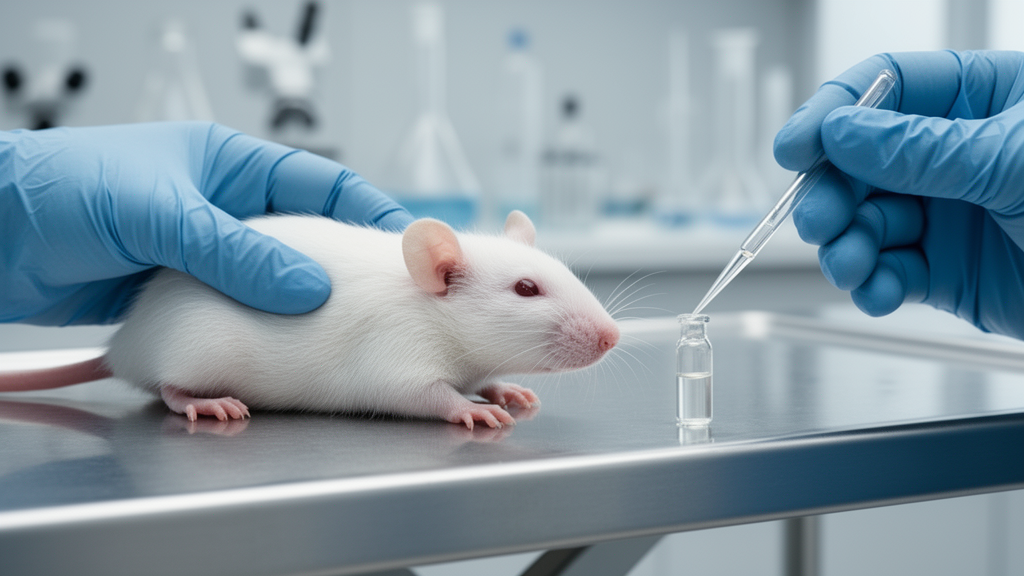
A widely used grass-selective herbicide can accumulate in both pregnant mothers and their developing fetuses, according to a new study in Wistar rats that tracked the chemical’s journey through maternal tissues and across the placenta. The research, published in Environmental Science and Pollution Research, examined haloxyfop-R-methyl, an aryloxyphenoxypropionate herbicide prized by farmers for its ability to kill grassy weeds without harming broadleaf crops. The findings suggest that when pregnant animals are exposed to this compound, it does not remain confined to maternal circulation but instead reaches fetal organs, including the liver, lung, brain, and spleen, at concentrations that vary depending on when during gestation the exposure occurs.
The research team, led by Abdurakhmonova Mashkhura Javdatovna of Andijan State Pedagogical Institute in Uzbekistan together with colleagues at several Uzbek institutions and Muhammad Waheed of the University of Okara in Pakistan, designed the experiment around a deceptively simple question: where does the herbicide go once it enters a pregnant body, and what does it do there? To answer it, pregnant Wistar rats received a single oral dose of haloxyfop-R-methyl at one-tenth of the dose lethal to half of exposed animals, a sublethal level intended to model realistic environmental exposure rather than acute poisoning. Crucially, the timing of that dose was varied across three groups, with animals dosed on gestational day 3, gestational day 13, or gestational day 17, spanning the earliest stages of embryonic development through late organogenesis.
On gestational days 20 and 21, near the end of the roughly three-week rat pregnancy, the researchers collected liver, lung, spleen, and brain tissue from both mothers and fetuses and quantified herbicide residues using liquid chromatography coupled with tandem mass spectrometry, the gold-standard analytical technique for trace contaminant detection. The method’s performance was rigorous: calibration curves showed strong linearity, with slopes of 93,384.20 and 97,181.37 and uncentered R-squared values of 0.99993 and 0.99978, meaning the instrument’s signal tracked concentration almost perfectly across the measured range. Control animals showed no detectable herbicide, confirming that the signal in treated animals came from the experimental exposure rather than background contamination.
The residue data revealed a striking pattern. Haloxyfop-R-methyl was present in every maternal and fetal tissue examined, demonstrating that the compound crosses the placenta efficiently and distributes widely through fetal circulation. Concentrations differed among the three exposure-timing groups, with the highest levels appearing in animals dosed latest in pregnancy. In the gestational day 17 group, maternal liver reached 0.619 plus or minus 0.050 micrograms per gram and maternal lung reached 0.529 plus or minus 0.041 micrograms per gram, the highest maternal values recorded. Fetal tissues followed the same trend, with fetal liver peaking at 0.419 plus or minus 0.035 micrograms per gram and fetal lung at 0.405 plus or minus 0.020 micrograms per gram in that same late-exposure group.
Perhaps the most consequential metric was the fetal-to-maternal residue ratio, which expresses how much chemical accumulates in fetal tissue relative to the corresponding maternal tissue. These ratios were highest in several organs in the gestational day 17 group, particularly the lung, liver, and brain. A ratio approaching or exceeding parity means the fetus is not merely passively receiving trace amounts but is accumulating the compound at concentrations comparable to its mother’s, whose liver and kidneys would normally be expected to handle the bulk of detoxification. The elevated brain ratios are especially noteworthy because the developing nervous system is uniquely vulnerable during organogenesis, and the blood-brain barrier that protects the adult brain is still immature in fetal life.
Residue burden was only half of the story. In a parallel experiment, the team measured three standard clinical biomarkers of liver injury in maternal plasma: alanine aminotransferase, or ALT; aspartate aminotransferase, or AST; and total bilirubin. These enzymes and pigments are workhorses of clinical hepatology. ALT and AST leak into the bloodstream when hepatocytes, the liver’s metabolic workhorse cells, are damaged or dying, while bilirubin rises when the liver’s capacity to process heme breakdown products is compromised. Across all three exposure windows, haloxyfop-R-methyl exposure elevated all three biomarkers, with the highest values again occurring in the gestational day 17 group at terminal sampling. The pattern indicates genuine hepatic biochemical injury, not merely chemical presence, and it appeared at a dose well below the lethal threshold.
The authors are careful to flag an important limitation of the timing comparison. Because all groups were sampled on the same gestational days, 20 and 21, the interval between dosing and sampling differed across groups. Animals dosed on day 3 had roughly eighteen days for the herbicide to be metabolized and cleared before measurement, while animals dosed on day 17 had only three or four. The observed differences among exposure-timing groups therefore cannot cleanly distinguish whether late gestation is intrinsically more vulnerable, or whether the higher residues simply reflect less time for elimination. This confound does not undermine the central findings, that the herbicide reaches fetal tissues and injures the maternal liver, but it does temper interpretation of the window-specific differences.
The study also tested a potential countermeasure. The researchers co-administered two plant-derived flavonoids, narcissin and sophoroflavonoside, alongside the herbicide and measured whether they could blunt the biochemical damage. Flavonoids are a large family of polyphenolic plant compounds known for antioxidant and anti-inflammatory properties, and prior work by some of the same authors had suggested they might protect liver mitochondria from pesticide-induced dysfunction. In this experiment, both compounds reduced the pesticide-induced elevations in ALT, AST, and bilirubin, but sophoroflavonoside showed greater protective efficacy across most endpoints, with particularly strong effects on bilirubin in the gestational day 3 group and AST in the gestational day 13 group. Standardized effect-size analysis confirmed that the herbicide produced large effects on the biomarkers and that the flavonoid treatments produced measurable, though incomplete, correction.
Why does this matter beyond the laboratory? Haloxyfop belongs to a class of herbicides whose residues are regulated through maximum residue limits set by food safety authorities, including a targeted review of haloxyfop-P limits by the European Food Safety Authority in 2022. Regulatory risk assessment for pesticides has historically focused on adult toxicity and occupational exposure, with developmental exposure windows receiving less granular attention. Studies like this one, which map residue distribution across maternal and fetal organs at specific gestational stages, feed into the tissue residue approach in toxicology, a framework that argues toxicity is better predicted by the amount of chemical actually present in target tissues than by the external dose an animal receives. By pairing residue quantification with clinical biomarkers, the study offers a template for that integrated approach.
Several caveats frame the translation to human health. Rats are not humans, and the pharmacokinetics of haloxyfop-R-methyl, including its ester hydrolysis to the active acid and its species-dependent induction of peroxisome proliferation documented in earlier work, differ across mammals. The single-dose design, while elegant for isolating timing effects, does not capture the repeated low-level exposures that characterize real-world dietary residue intake. And the flavonoid protection, while encouraging, was partial rather than complete, and the doses and mechanisms in rats cannot be directly prescribed as a human intervention. What the study does establish firmly is that a sublethal gestational dose of a common herbicide distributes into fetal organs, produces measurable maternal liver injury, and that timing of exposure shapes the residue profile. For a chemical applied to food crops worldwide, that combination of placental transfer and hepatic injury at one-tenth of the lethal dose is a data point that regulators, farmers, and expectant parents alike will want to watch closely as follow-up studies attempt to disentangle gestational-stage vulnerability from simple clearance kinetics.
Subject of Research: Gestational exposure to the herbicide haloxyfop-R-methyl and its maternal and fetal residue distribution and hepatic toxicity in Wistar rats
Article Title: Gestational exposure to haloxyfop-R-methyl drives maternal and embryonic residue burden and hepatic biochemical injury in Wistar rats
Article References: Gestational exposure to haloxyfop-R-methyl drives maternal and embryonic residue burden and hepatic biochemical injury in Wistar rats. (n.d.). https://doi.org/10.1007/s11356-026-38308-4
Image Credits: AI Generated
DOI: 10.1007/s11356-026-38308-4
Keywords: haloxyfop-R-methyl, herbicide, pregnancy, placental transfer, pesticide residues, hepatotoxicity, Wistar rats, LC-MS, flavonoids, narcissin, sophoroflavonoside, developmental toxicology
Cite Scienmag News
Harold Sullivan. (October 15, 2026). Common Herbicide Crosses the Placenta in Rats, Raising Fetal Exposure Concerns. Scienmag. https://scienmag.com/common-herbicide-crosses-the-placenta-in-rats-raising-fetal-exposure-concerns/
Harold Sullivan. "Common Herbicide Crosses the Placenta in Rats, Raising Fetal Exposure Concerns." Scienmag, 15 October 2026, https://scienmag.com/common-herbicide-crosses-the-placenta-in-rats-raising-fetal-exposure-concerns/. Accessed 15 October 2026.
Harold Sullivan. "Common Herbicide Crosses the Placenta in Rats, Raising Fetal Exposure Concerns." Scienmag. October 15, 2026. https://scienmag.com/common-herbicide-crosses-the-placenta-in-rats-raising-fetal-exposure-concerns/