


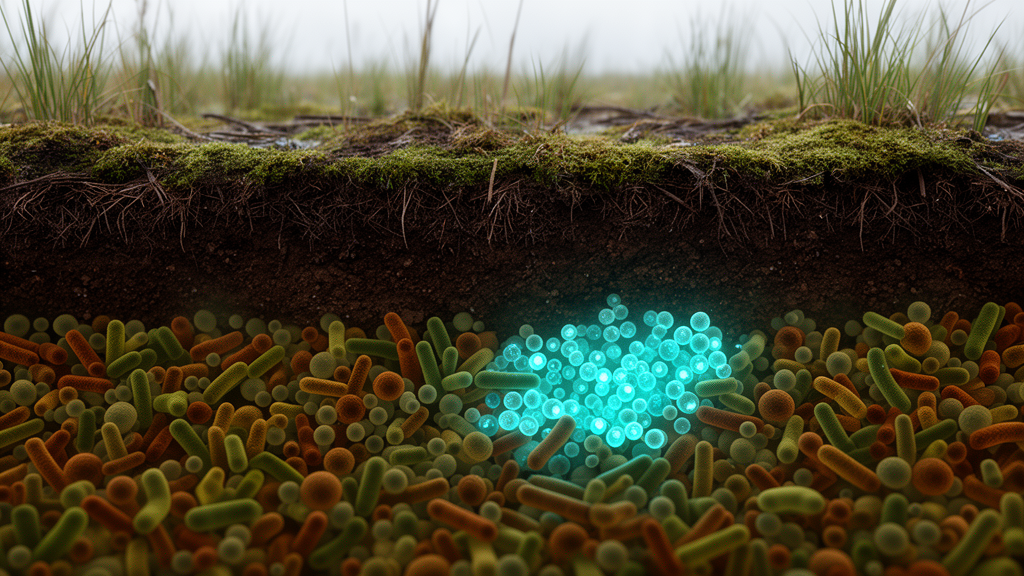
Beneath the mossy surface of a small acidic fen in northern Bavaria, one of the richest stores of unexplored chemical diversity ever catalogued in a single microbial community has been sitting quietly, mostly switched off. A team of researchers from Friedrich Schiller University Jena, the University of Delaware, and Heinrich Heine University Düsseldorf applied a combined metagenomic and metatranscriptomic approach to peat collected from the Schlöppnerbrunnen fen, and what they found challenges long-standing assumptions about where and when microbes deploy their chemical arsenals. From just seven metagenomes, the team recovered 9,694 biosynthetic gene clusters, the colocalized and coregulated gene groups that encode secondary metabolites such as antibiotics, antifungals, and metal chelators. Yet only a small slice of this enormous potential was actually being expressed in the living peat.
The study site, the Schlöppnerbrunnen fen, is a roughly 0.8-hectare wetland underlain by granite, with acidic soils of around pH 4.7 and groundwater rich in iron(II) feeding the system from below. Its hydrology creates steep vertical redox gradients: an oxic surface layer gives way to permanently anoxic, water-saturated horizons within tens of centimetres. These gradients are accompanied by shifts in nutrient availability and competition for electron acceptors, conditions that in laboratory cultures are known to trigger secondary metabolite production. That parallel made the fen an ideal natural laboratory for asking whether environmental heterogeneity filters the broad biosynthetic repertoires that microbes carry in their genomes.
The researchers sectioned peat cores at 5-centimetre intervals from 5 to 30 centimetres depth, taking a second core one metre away for replication, and sequenced both DNA and RNA. From the metagenomes they reconstructed 573 metagenome-assembled genomes, or MAGs, of at least 70 percent completeness and less than 10 percent contamination, with a median completeness of 94.4 percent. The community was dominated by Acidobacteriota, which made up 30 to 43 percent of the microbiome, followed by Pseudomonadota at 16 to 19 percent, with Actinomycetota, Verrucomicrobiota, and the enigmatic Patescibacteriota also present. As expected, the relative abundance of these groups shifted markedly with depth: aerobic taxa declined while Desulfobacterota, Archaea, and Pseudomonadota increased toward the anoxic layers, reflecting a transition from predominantly aerobic to anaerobic assemblages.
Using antiSMASH to mine contigs longer than 5 kilobase pairs, the team identified 9,694 biosynthetic gene clusters, of which 1,594 were considered complete. The average cluster spanned about 31 kilobase pairs, and the largest was a 100,738-base-pair hybrid combining nonribosomal peptide synthetase and type I polyketide synthase elements. Because short-read assemblies can fragment large modular clusters, the researchers applied a careful sensitivity analysis, flagging incomplete NRPS, PKS, and hybrid clusters that lacked any biosynthetic core gene more than 5 kilobases from a contig end as potential overestimates. Even after this conservative filtering, the peatland microbiome still contained 3,452 gene cluster families from only seven metagenomes, a diversity comparable in scale to surveys built from tens to thousands of samples spanning the global ocean, Antarctic soils, the rumen, and agricultural soils.
The novelty of this chemical repertoire was striking. When compared against the BGC Atlas, a reference database comprising nearly two million clusters from more than 35,000 metagenomic datasets, only 233 peatland clusters, or 2.9 percent, fell into existing gene cluster families. The remaining 97.1 percent had no close relatives in this global reference. A comparison against MIBiG, which holds experimentally validated clusters, was even more sobering: just 10 clusters, 0.1 percent, showed close similarity, with matches to known compounds such as Michiganin A, microcin B17, phazolicin, and kawaguchipeptin A. Virtually the entire peatland biosynthetic repertoire lies outside both genome-derived and experimentally characterized families, marking peatlands as a major reservoir of unexplored chemistry with obvious implications for bioprospecting.
The product classes were diverse and, in part, unexpected. Ribosomally synthesized and post-translationally modified peptides, known as RiPPs, dominated with 1,361 clusters, followed by terpenes at 620, NRPS clusters at 510, PKS clusters at 367, and 107 NRPS-PKS hybrids. Notably, 40 gene cluster families came from Archaea, including Thermoproteota clusters encoding darobactin-like RiPPs, a class with reported antibiotic activity against Gram-negative bacteria, and hydrogen cyanide biosynthesis genes, whose product inhibits cytochrome c oxidases and nitrogenases. These findings suggest archaeal secondary metabolites may confer competitive or defensive advantages in redox-dynamic habitats, extending the known boundaries of secondary metabolism well beyond the classical bacterial producers.
Then came the central surprise: most of this potential was silent. At the community level, only 13.7 percent of clusters showed transcription of at least one biosynthetic core gene. At the genome level, just 8.8 to 27 percent of the biosynthetic potential of the active community was expressed. The most BGC-rich organisms were largely quiet. Two Alphaproteobacteria MAGs each carried 24 clusters, including five PKS, five NRPS, and five RiPP clusters, and two Bdellovibrionota MAGs carried 17 and 18 clusters, yet no transcripts from biosynthetic genes were detected in any of these talented producers. Across all genomes, the researchers found a clear inverse relationship between repertoire size and the fraction of clusters active, with a Spearman correlation of −0.522, indicating that genomes with smaller repertoires tended to express a larger share of what they carried.
The organisms doing most of the expressing were not the ones with the biggest arsenals. Acidobacteriota, despite holding only moderate repertoires, accounted for over half of all BGC transcription, an average of 68.2 percent of expressed clusters per sample while representing about 40.6 percent of the metagenomic community. After normalizing for abundance, they remained consistently enriched, roughly 1.7-fold above what their community share would predict. By contrast, Pseudomonadota contributed less BGC transcription than expected from their abundance. The trait comparison between these two phyla was revealing: predicted doubling times, estimated from codon-usage bias, were significantly shorter in Pseudomonadota, while Acidobacteriota encoded significantly more carbohydrate-active enzymes associated with complex carbon degradation, averaging 152.6 annotations per genome versus 69.9 in Pseudomonadota. Acidobacteriota also showed substantially higher in situ expression of these enzymes, particularly glycoside hydrolases.
That last detail turned out to be the key to the whole pattern. Across all active BGC-encoding MAGs, the fraction of expressed clusters was strongly and positively associated with glycoside hydrolase expression, a relationship confirmed by linear mixed-effects models with genome identity and depth as random effects. In a mixed logistic model, greater glycoside hydrolase expression was associated with a nearly sixfold increase in the odds that a genome expressed its BGCs, and with expression of a larger fraction of its encoded repertoire. Fully 97 percent of BGC-expressing observations also showed glycoside hydrolase expression. Redox context, by contrast, was heterogeneous: BGC expression occurred alongside microoxic, aerobic, and anaerobic metabolic signatures with no single redox profile shared across active taxa. Secondary metabolism in the fen was not governed by a universal stress or oxygen cue but was woven into the carbon-processing activity of individual organisms.
The broader message is a caution and an invitation at once. Cataloguing biosynthetic gene clusters, the study shows, is not enough to infer ecological function; genomic capacity poorly predicts realized chemistry, and metabolic strategy, carbon-processing activity, and taxon-specific life history are the real determinants of what gets made. Even the sparse expression that did occur mirrors the silence familiar from cultured Streptomyces, where up to 90 percent of clusters stay off under standard conditions. Yet expression was detected at every depth, including deeper anoxic layers, and even from Desulfobacterota, the fen’s oxygen-sensitive sulfate reducers, showing that secondary metabolism persists in energy-limited, oxygen-poor environments rather than being confined to oxic ones. BGCs, it turns out, are everywhere. The environment selects.
Subject of Research: Diversity and in situ expression of microbial biosynthetic gene clusters along a peatland redox gradient
Article Title: High diversity but limited expression of biosynthetic gene clusters in a peatland microbial community
Article References: Human, Z. R., Hoover, R., Chan, C., Küsel, K., & Wegner, C.-E. (2026). High diversity but limited expression of biosynthetic gene clusters in a peatland microbial community. Nature Communications, 17(1), Article 10529. https://doi.org/10.1038/s41467-026-78121-8
Image Credits: AI Generated
DOI: 10.1038/s41467-026-78121-8
Keywords: biosynthetic gene clusters, metagenomics, metatranscriptomics, peatland microbiome, Acidobacteriota, secondary metabolites, natural products, redox gradient, carbon cycling, glycoside hydrolases, MAGs, microbial ecology
Cite Scienmag News
Juliet Wilcox. (October 15, 2026). Peatland Microbes Harbor Nearly 10,000 Hidden Gene Clusters but Switch On Only a Fraction. Scienmag. https://scienmag.com/peatland-microbes-harbor-nearly-10000-hidden-gene-clusters-but-switch-on-only-a-fraction/
Juliet Wilcox. "Peatland Microbes Harbor Nearly 10,000 Hidden Gene Clusters but Switch On Only a Fraction." Scienmag, 15 October 2026, https://scienmag.com/peatland-microbes-harbor-nearly-10000-hidden-gene-clusters-but-switch-on-only-a-fraction/. Accessed 15 October 2026.
Juliet Wilcox. "Peatland Microbes Harbor Nearly 10,000 Hidden Gene Clusters but Switch On Only a Fraction." Scienmag. October 15, 2026. https://scienmag.com/peatland-microbes-harbor-nearly-10000-hidden-gene-clusters-but-switch-on-only-a-fraction/


