


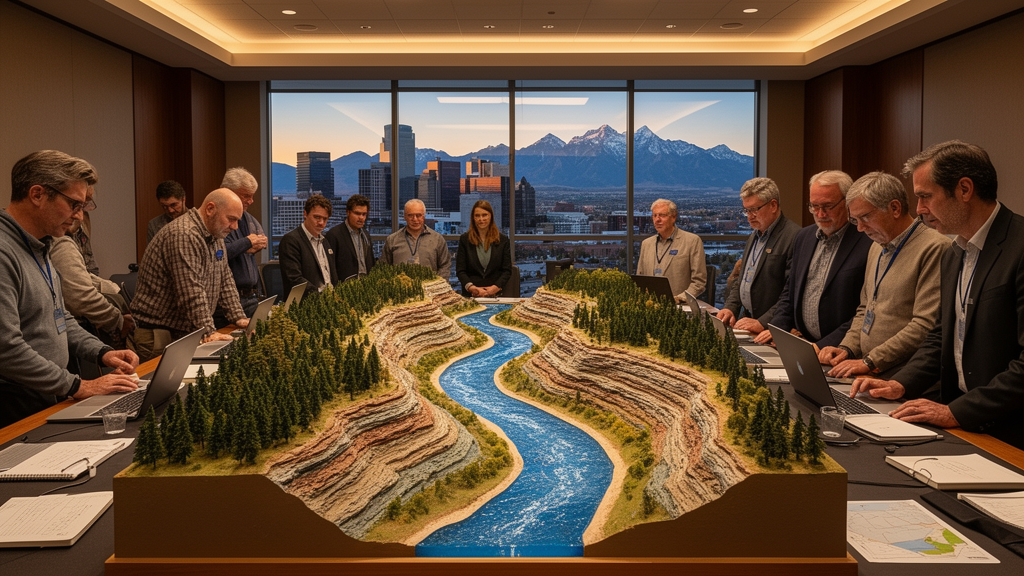
Water is the resource that defines civilization, and right now it is changing faster than at almost any point in the human record. Some of those changes announce themselves quietly, in slowly declining groundwater tables or shifting snowmelt timing that only decades of careful measurement can reveal. Others arrive with terrifying suddenness, as flash floods tearing through mountain canyons or hurricanes pushing storm surge far inland. This week, geologists from across the United States and around the world have gathered in Denver, Colorado, for GSA Connects 2026, the Geological Society of America’s annual meeting, where one of the event’s three scientific themes confronts this challenge head-on. The theme, Riverscapes in Transition: Dynamics, Hazards, and Human Futures, is bringing together researchers who study how changing water resources reshape the natural environment, influence communities, and force a reckoning with how societies prepare for an uncertain hydrological future.
The choice of venue is more than logistical convenience. Denver sits at the foot of the Colorado Rockies, a landscape where water issues are not abstract academic questions but daily realities. Lon Abbott, GSA Connects 2026 General Chair and Teaching Professor of Distinction in Earth Science at the University of Colorado Boulder, captured this in his welcome letter to attendees. Water is humanity’s most critical resource of all, and the foot of the Colorado Rockies, where geoscientists work daily to address myriad water issues from drought to acid-mine drainage to flash flooding, is a fitting place to hold the Riverscapes in Transition themed sessions that will probe the connection between humans and water, Abbott wrote. The statement frames the meeting’s central premise: the relationship between people and water is dynamic, reciprocal, and increasingly strained, and understanding it requires the full toolkit of the geosciences.
At the heart of the theme lies fluvial geomorphology, the science of how rivers move water and sediment and, in doing so, sculpt the surface of the planet. Two sessions held earlier in the week, organized in two parts under the title Riverscapes in Transition: Advances in Fluvial Geomorphology, Sediment Transport, Deposition, River Health, and Urban Rivers, explored how river systems transport their sediment loads, reshape their channels, and respond to both natural and human-driven disturbances. This is a field that has been transformed in recent decades by technology. Where early geomorphologists relied on surveying equipment and painstaking field measurements, today’s researchers combine remote sensing, field observations, and numerical modeling to track river behavior across spatial scales ranging from a single gravel bar to entire drainage basins, and across time scales from a single flood pulse to millennia of landscape evolution.
The technical questions at stake are far from academic. Sediment transport, for instance, governs whether a river builds up its floodplain or incises into it, whether reservoirs behind dams fill with silt or remain viable for generations, and whether coastal deltas that host hundreds of millions of people receive the sediment they need to keep pace with rising seas. River health, meanwhile, depends on the physical complexity of channels and floodplains, the pools and riffles and side channels that aquatic ecosystems require. When rivers are straightened, armored, or cut off from their floodplains, that complexity collapses, and the ecological consequences ripple through entire watersheds. The Denver sessions brought together scientists working on all of these fronts, using tools such as high-resolution topographic surveys, sediment flux measurements, and landscape evolution models to understand how rivers behave under stress and how they might recover.
But the theme deliberately extends beyond river channels themselves. Other sessions at the meeting approach the human-water relationship through landscape modeling, groundwater contaminants, and the hazards associated with landslides and hurricanes. This breadth reflects a growing recognition among geoscientists that water-related processes are not confined to the visible ribbon of a river. Groundwater, hidden beneath the surface, supplies a substantial share of the world’s drinking water and irrigation, yet it is vulnerable to contamination from industrial, agricultural, and mining sources. Landslides, often triggered by intense rainfall or by the saturation of slopes destabilized by wildfire, are among the deadliest water-related hazards. Hurricanes concentrate the ocean/land interface problem into a single violent event, dumping rain, eroding coastlines, and flooding communities far from any river. Understanding these processes requires the same combination of fieldwork, monitoring, and modeling that drives modern geomorphology, applied to systems where the stakes for human safety are immediate and severe.
Field trips are a signature feature of any GSA meeting, and this year’s offerings tie the Riverscapes in Transition theme directly to the landscapes of Colorado. Trips explore glacial deposits and mountain hydrology along the Colorado Front Range, the densely populated transition zone where the Rocky Mountains meet the Great Plains and where snowpack accumulation in the high country ultimately feeds the rivers that tens of millions of people depend on. Another trip examines the role of beaver dams in shaping stream environments, a topic that has surged in scientific and public interest as researchers document how these natural engineers slow runoff, trap sediment, raise water tables, and create habitat, sometimes offering a low-cost form of stream restoration that mimics processes humans once spent millions of dollars trying to replicate with heavy machinery.
Perhaps the most immediately relevant excursion, however, takes place close to the Colorado Convention Center itself. A field trip exploring Denver’s urban riverscapes stops at small creeks, range-front streams, and the South Platte River, examining how anthropogenic changes to these waterways affect their health and resilience. Urban rivers face a distinctive set of pressures. Impervious surfaces such as roads, parking lots, and rooftops prevent rainwater from soaking into the ground, so storm runoff arrives at streams faster and in greater volumes, scouring channels and delivering pollutants. Historic channelization and burial have erased habitat. Yet the Denver trip also highlights a success story: effective trout stream rehabilitation efforts and what they reveal about how rivers can recover from past disturbances when restoration is grounded in a sound understanding of fluvial process. For the scientists walking these urban corridors, the city itself becomes a laboratory for studying how rivers respond to, and sometimes rebound from, the most intense form of human modification.
What unites the research presented under this theme, despite its diversity of landscapes, methods, and challenges, is a single constant: rivers have a remarkable power to reshape landscapes, and their changes have direct consequences for the communities that depend on them. A river that shifts its course can undermine infrastructure built on its banks. A floodplain that no longer floods naturally can lose the sediment and nutrients that once sustained agriculture. A channel that incises can drop the water table across an entire valley, turning wetland to desert. Conversely, restored streams running through Denver neighborhoods demonstrate that informed intervention can reverse some of this damage. The science of changing riverscapes, from flash floods rushing through Front Range canyons to the slow recovery of rehabilitated urban creeks, tells the story of how humanity’s relationship with water is changing too.
That story is likely to grow more urgent. As climate and land-use change alter where, when, and how much water is available, the extremes of flood and drought are expected to intensify in many regions, stressing infrastructure, ecosystems, and the institutions that manage water. Meetings like GSA Connects 2026 serve as a critical venue where the observational record, the process models, and the hazard assessments produced by geoscientists are shared, debated, and translated into knowledge that planners, engineers, and policymakers can use. The Riverscapes in Transition theme makes the case that understanding rivers is not a narrow technical pursuit but a matter of human futures, because every landscape shaped by flowing water is also a landscape shaped by the people who live along it, draw from it, and depend on its continued capacity to sustain them.
Subject of Research: Fluvial geomorphology and changing water resources, including floods, drought, and river restoration, presented at the GSA Connects 2026 meeting
Article Title: Riverscapes in transition: Geoscientists gather in Denver to explore how changing water resources shape landscapes and lives
Article References: Riverscapes in transition: Geoscientists gather in Denver to explore how changing water resources shape landscapes and lives. (n.d.). Original publication
Image Credits: AI Generated
DOI: Not provided
Keywords: riverscapes, fluvial geomorphology, sediment transport, floods, drought, river health, urban rivers, groundwater, river restoration, GSA Connects 2026, Colorado Front Range, water resources
Cite Scienmag News
Violet Maxwell. (October 15, 2026). Riverscapes in Transition: Geoscientists Meet in Denver to Decode Water’s Future. Scienmag. https://scienmag.com/riverscapes-in-transition-geoscientists-meet-in-denver-to-decode-waters-future/
Violet Maxwell. "Riverscapes in Transition: Geoscientists Meet in Denver to Decode Water’s Future." Scienmag, 15 October 2026, https://scienmag.com/riverscapes-in-transition-geoscientists-meet-in-denver-to-decode-waters-future/. Accessed 15 October 2026.
Violet Maxwell. "Riverscapes in Transition: Geoscientists Meet in Denver to Decode Water’s Future." Scienmag. October 15, 2026. https://scienmag.com/riverscapes-in-transition-geoscientists-meet-in-denver-to-decode-waters-future/


