


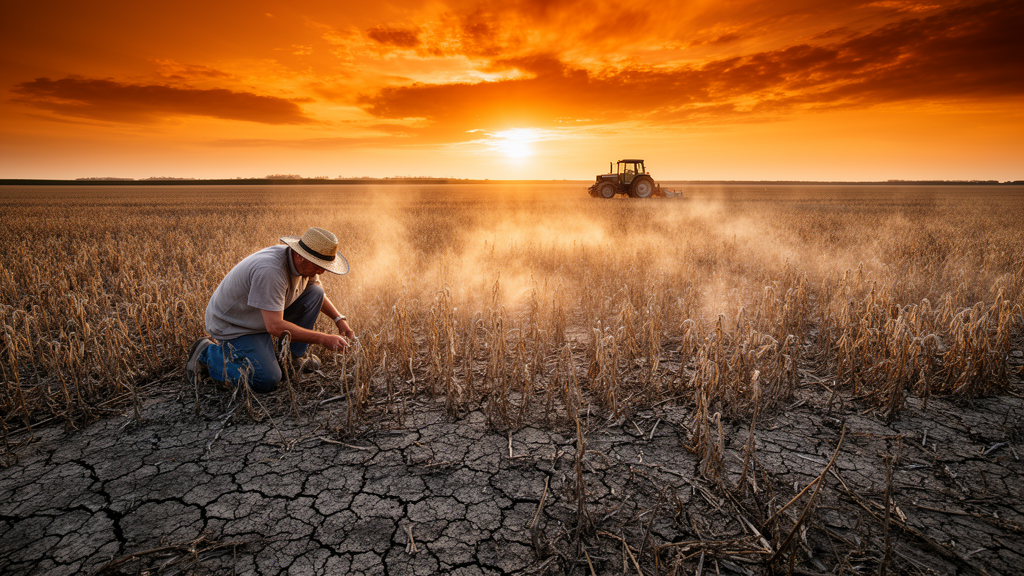
Compound drought and heatwave events—situations in which severe soil-moisture deficits and extreme heat coincide in space and time—have long been treated by hydrologists and climate scientists as essentially stationary hazards: they appear over a region, intensify, and decay in roughly the same place. A new study published in Nature Communications dismantles that assumption. By tracking more than 2,500 such events across the global land surface, researchers led by Amitesh Sabut and Ashok Mishra of Texas A&M University, together with Ruby Leung of Pacific Northwest National Laboratory and Dara Entekhabi of the Massachusetts Institute of Technology, show that these compound extremes systematically migrate, sometimes by hundreds of kilometers over the course of a single event. The finding reframes compound drought–heatwave risk as a moving target, with profound implications for how water managers, farmers, and emergency planners prepare for some of the most damaging weather-related disasters on Earth.
The methodological heart of the study is a three-dimensional connected-component labeling approach, abbreviated CC3D, borrowed in spirit from image-processing and computer vision. Instead of analyzing drought and heatwave conditions independently, the researchers constructed a three-dimensional data cube in which two dimensions represent space and the third represents time. Within that cube, they identified contiguous clusters of grid cells that simultaneously satisfy drought and heatwave thresholds, treating each cluster as a single coherent object—an event with a birth, a trajectory, a lifetime, and a death. This is the same conceptual machinery used to track thunderstorm cells in radar imagery, applied here to the coupled signature of heat and moisture stress. The approach allows each event to be characterized not only by its intensity and duration but also by its spatial footprint at every time step and by the distance it travels between its origin and its eventual dissipation.
The statistics that emerge from this tracking exercise are striking. Most contiguous compound drought–heatwave events persist for six to twelve days, yet during that short lifetime they can displace by up to roughly 500 kilometers. At their peak, individual events can blanket daily spatial extents of two to five hundred thousand square kilometers—an area comparable to a large European country. Crucially, the analysis reveals a scaling relationship: the larger and longer-lasting an event is, the farther and faster it tends to travel. This coupling between event magnitude and mobility means that the most severe compound extremes are precisely the ones most likely to sweep across new territory, expanding the spatial footprint of combined heat and moisture stress well beyond where the hazard first ignited.
Geographically, the migration signal is strongest in the Northern Hemisphere mid-latitudes, and the dominant direction of travel is eastward. That preference is not accidental. The mid-latitudes sit beneath the storm tracks and the westerly flow of the extratropical circulation, so anomalies embedded in the jet stream—blocking highs, quasi-stationary ridges, and the wave patterns that steer heat domes—tend to propagate downstream from west to east. When a drought–heatwave event is anchored to such a circulation feature, its spatial expression moves with the feature. The study links the observed displacement of compound events to these evolving large-scale atmospheric circulation patterns, providing a physical explanation for why events behave like traveling objects rather than fixed blights on the landscape.
But circulation alone is only half the story. The researchers show that the migration of compound drought–heatwave events is reinforced by downstream drying—a feedback loop in which the moving event itself helps create the conditions it needs to persist. As an event advances, reduced moisture transport leaves the air downwind drier, and strengthened land–atmosphere coupling allows soil-moisture deficits to deepen. In a tightly coupled system, a parched land surface suppresses evaporation, so more of the sun’s energy goes into heating the air rather than into latent heat flux, amplifying temperature extremes. That heat, in turn, accelerates drying. The result is a self-sustaining propagation mechanism: the event carries its own drought precondition eastward, priming each new region it touches for the heat stress that follows. This interplay between moisture transport and land–atmosphere feedbacks is what gives compound events their remarkable coherence as traveling structures.
Perhaps the most consequential finding is the identification of emerging hotspots where compound drought–heatwave migration potential is increasing. The study singles out the European Plains, western North America, the Amazon, the West African Sahel, Central Asia, and northern Australia. These regions span a remarkable range of climates—from the moisture-laden Amazon to the semi-arid Sahel—yet they share conditions that favor mobile compound extremes: extensive flat terrain aligned with prevailing flow, strong land–atmosphere coupling, and sensitivity of the surface water balance to modest shifts in precipitation and temperature. The fact that hotspots are emerging rather than merely persisting suggests a spatial reorganization of risk under a changing climate, with regions that previously experienced isolated droughts or isolated heatwaves increasingly hosting compound events that arrive from upwind.
The agricultural implications are immediate and sobering. The authors highlight that increasing migration potential over agricultural landscapes may expand exposure to compound heat and moisture stress, with particular concern for grazing-dependent regions vulnerable to pastureland-to-scrubland transitions. When a compound event sweeps through rangeland, the combination of depleted soil moisture and extreme heat can push perennial grasses past physiological thresholds, accelerating the conversion of productive pasture into woody scrub—a transition that is difficult and expensive to reverse. Unlike a stationary drought, which degrades conditions in one place over weeks or months, a migrating compound event can deliver acute stress to a sequence of grazing regions within days, leaving herders and livestock managers little time to move animals or secure fodder. Similar logic applies to rain-fed croplands, where a traveling event can strike several breadbaskets in a single growing season.
The study also carries a methodological message for the hazard-modeling community. Risk assessments, insurance products, and early-warning systems frequently treat droughts and heatwaves as spatially fixed hazards, compiling statistics of exceedance for defined administrative or hydrological units. If compound events systematically displace by hundreds of kilometers, such frameworks will systematically misallocate risk—underestimating exposure in regions that lie downstream of current hotspots and overestimating it where events merely originate. Tracking-based approaches like CC3D offer a path forward: by treating extremes as objects with trajectories, forecasters can in principle anticipate not only where a compound event will form but where it is likely to travel, buying lead time for the regions in its path. Embedding this object-based perspective into seasonal prediction systems and coupled land–atmosphere models is an obvious next step for the field.
What makes the work resonate beyond hydrology is the way it captures a shift in how scientists think about climate extremes. For decades, the discipline has moved from analyzing single hazards to compound ones, from fixed locations to connected systems, and from static climatologies to evolving risk landscapes. This study pushes that evolution another step: the hazard itself is in motion. As global warming intensifies both drought and heat extremes and alters the circulation patterns that steer them, the corridors along which compound events travel may widen and shift, redrawing the map of vulnerability. For the millions of people who depend on the rain-fed pastures and croplands of the European Plains, the Sahel, Central Asia, and beyond, the message is that the next compound drought–heatwave may not come to them—it may already be on its way from somewhere else.
Subject of Research: Migration and expanding spatial footprint of compound drought–heatwave events across global land regions
Article Title: Global expansion of compound drought–heatwave risk
Article References: Global expansion of compound drought–heatwave risk. (n.d.). https://doi.org/10.1038/s41467-026-78045-3
Image Credits: AI Generated
DOI: 10.1038/s41467-026-78045-3
Keywords: compound events, drought, heatwave, climate change, land–atmosphere coupling, hydrology, natural hazards, agriculture, water security, atmospheric circulation, CC3D tracking, ecosystems
Cite Scienmag News
Violet Maxwell. (October 14, 2026). Compound drought–heatwave events are on the move, and farmland is in their path. Scienmag. https://scienmag.com/compound-drought-heatwave-events-are-on-the-move-and-farmland-is-in-their-path/
Violet Maxwell. "Compound drought–heatwave events are on the move, and farmland is in their path." Scienmag, 14 October 2026, https://scienmag.com/compound-drought-heatwave-events-are-on-the-move-and-farmland-is-in-their-path/. Accessed 14 October 2026.
Violet Maxwell. "Compound drought–heatwave events are on the move, and farmland is in their path." Scienmag. October 14, 2026. https://scienmag.com/compound-drought-heatwave-events-are-on-the-move-and-farmland-is-in-their-path/


