


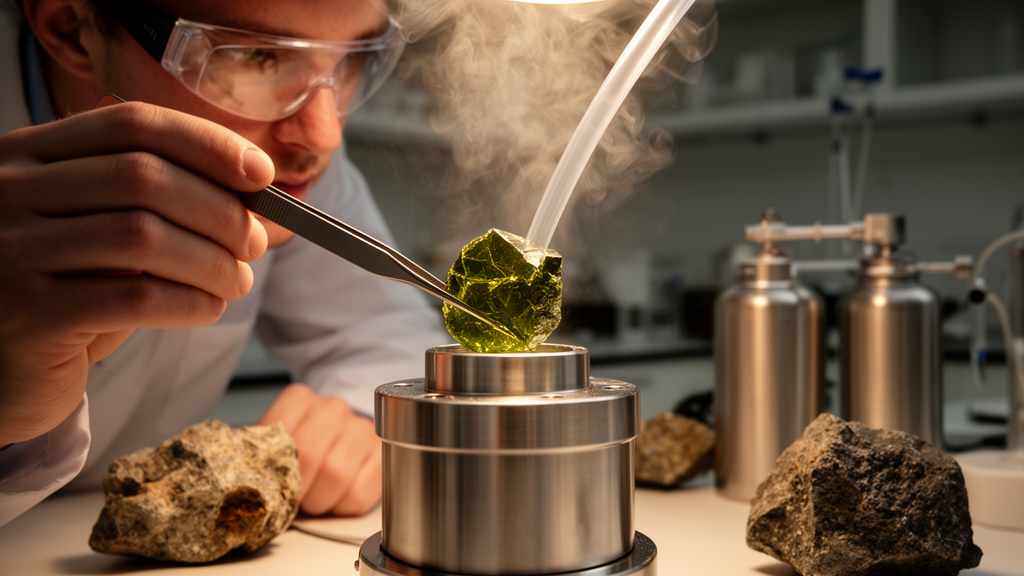
Deep beneath the surface of the planet lies one of the most promising weapons against climate change: rock with the capacity to chemically lock carbon dioxide into solid minerals, permanently and safely. Now a team of researchers in Japan has uncovered the fundamental atomic-scale reason why some of these rocks react with CO2 astonishingly fast while others lag far behind, a discovery that could reshape how engineers design the next generation of carbon storage operations. The study, published in Nature Communications by Zihua Shao, Yunfeng Liang, Gyuhwan Jo, Keisuke Nakamura, and Takeshi Tsuji of the University of Tokyo and ENEOS Xplora Inc., reveals that the secret lies not simply in which metal atoms a mineral carries, but in how those atoms control the reactivity of oxygen at the mineral surface.
Olivine, a magnesium- and iron-rich silicate mineral abundant in ultramafic rocks, has long been celebrated as a candidate for CO2 mineralization. When CO2 dissolved in water encounters olivine, a chain of chemical reactions converts the carbon into carbonate minerals such as magnesite, effectively turning a greenhouse gas into stone. This process, known as mineral carbonation, is attractive because the captured carbon is stored permanently, with no risk of leakage back into the atmosphere over human timescales. Yet the practical challenge has always been speed. Natural weathering of olivine at Earth’s surface takes thousands to millions of years, and even under engineered conditions the reaction rates can vary dramatically depending on the composition of the mineral and the chemistry of the surrounding fluids.
One puzzling observation has stood out in the literature: calcium-bearing olivines, such as the mineral kirschsteinite, appear to react with carbon dioxide far more readily than their magnesium-bearing counterparts, such as the common mineral forsterite. The origin of this striking difference in reactivity has remained poorly understood, and the new study set out to resolve it. Rather than treating the cation itself as the sole actor, the researchers built a multiscale theoretical framework that connects the electronic structure of the mineral surface to the macroscopic dissolution rates that can be measured in the laboratory.
At the heart of the framework is a seemingly humble chemical species: the nonbridging oxygen. In silicate minerals, oxygen atoms either bridge two silicon tetrahedra or dangle from a single silicon atom, the latter being known as nonbridging oxygens. These dangling oxygens are chemically more reactive, and the new work identifies them as the critical oxygen source for the surface reactions that initiate CO2 mineralization. When a CO2 molecule approaches the olivine surface, it is these nonbridging oxygens that participate directly in forming carbonate species, setting the stage for the dissolution of the metal cations and the eventual precipitation of solid carbonate.
The calculations, grounded in density functional theory, revealed that the type of cation modulates the reactivity of these surface oxygens in profound ways. In calcium-bearing olivine, the presence of Ca2+ alters the local electronic environment such that the energy barrier for calcium dissolution is reduced by 60 percent compared with the magnesium analogue. That seemingly modest energetic change has enormous kinetic consequences: the rate of ion release accelerates by six orders of magnitude, a millionfold increase. In chemical kinetics, a millionfold rate difference is the difference between a reaction that finishes in an afternoon and one that grinds on for centuries.
To test whether these atomic-scale predictions hold up at the laboratory scale, the team compared their calculated apparent dissolution rate constants with experimental observations. The agreement was remarkable. The computed rates reproduced the experimentally observed complete conversion of calcium olivine within hours under a carbon dioxide pressure of just one atmosphere, conditions that are mild by the standards of industrial carbonation processes. This cross-scale consistency, from quantum mechanical calculations of bond breaking to bulk conversion measurements in a reactor, provides strong evidence that surface carbonation reactions, rather than bulk transport or precipitation, are the governing bottleneck in olivine carbonation.
The implications of this mechanistic insight extend well beyond explaining a laboratory curiosity. For engineers designing CO2 mineralization systems, the framework offers a predictive basis for selecting and tailoring materials. If the reactivity of a silicate surface can be tuned by controlling the density and environment of nonbridging oxygens, then synthetic materials could be engineered to maximize the availability of these reactive sites, dramatically accelerating carbonation rates without resorting to extreme temperatures or pressures. The same logic applies to natural reservoirs: basaltic and ultramafic formations, which host vast quantities of reactive divalent cations, could be evaluated and ranked according to their surface chemistry rather than merely their bulk composition.
The study also carries a conceptual lesson for geochemistry more broadly. Dissolution rates of silicate minerals have traditionally been parameterized by empirical rate laws that depend on pH, temperature, and solution composition, but the atomic origins of those dependencies have often remained obscure. By demonstrating that cation identity acts on dissolution kinetics through its modulation of oxygen reactivity, the work provides a bridge between electronic structure theory and the macroscopic rate laws used in reactive transport models. Such bridges are essential if models of subsurface carbon storage are to move from descriptive to predictive, allowing operators to forecast how quickly injected CO2 will mineralize in a given formation and to design injection strategies accordingly.
For the global climate effort, the stakes are considerable. Ultramafic rocks are a global resource with vast potential for permanent CO2 mineralization, and basaltic reservoirs such as those already being used for pilot carbon storage projects in Iceland and the Columbia River Basalt Group in the United States have demonstrated that injected CO2 can mineralize within years rather than millennia. Understanding at the atomic level why certain minerals convert so much faster than others gives scientists a lever to pull: the possibility of accelerating the process further, whether through fluid chemistry manipulation, thermal treatment, or the design of engineered reactive materials that mimic the fast-reacting calcium olivines identified in this study.
The research, funded by the Japan Society for the Promotion of Science through KAKENHI grants and by ENEOS Xplora Inc., represents a convergence of quantum chemistry, geochemistry, and reaction engineering aimed squarely at one of the hardest problems in decarbonization: what to do with the CO2 once it is captured. By showing that the answer to rapid mineralization lies in the fine-grained choreography of oxygen atoms at a mineral surface, the Tokyo team has turned a long-standing puzzle into a design principle. As carbon capture and storage infrastructure scales up worldwide, the ability to predict and engineer mineral reactivity from first principles may prove to be one of the quiet but decisive advances that turns permanent geological carbon storage from a promising idea into a dependable industrial reality.
Subject of Research: Atomic-scale mechanisms of olivine surface carbonation and CO2 mineralization kinetics
Article Title: Surface carbonation governs olivine reactivity for rapid CO2 mineralization
Article References: Surface carbonation governs olivine reactivity for rapid CO2 mineralization. (n.d.). https://doi.org/10.1038/s41467-026-78548-z
Image Credits: AI Generated
DOI: 10.1038/s41467-026-78548-z
Keywords: CO2 mineralization, olivine, carbon capture and storage, geochemistry, density functional theory, nonbridging oxygens, dissolution kinetics, ultramafic rocks, carbonate minerals, basalt reservoirs, reaction mechanisms, climate mitigation
Cite Scienmag News
Bethany Barker. (October 14, 2026). Hidden Oxygen Chemistry Explains Why Some Olivine Locks Away CO2 in Hours. Scienmag. https://scienmag.com/hidden-oxygen-chemistry-explains-why-some-olivine-locks-away-co2-in-hours/
Bethany Barker. "Hidden Oxygen Chemistry Explains Why Some Olivine Locks Away CO2 in Hours." Scienmag, 14 October 2026, https://scienmag.com/hidden-oxygen-chemistry-explains-why-some-olivine-locks-away-co2-in-hours/. Accessed 14 October 2026.
Bethany Barker. "Hidden Oxygen Chemistry Explains Why Some Olivine Locks Away CO2 in Hours." Scienmag. October 14, 2026. https://scienmag.com/hidden-oxygen-chemistry-explains-why-some-olivine-locks-away-co2-in-hours/


