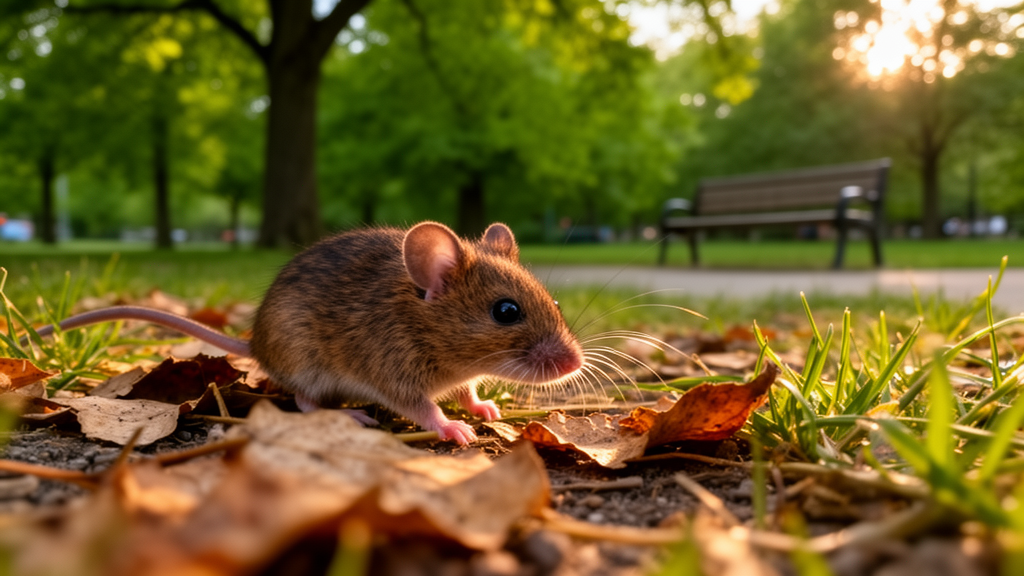
In the wooded ravines and urban wildlands of Toronto and Vaughan, Ontario, a quiet chemical trail is being left behind by one of the pest control industry’s most routine practices. A new study published in Environmental Monitoring and Assessment has found that white-footed mice (Peromyscus leucopus), native rodents that have no part in the human-rodent conflicts that prompt pest control, are picking up residues of second-generation anticoagulant rodenticides, or SGARs, in their livers. The findings, drawn from 111 mice trapped across seven sites near active baiting programs, provide some of the first direct evidence from Ontario that professional rodenticide use spills over into nontarget wild rodents, potentially turning these small mammals into toxic carriers for the owls, hawks, and other predators that eat them.
Second-generation anticoagulant rodenticides were developed in the 1970s after rodents began evolving resistance to first-generation compounds such as warfarin. These newer compounds, including bromadiolone and difethialone, work by interfering with the vitamin K cycle, specifically the VKORC1 enzyme complex, which is essential for recycling vitamin K1 and producing functional clotting factors. A poisoned animal ultimately dies from internal hemorrhaging, but the process is slow, often taking several days. During that time, the animal can accumulate a lethal body burden of the compound and continue moving through the environment. Because SGARs are extremely persistent in liver tissue, with half-lives that can stretch from weeks to months, they do not simply vanish when the target rodent dies. Instead, they linger in the carcass and in the tissues of any animal that consumed the poisoned prey, creating a pathway for secondary poisoning up the food chain.
The research team, led by Luigi F. Richardson and Albrecht I. Schulte-Hostedde of Laurentian University, set out to answer a deceptively simple question: are the bait stations that pest management professionals deploy around buildings in urban and suburban settings leaking poison into the surrounding wild rodent community? To find out, they used snap traps to capture white-footed mice in urban wildland areas of Toronto and Vaughan, deliberately choosing trapping locations near ongoing professional baiting programs that used products containing bromadiolone and difethialone. White-footed mice are an ideal sentinel species for this kind of work. They are abundant, territorial, and have relatively small home ranges, which means that any residue found in their tissues likely reflects local exposure rather than long-distance movement from a contaminated area far away.
The results were unambiguous, if modest in absolute numbers. Out of 111 mice tested, nine carried detectable residues of bromadiolone and two carried difethialone. That is roughly one in ten animals carrying a potent anticoagulant poison in a population that was never the intended target. Concentrations in liver tissue ranged from 0.008 to 0.03 micrograms per gram for bromadiolone and from 0.008 to 0.023 micrograms per gram for difethialone. While these figures may sound vanishingly small, the authors note that concentrations in this range may be sublethal for raptors, meaning that a bird of prey feeding regularly on contaminated mice could accumulate a toxic burden over time even if no single mouse delivers a lethal dose.
Perhaps the most striking spatial finding is how far from the bait stations the contaminated mice were caught. SGAR residues were detected in individuals trapped at distances of 0 meters, 5 meters, 20 meters, 40 meters, 70 meters, and 100 meters from active rodenticide stations. This pattern suggests that the compounds are not simply leaking a few centimeters into the surrounding soil or being picked up only by animals that wander directly into a bait box. Instead, the exposure appears to be distributed across the landscape, likely through a combination of mechanisms. Poisoned commensal rodents may disperse into wildland areas before dying, contaminated carcasses may be scavenged or partially consumed by mice, and bait itself may be carried out of stations by target rodents or other animals. Invertebrates that feed on bait have also been proposed in the broader literature as a potential vector, though the present study did not directly test that pathway.
When the researchers compared the SGAR-positive mice with the SGAR-negative ones, they found no significant differences in sex, age, body condition, distance to the rodenticide source, capture date, or capture site. In other words, there was no obvious profile of the contaminated mouse. Exposure did not concentrate in juveniles, in animals in poor condition, or in individuals trapped closest to bait stations. This lack of pattern is itself informative. It suggests that exposure risk is broadly distributed across the local mouse population rather than confined to a particular demographic subset or a narrow zone around bait deployment. It also complicates any attempt to predict which individuals or areas are most at risk based on simple proximity measures.
That said, the study did note that four of the exposed individuals were classified as being in poor body condition. While the sample size is too small to draw firm conclusions about a causal relationship between rodenticide burden and physical condition, the observation is consistent with the possibility that sublethal exposure imposes physiological costs. Anticoagulant poisoning, even at doses that do not kill outright, can cause chronic internal bleeding, anemia, and reduced fitness. For a wild mouse, those costs could translate into reduced survival or reproductive output, and for the predators that depend on mice as prey, a population of weakened or poisoned rodents represents a hidden hazard embedded in a normal food source.
The broader context of this work is a growing body of evidence that anticoagulant rodenticides have become pervasive contaminants in urban and suburban food webs. Studies in Chicago have documented widespread exposure among common urban mesopredators, while research in British Columbia has found these compounds in endangered American badgers and fishers. Raptors in Ontario have already been shown to carry SGAR residues, and the compounds have been detected in unexpected places, from urban reptiles in Australia to frogs and freshwater fish in Germany. What has been missing, particularly in Ontario, is a clear understanding of the exposure pathways, the specific mechanisms by which the poison moves from a locked bait station to a hawk’s bloodstream. By demonstrating that nontarget wild rodents near professional baiting programs carry SGAR residues, this study helps fill that gap and points to a plausible link between routine pest control and the contamination of predators.
The authors also raise the possibility that some of the exposure they detected may have come from residential SGAR use rather than from the professional baiting programs they focused on. In Ontario, as in many jurisdictions, consumers can purchase rodenticide products for home use, and these products are often deployed with less oversight than professional applications. Distinguishing between professional and residential sources of exposure is methodologically difficult, but the finding underscores that the problem is not confined to any single sector of the pest control industry. It is a landscape-scale contamination issue driven by the sheer volume of persistent anticoagulants being deployed across urban environments, whether by licensed technicians or by homeowners dealing with a mouse in the garage.
The implications for policy and practice are significant. Several jurisdictions, including parts of the United States and the European Union, have already moved to restrict public access to SGARs or to limit their use in certain settings, and Health Canada has imposed restrictions on commercial-class rodenticides in agricultural contexts. This study adds weight to the argument that urban and suburban baiting practices deserve similar scrutiny, particularly near wildland fragments that support native rodent populations and the predators that feed on them. The authors suggest that the pest management industry’s use of rodenticides in these settings is likely causing some degree of nontarget spillover in Toronto and the Greater Toronto Area. As cities continue to densify and the boundary between built and natural habitat grows ever more porous, the question is no longer whether rodenticides reach nontarget wildlife, but how much exposure ecosystems can absorb before the cumulative toll on predators and other wildlife becomes unsustainable. For now, the white-footed mice of Toronto’s ravines are carrying the answer in their livers, one contaminated individual at a time.
Subject of Research: Nontarget exposure of white-footed mice to second-generation anticoagulant rodenticides in urban Ontario
Article Title: Exposure of nontarget white-footed mice (Peromyscus leucopus) to second-generation anticoagulant rodenticides in an urban context
Article References: Exposure of nontarget white-footed mice (Peromyscus leucopus) to second-generation anticoagulant rodenticides in an urban context. (n.d.). https://doi.org/10.1007/s10661-026-16038-x
Image Credits: AI Generated
DOI: 10.1007/s10661-026-16038-x
Keywords: anticoagulant rodenticides, SGARs, white-footed mouse, Peromyscus leucopus, bromadiolone, difethialone, urban wildlife, ecotoxicology, secondary poisoning, Toronto, pest control, nontarget exposure
Cite Scienmag News
Violet Maxwell. (October 14, 2026). Rat Poison Is Reaching Wild Mice in Toronto’s Green Spaces, Study Finds. Scienmag. https://scienmag.com/rat-poison-is-reaching-wild-mice-in-torontos-green-spaces-study-finds/
Violet Maxwell. "Rat Poison Is Reaching Wild Mice in Toronto’s Green Spaces, Study Finds." Scienmag, 14 October 2026, https://scienmag.com/rat-poison-is-reaching-wild-mice-in-torontos-green-spaces-study-finds/. Accessed 14 October 2026.
Violet Maxwell. "Rat Poison Is Reaching Wild Mice in Toronto’s Green Spaces, Study Finds." Scienmag. October 14, 2026. https://scienmag.com/rat-poison-is-reaching-wild-mice-in-torontos-green-spaces-study-finds/