


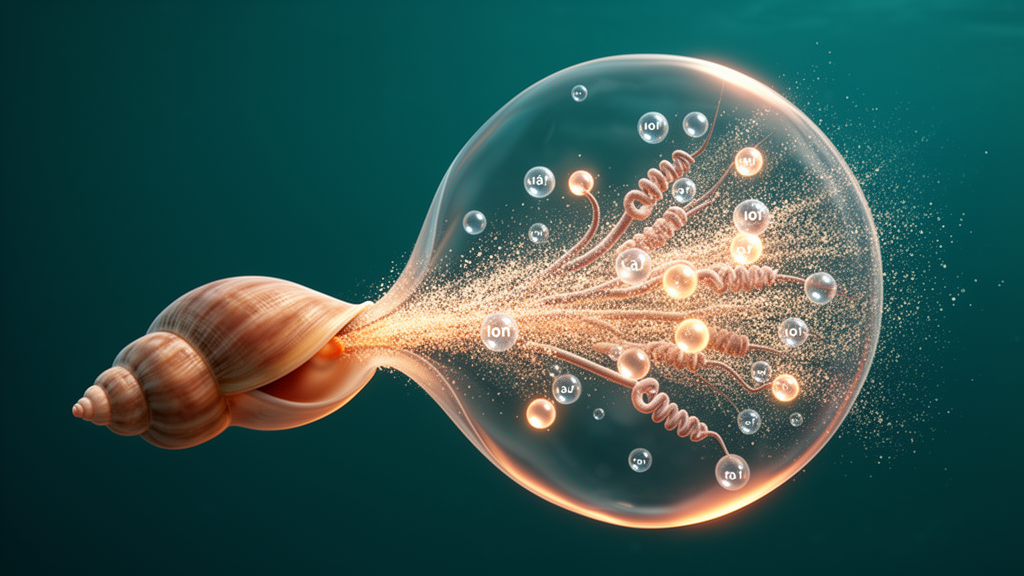
In the warm waters of the Indo-Pacific, the strawberry conch, a striking marine snail known scientifically as Conomurex luhuanus, carries out one of the more peculiar reproductive strategies in the animal kingdom. Like a number of other animal groups, this gastropod produces two morphologically distinct types of sperm in its testis: the fertilizing eusperm, which carry out the essential task of egg fertilization, and the non-fertilizing parasperm, whose purpose has long puzzled biologists. A new study published in PLOS One by Ryo Yokoya, Kogiku Shiba, Masaya Morita and Kazuo Inaba now sheds light on one of the most enigmatic features of these parasperm cells, revealing in fine cellular detail how they discharge the contents of their globular bodies through a calcium-dependent process of exocytosis.
Sperm dimorphism, the production of two different sperm types by a single male, is considered to play a role in reproductive strategies such as sperm competition, in which the gametes of different males vie for access to eggs. In the strawberry conch, parasperm are equipped with numerous globular bodies, membrane-bound spheres packed within the cell, as well as cilia-based undulating membranes that ripple along the cell surface. For years, researchers have wondered what the globular bodies contain and what function they serve, and how the undulating membranes propel these unusual cells. The new work addresses the first of these questions by describing, step by step, the process and regulation of globular body exocytosis, the cellular mechanism by which internal vesicles fuse with the cell’s outer membrane and release their cargo to the exterior.
The researchers found that when parasperm are diluted in artificial seawater, a trigger that mimics the conditions the cells encounter after ejaculation, exocytosis begins. The process occurs through membrane fusion between the membrane surrounding each globular body and the plasma membrane of the cell itself. Once the two membranes merge, the contents of the globular bodies are released outside the cell. This is a classic exocytotic pathway, the same fundamental mechanism that neurons use to release neurotransmitters and that many secretory cells use to export hormones, enzymes and other molecules. Its presence in parasperm suggests that these non-fertilizing cells are not passive passengers in the reproductive tract but active participants capable of delivering specific substances into their environment.
Central to the discovery is the role of calcium. The team demonstrated that exocytosis was markedly suppressed under calcium-deficient conditions, meaning that when extracellular calcium was removed or reduced, the globular bodies largely failed to fuse with the plasma membrane and release their contents. Conversely, when the researchers artificially raised the level of calcium inside the cells using an ionophore called A23187, a chemical that shuttles calcium ions across membranes, exocytosis was enhanced. This pattern establishes calcium as a key regulatory signal for the discharge process, consistent with the way calcium triggers membrane fusion in many other secretory systems across the animal kingdom. In parasperm, then, an influx of calcium from the surrounding seawater appears to be the switch that converts the cells from a storage state into a secretory one.
Perhaps the most surprising finding concerns potassium, another ion abundant in seawater. The researchers observed that both the complete absence of extracellular potassium and high extracellular potassium concentrations enhanced exocytosis. This bidirectional effect, in which two very different potassium conditions produce the same outcome, hints at a more complex regulatory circuitry than a simple calcium trigger alone. It suggests that potassium dynamics across the parasperm plasma membrane may modulate the exocytotic machinery, possibly through effects on membrane potential or on the activity of ion channels that indirectly influence intracellular calcium levels. Untangling exactly how potassium exerts this dual effect will be a task for future work, but the observation alone broadens the picture of how these cells are controlled after they leave the male.
The study did not stop at exocytosis. The team also examined the behavior of the undulating membranes, the cilia-driven structures that generate the parasperm’s characteristic swimming motion. Here they found a striking dissociation between the two cellular activities. The direction of wave propagation along the undulating membrane was reversed by high extracellular calcium concentrations or by treatment with the calcium ionophore A23187, whereas the wave propagation was suppressed under high extracellular potassium conditions. In other words, calcium and potassium influence the undulating membrane, but in ways that do not simply mirror their effects on globular body release.
This divergence is the study’s most important conceptual contribution. Because calcium enhances exocytosis while reversing the direction of membrane waves, and because potassium manipulations enhance exocytosis while suppressing wave propagation, the two processes must be governed by different regulatory mechanisms within the same cell. The globular bodies and the undulating membranes, though housed together in a single parasperm cell, respond to ionic cues through separable pathways. This kind of intracellular division of labor allows the cell to fine-tune its secretory output and its swimming behavior independently, a level of control that could be crucial for whatever role parasperm play inside the female reproductive tract.
What might that role be? The authors suggest that their findings provide novel insight into the post-ejaculatory behavior and potential function of parasperm within the female reproductive tract of gastropods. One plausible scenario, consistent with theories of sperm dimorphism and sperm competition, is that parasperm act as helpers or manipulators of the environment through which eusperm must travel. If globular bodies release their contents upon exposure to the ionic conditions of the female tract, those contents could alter the viscosity of reproductive fluids, nourish fertilizing sperm, or influence female physiology in ways that favor the male’s gametes. The new demonstration that release is an active, calcium-gated event makes such hypotheses far more testable than before, because researchers can now manipulate the trigger experimentally and observe the consequences.
The technical achievement of the study lies in connecting a visible morphological feature, the globular bodies, to a defined molecular mechanism, calcium-dependent membrane fusion, and then showing that this mechanism is regulated differently from the cell’s motility machinery. By using artificial seawater dilution as a physiological trigger, calcium deprivation to block the process, the ionophore A23187 to force intracellular calcium upward, and potassium manipulations to probe a second regulatory axis, the team built a coherent pharmacological map of parasperm behavior. The parallel analysis of undulating membrane wave direction adds an unexpected layer, revealing that the same ions that promote secretion can redirect or suppress movement, depending on concentration and context.
Beyond the strawberry conch, the findings resonate with broader questions in evolutionary biology and cell physiology. Sperm dimorphism has evolved independently in several animal lineages, and understanding how parasperm function after ejaculation may illuminate why males invest so heavily in cells that cannot fertilize eggs. At the same time, the work offers a tractable experimental system for studying exocytosis and cilia-driven motility in a single cell with two separable outputs. As researchers begin to identify the contents of the globular bodies and trace their effects inside the female reproductive tract, the humble parasperm of the strawberry conch may turn out to be far more than an evolutionary curiosity, and instead a sophisticated agent in the competitive drama of marine reproduction.
Subject of Research: Calcium-dependent exocytosis of parasperm globular bodies in the strawberry conch gastropod Conomurex luhuanus
Article Title: Ca 2+ -dependent exocytosis of parasperm globular bodies in the strawberry conch gastropod Conomurex luhuanus
Article References: Yokoya, R., Shiba, K., Morita, M., & Inaba, K. (2026). Ca2+-dependent exocytosis of parasperm globular bodies in the strawberry conch gastropod Conomurex luhuanus. PLOS One, 21(10), e0360627. https://doi.org/10.1371/journal.pone.0360627
Image Credits: AI Generated
DOI: 10.1371/journal.pone.0360627
Keywords: parasperm, sperm dimorphism, exocytosis, calcium signaling, gastropod, Conomurex luhuanus, reproductive biology, undulating membrane, marine invertebrates, sperm competition, cell biology, ionophore A23187
Cite Scienmag News
Drew Townsend. (October 14, 2026). Sea Snail’s Strange Sperm Release Their Secret Cargo in a Calcium-Triggered Burst. Scienmag. https://scienmag.com/sea-snails-strange-sperm-release-their-secret-cargo-in-a-calcium-triggered-burst/
Drew Townsend. "Sea Snail’s Strange Sperm Release Their Secret Cargo in a Calcium-Triggered Burst." Scienmag, 14 October 2026, https://scienmag.com/sea-snails-strange-sperm-release-their-secret-cargo-in-a-calcium-triggered-burst/. Accessed 14 October 2026.
Drew Townsend. "Sea Snail’s Strange Sperm Release Their Secret Cargo in a Calcium-Triggered Burst." Scienmag. October 14, 2026. https://scienmag.com/sea-snails-strange-sperm-release-their-secret-cargo-in-a-calcium-triggered-burst/


