


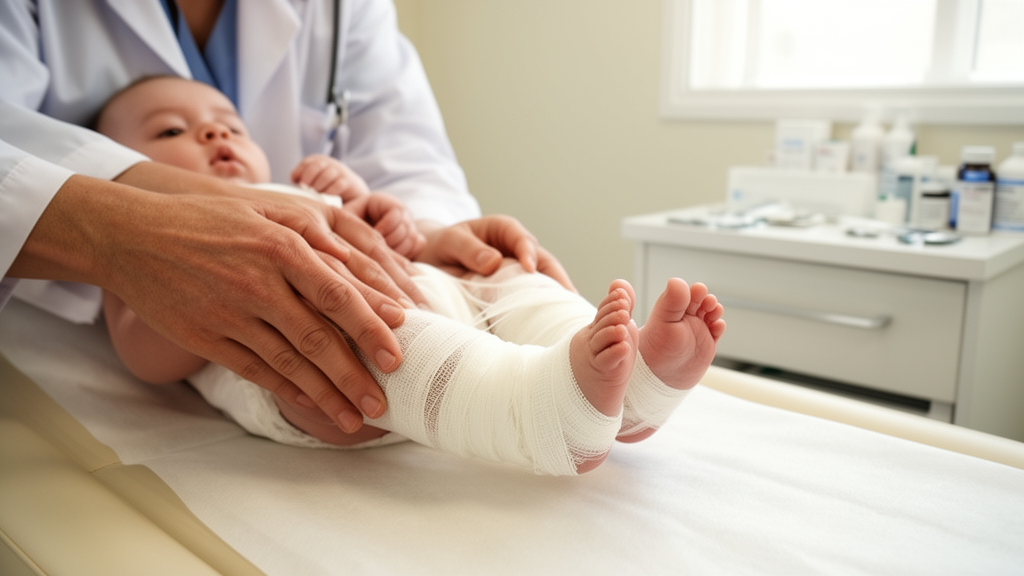
For decades, children born with both spina bifida and clubfoot faced a grim orthopedic trajectory: multiple major surgeries, stiff scarred feet, and often a lifetime of compromised mobility. Now a large retrospective cohort study from Brazil, published in BMC Pediatrics, offers some of the strongest evidence yet that the gentle, casting-based Ponseti method can correct clubfeet in children with myelomeningocele just as effectively as it corrects ordinary clubfeet, with one important caveat: these children experience complications far more often along the way.
Clubfoot, medically known as congenital talipes equinovarus, is one of the most common musculoskeletal birth defects, in which a baby’s foot is twisted inward and downward. In children with myelomeningocele, the most severe form of spina bifida in which the spinal cord and meninges protrude through an opening in the spine, clubfoot appears in roughly 30 to 50 percent of cases. These so-called paralytic or teratologic clubfeet have historically been treated with extensive surgical release, but surgery in children with spina bifida carries particular risks, including pressure sores, infections, and loss of the limited sensation and mobility these children already have. The stakes of finding a less invasive approach are therefore unusually high.
The Ponseti method, developed by Dr. Ignacio Ponseti at the University of Iowa in the mid-twentieth century, revolutionized idiopathic clubfoot care. Instead of cutting through tissue in a single operation, the technique uses a series of carefully directed manual manipulations followed by successive plaster casts, each cast gently stretching the deformed joints a little further toward the correct position. In most cases a minor procedure called a percutaneous Achilles tenotomy, in which the tight heel cord is released through a tiny incision, completes the correction. Afterward, the child wears an abduction brace, typically attached to a bar, for several years to hold the foot in place while it grows. By the early 2000s, orthopedic surgeons began extending the method to non-idiopathic feet, including those associated with myelodysplasia, but robust comparative data remained scarce.
That gap is what the new study set out to fill. A team led by Elizabeth de Alvarenga Borges da Fonseca, Pothyra Campos Pascoal, and senior author Monica Paschoal Nogueira of the Orthopedic and Traumatology Department at IAMSPE, the Institute of Medical Assistance for State Civil Servants of São Paulo, in collaboration with Jose Antonio Morcuende of the Ponseti Clubfoot Treatment and Research Center at the University of Iowa, assembled a cohort spanning two decades of treatment, from 2004 to 2024. The research group comprised 50 patients with clubfoot and myelomeningocele, representing 83 affected feet, who were matched against a comparison group of 170 patients with idiopathic clubfoot, representing 293 feet. All children in both groups were treated with the Ponseti method.
The researchers’ central hypothesis was straightforward: if the Ponseti method works through the same biomechanical principles in both populations, the outcomes should be broadly similar. The team measured results using the Pirani score, a widely used six-point clinical grading system that scores six physical signs of clubfoot deformity, three assessing the midfoot and three assessing the hindfoot, with higher scores indicating more severe deformity. They tracked the number of casts required to achieve correction, the rate of initial correction, the rate of recurrence at final follow-up, and the frequency of complications.
The headline finding is striking. Initial correction was achieved in 96 percent of the myelomeningocele feet, and 82 percent of those feet maintained their correction at final follow-up. Even more notably, the statistical comparison between the two groups revealed no significant differences in initial Pirani score, final Pirani score, number of casts needed, or recurrence rate. In other words, by these core measures, the paralytic clubfeet of children with spina bifida responded to serial casting and tenotomy essentially the same way that ordinary clubfeet do. For a condition long treated as a surgical problem, that is a genuinely consequential result.
Complications, however, told a different story. Adverse events occurred in 44 percent of the myelomeningocele group compared with just 8 percent of the idiopathic group, a difference that was statistically significant. The authors’ clinical experience, reflected in the study’s framing, points to the particular vulnerability of these children’s skin and soft tissues: insensate or poorly sensate feet, fragile skin, and the constant pressure of casts and braces make blistering, pressure sores, and skin breakdown far more likely. This finding does not undermine the case for the Ponseti method in spina bifida, but it does underscore that these children need closer surveillance, more frequent cast changes when needed, and meticulous skin care throughout treatment.
The study also dug into a clinically meaningful subgroup question: does the level of the spinal lesion matter? Children with myelomeningocele are conventionally classified by the highest functioning vertebral level, and the researchers compared high lumbar cases against low lumbar cases. In the subgroup analysis, the level of the lesion made no significant difference in the number of casts required, the complication rate, or the need for tenotomy. That is encouraging, because it suggests that the casting protocol does not need to be fundamentally recalibrated based on neurologic level alone.
There were, however, real differences between the lumbar subgroups on other measures. The initial Pirani score, meaning the severity of the deformity at the start of treatment, differed significantly between high and low lumbar patients, as did the rate of bilaterality, meaning whether both feet were affected. These findings fit the broader clinical picture of myelomeningocele, in which higher lesions are generally associated with more severe muscle imbalance and more complex deformity patterns. The authors also note that treatment in this population extends beyond casting: solid ankle-foot orthoses, known as AFOs, play a central role in maintaining correction, and procedures such as anterior tibial transfer and posteromedial release remain part of the surgical armamentarium for selected cases, even if far less often than in the era before Ponseti treatment.
What makes this study particularly valuable is its scale and its design. Fifty patients with myelomeningocele and clubfoot is, by the standards of this rare condition, a substantial series, and matching it against 170 idiopathic patients treated at the same institution over the same period gives the comparison real statistical weight. The work was conducted at IAMSPE with approval from the Research Ethics Committee of the São Paulo State Hospital, and it formed part of a master’s degree dissertation supported by a CAPES scholarship from the Brazilian federal government. The study was published open access on 17 September 2026 under a Creative Commons license, making the full data available to clinicians worldwide.
The implications reach well beyond São Paulo. Spina bifida remains one of the most common disabling birth defects globally, and in many low- and middle-income countries surgical capacity for complex pediatric foot reconstruction is limited. A conservative, low-cost method that achieves initial correction in 96 percent of cases and durable correction in more than four out of five feet, using little more than plaster, skilled hands, and a brace, could transform access to care. The message for families and clinicians is cautiously optimistic: children with myelomeningocele and clubfoot should be offered the same gentle first-line treatment as any other child with clubfoot, provided their care team is prepared for the higher rate of skin and soft-tissue complications and monitors them accordingly. As the Ponseti method’s indications continue to expand two decades after surgeons first applied it to myelodysplastic feet, this fifty-patient series provides the kind of matched, long-horizon evidence that turns clinical intuition into standard practice.
Subject of Research: Ponseti method treatment of clubfoot in children with myelomeningocele compared with idiopathic clubfoot
Article Title: Ponseti method in patients with myelomeningocele a fifty-patient-series matched with idiopathic cases
Article References: de Alvarenga Borges da Fonseca, E., Pascoal, P. C., Morcuende, J. A., & Nogueira, M. P. (2026). Ponseti method in patients with myelomeningocele a fifty-patient-series matched with idiopathic cases. BMC Pediatrics. https://doi.org/10.1186/s12887-026-07667-9
Image Credits: AI Generated
DOI: 10.1186/s12887-026-07667-9
Keywords: Ponseti method, clubfoot, myelomeningocele, spina bifida, pediatric orthopedics, Pirani score, Achilles tenotomy, conservative treatment, equinovarus deformity, retrospective cohort study, BMC Pediatrics, ankle-foot orthoses
Cite Scienmag News
Ophelia Keating. (October 14, 2026). Gentle Casting Method Works as Well for Spina Bifida Clubfeet as for Typical Cases. Scienmag. https://scienmag.com/gentle-casting-method-works-as-well-for-spina-bifida-clubfeet-as-for-typical-cases/
Ophelia Keating. "Gentle Casting Method Works as Well for Spina Bifida Clubfeet as for Typical Cases." Scienmag, 14 October 2026, https://scienmag.com/gentle-casting-method-works-as-well-for-spina-bifida-clubfeet-as-for-typical-cases/. Accessed 14 October 2026.
Ophelia Keating. "Gentle Casting Method Works as Well for Spina Bifida Clubfeet as for Typical Cases." Scienmag. October 14, 2026. https://scienmag.com/gentle-casting-method-works-as-well-for-spina-bifida-clubfeet-as-for-typical-cases/


