


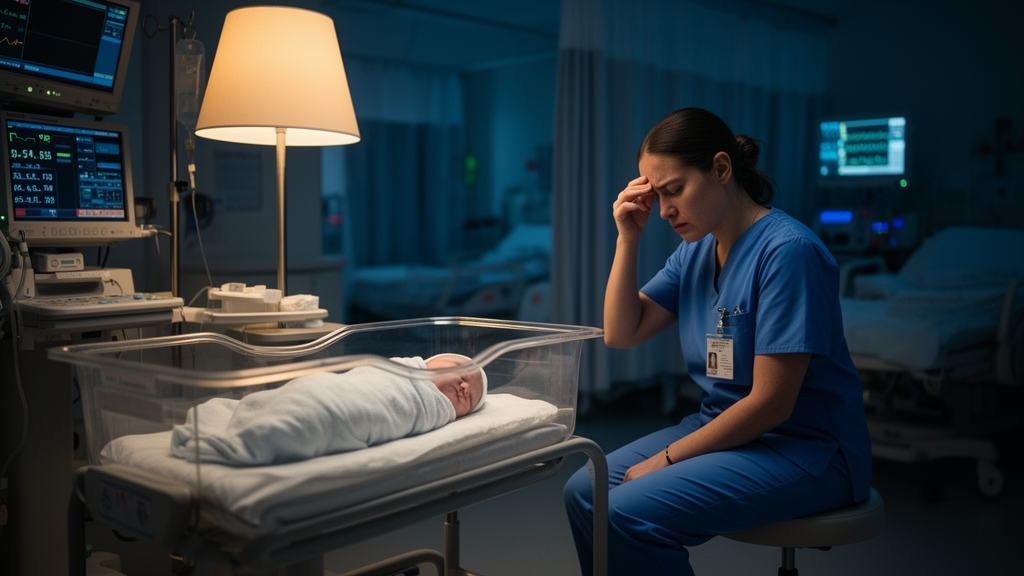
In the delivery rooms, postpartum wards, and gynecological units where the margins for error are measured in millimeters and minutes, the people watching over mothers and newborns are often running on empty. A new cross-sectional study from southern Poland has put hard numbers on a problem that hospital administrators have long preferred to treat as background noise: nurses and midwives who are fatigued and sleep-deprived view the safety culture around them far more negatively than their well-rested colleagues. The research, conducted by a team at the Jagiellonian University Medical College in Kraków and published in BMC Nursing, surveyed 541 nursing and midwifery professionals working in obstetric and gynecological units across the Małopolska region, and its findings carry an uncomfortable message for any healthcare system that treats staff exhaustion as an individual failing rather than a systemic hazard.
The study’s design was straightforward but methodologically disciplined. Participants completed an anonymous questionnaire battery combining three validated psychometric instruments with a demographic and occupational survey. Fatigue was measured using the Fatigue Assessment Scale, or FAS, a ten-item tool that captures both physical and mental exhaustion. Insomnia severity was assessed with the Athens Insomnia Scale, an eight-item instrument developed originally for epidemiological studies of sleep disorders, which probes difficulties with sleep induction, awakening, duration, and daytime consequences. Attitudes toward patient safety were quantified with the Polish adaptation of the Safety Attitudes Questionnaire Short Form, a widely used instrument that evaluates six distinct domains: safety climate, teamwork climate, perceptions of management, job satisfaction, working conditions, and stress recognition. Each domain yields a score from zero to one hundred, allowing the researchers to map precisely where the safety culture of these units was strongest and where it was fraying.
The headline results reveal a safety culture that is, at best, uneven. The highest mean scores appeared in job satisfaction, at 72.99 points, and stress recognition, at 68.23 points, suggesting that despite the pressures of the job, most respondents still found meaning in their work and were acutely aware that stress affects their professional performance. At the other end of the spectrum, working conditions scored lowest at 61.16 points, followed closely by teamwork climate at 62.80 points. In a field like obstetrics, where coordinated handoffs, clear communication during emergencies, and seamless collaboration between midwives, nurses, and physicians can determine whether a delivery ends well, a mediocre teamwork climate score is not a soft statistic. It is a leading indicator of the kind of communication failures that safety researchers have repeatedly linked to adverse events.
The correlations between fatigue and safety attitudes were negative across five of the six domains, and all reached the stringent threshold of p less than 0.001. The strongest association appeared with job satisfaction, where the correlation coefficient was minus 0.383, indicating that as fatigue deepened, satisfaction with the job eroded substantially. Teamwork climate and safety climate followed closely, with coefficients of minus 0.297 and minus 0.291 respectively, while perception of management and working conditions showed coefficients of minus 0.276 and minus 0.218. In practical terms, this means that an exhausted midwife is not merely tired; she is systematically more likely to doubt the safety of her unit, to rate collaboration with colleagues poorly, and to view hospital leadership as unsupportive of safe practice. Fatigue, in other words, does not just slow reflexes. It corrodes the cognitive and emotional foundations on which safety culture is built.
Insomnia told a parallel story, with slightly weaker but consistently significant negative correlations. Sleep disturbance was associated with lower scores in perception of management, at minus 0.273, job satisfaction at minus 0.219, working conditions at minus 0.209, teamwork climate at minus 0.199, and safety climate at minus 0.195, all statistically significant at the same threshold. The one domain that bucked the trend is perhaps the most psychologically revealing: stress recognition. Both fatigue and insomnia were positively associated with stress recognition scores, meaning that the most exhausted clinicians were also the most likely to acknowledge that stress impairs their performance. This is a double-edged finding. On one hand, it suggests that tired nurses and midwives retain enough metacognitive insight to recognize their own vulnerability, which is itself a safety asset. On the other hand, it implies that the system is relying on exhausted staff to self-identify their impairment, with no structural safeguard catching the problem before it reaches the bedside.
The mechanistic plausibility of these findings is well supported by decades of occupational health research. Sleep deprivation degrades attention, working memory, and executive function in ways that mirror alcohol intoxication at comparable levels of wakefulness. In clinical settings, these deficits translate into slower responses to fetal heart rate abnormalities, more medication errors, and poorer situational awareness during obstetric emergencies. But the Polish study adds a subtler layer: the attitudinal pathway. A clinician who perceives her working conditions as poor and her management as indifferent is less likely to speak up about a safety concern, less likely to report a near miss, and less likely to engage in the informal vigilance that keeps units safe between formal protocols. Fatigue may thus harm patients twice, first by degrading individual performance and second by dampening the collective willingness to flag danger.
Obstetric and gynecological units present a particularly demanding test case. The work is episodic and unpredictable, with night shifts punctuated by deliveries that cannot be scheduled, emotional intensity that few other specialties match, and a patient population that includes both healthy mothers and high-risk pregnancies where minutes matter. Shift work in these settings disrupts circadian rhythms in ways that accumulate over years, and chronic insomnia among nursing personnel is well documented internationally. The Małopolska sample, drawn from real-world hospital units rather than academic centers alone, offers a snapshot of a workforce in which fatigue is not an occasional inconvenience but, for many respondents, a chronic occupational condition. The study was approved by the Bioethics Committee of the Jagiellonian University, and all participants provided written informed consent, with the research conducted in accordance with the Declaration of Helsinki.
What should hospital leaders take from these numbers? The correlation coefficients, while moderate rather than enormous, are consistent, statistically robust, and concentrated in exactly the domains that safety science identifies as protective. Improving staffing ratios, redesigning shift schedules to allow adequate recovery sleep, providing nap facilities for night staff, and screening for insomnia as an occupational health issue are all interventions with an evidence base in other high-reliability industries. Aviation long ago accepted that pilot fatigue is a system property to be managed, not a personal weakness to be disciplined. Healthcare has been slower to follow, partly because nursing workloads are driven by patient demand that does not respect circadian biology. The Polish findings suggest that the cost of that reluctance is measured not only in staff burnout and turnover but in the quiet erosion of the attitudes that make units safe.
There is also a research agenda embedded in these results. As a cross-sectional study, the work captures associations at a single point in time and cannot establish whether fatigue causes negative safety attitudes, whether negative attitudes worsen sleep, or whether both flow from a third factor such as understaffing. Longitudinal designs and intervention trials are needed to disentangle these pathways. Still, the consistency of the pattern across five safety domains, two independent exposure measures, and a sample of more than five hundred clinicians makes the association difficult to dismiss. The authors, led by Łukasz Lompart together with Klaudia Dubis, Marcin Rząca, Daria Buźniak, and Iwona Malinowska-Lipień, argue that higher levels of fatigue and sleep disturbance correspond to less favorable evaluations of most safety domains, alongside increased recognition of stress on professional functioning. For a health system preparing to face persistent nursing shortages, that conclusion deserves to be read not as an academic footnote but as a staffing policy warning written in the language of statistics.
Subject of Research: The association between fatigue, sleep disturbances, and patient safety attitudes among nurses and midwives in obstetric and gynecological units
Article Title: Attitudes of nurses and midwives toward patient safety in obstetric and gynecological units: the role of fatigue and sleep disturbances – a cross-sectional study
Article References: Attitudes of nurses and midwives toward patient safety in obstetric and gynecological units: the role of fatigue and sleep disturbances – a cross-sectional study. (n.d.). https://doi.org/10.1186/s12912-026-05496-w
Image Credits: AI Generated
DOI: 10.1186/s12912-026-05496-w
Keywords: patient safety, fatigue, insomnia, nurses, midwives, obstetrics, gynecology, safety attitudes, sleep disturbances, shift work, nursing workforce, cross-sectional study
Cite Scienmag News
Ophelia Keating. (October 14, 2026). Exhausted and Sleepless: Fatigue Erodes Patient Safety Attitudes in Maternity Wards. Scienmag. https://scienmag.com/exhausted-and-sleepless-fatigue-erodes-patient-safety-attitudes-in-maternity-wards/
Ophelia Keating. "Exhausted and Sleepless: Fatigue Erodes Patient Safety Attitudes in Maternity Wards." Scienmag, 14 October 2026, https://scienmag.com/exhausted-and-sleepless-fatigue-erodes-patient-safety-attitudes-in-maternity-wards/. Accessed 14 October 2026.
Ophelia Keating. "Exhausted and Sleepless: Fatigue Erodes Patient Safety Attitudes in Maternity Wards." Scienmag. October 14, 2026. https://scienmag.com/exhausted-and-sleepless-fatigue-erodes-patient-safety-attitudes-in-maternity-wards/


