


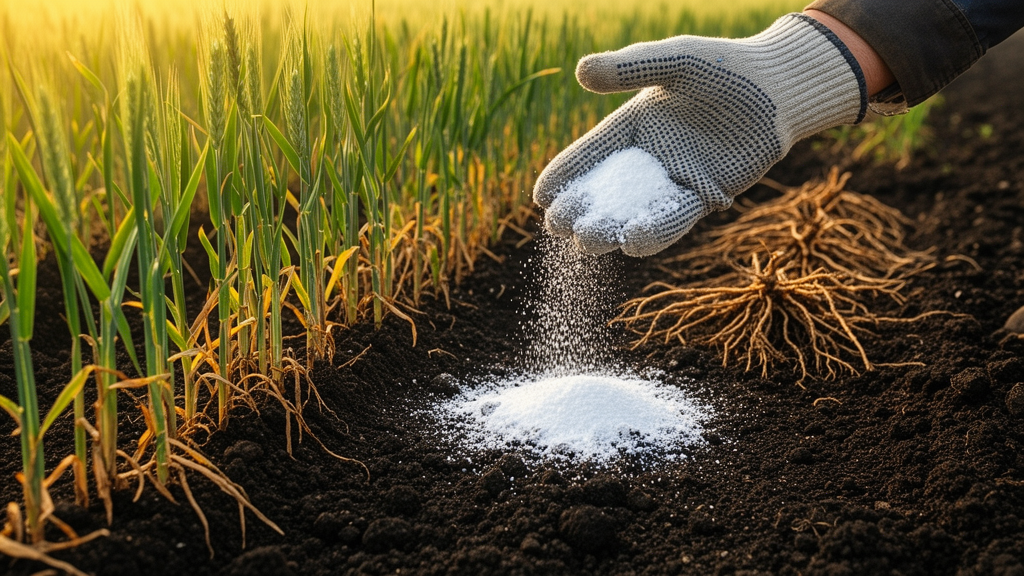
Soil acidity is one of agriculture’s most stubborn enemies, and researchers at the University of Western Australia have now delivered a promising new weapon. In a pot study published in the journal Plant and Soil, Suma Karki, Zakaria M. Solaiman and Zed Rengel tested whether calcium silicate, a silicon-rich mineral amendment, could rescue wheat growing in aluminium-toxic acidic soil. Their answer was a clear yes: calcium silicate boosted shoot and root growth, improved photosynthesis, and cut the amount of aluminium accumulating in plant tissue. The finding matters because roughly half of the world’s arable land is affected by soil acidity, and aluminium toxicity alone can strip between 25 and 80 percent off crop yields depending on the species.
The chemistry behind the problem is deceptively simple. When soil pH drops, aluminium that is normally locked into harmless mineral structures dissolves into the soil solution as free Al3+ ions. These ions are highly toxic to plant roots, where they inhibit cell division and elongation, producing short, thick, stubby root systems that cannot explore the soil for water and nutrients. The downstream effects cascade through the whole plant: reduced uptake of water and essential nutrients, disrupted physiological processes, and ultimately lower yields. For wheat, a staple feeding roughly 40 percent of the global population and Australia’s most important export crop, the stakes are enormous. In south-western Western Australia, the country’s wheat heartland, about 70 percent of soils suffer surface acidity and around half have acidic subsoil layers.
The traditional remedy is liming, spreading calcium carbonate to neutralise acidity. It works, but slowly, especially in the subsoil, where lime moves downward at a glacial pace and the costs of deep incorporation can be prohibitive. That is why the research team turned to silicon, the second most abundant element in the Earth’s crust and a long-recognised ally of plants under stress. Silicon helps crops cope with biotic and abiotic pressures ranging from fungal disease to drought, and previous work in maize, rice, sugarcane and potato had hinted that silicate amendments could correct soil acidity. What remained unclear was which silicon source worked best, at what rate, and through what mechanism.
To find out, the researchers ran two glasshouse experiments using acidic soil collected from Kalannie in the Western Australian wheatbelt, reconstructing a realistic soil profile with a topsoil layer sitting over a subsoil layer in each pot. The first experiment compared two silicon sources, calcium silicate and sodium silicate, applied at five rates from zero up to 1 gram of silicon per kilogram of soil, using the aluminium-sensitive wheat breeding line ES8. The second experiment zoomed in on calcium silicate at two rates, 0.2 and 0.5 grams of silicon per kilogram, and introduced a clever genetic contrast: two near-isogenic wheat lines, ES8 and ET8, which share more than 95 percent of their DNA but differ in aluminium tolerance at the Alt1 locus. The tolerant line ET8 carries the TaALMT1 gene, which encodes an aluminium-activated malate transporter that floods root tips with malate to detoxify incoming aluminium.
The results from the first experiment were striking. Calcium silicate outperformed sodium silicate, lifting shoot dry weight by about 10 percent relative to the sodium form, and the optimal silicon rate of 0.5 grams per kilogram of soil produced roughly 25 percent more shoot biomass than the untreated control. The most dramatic effects appeared underground. In the strongly acidic subsoil, calcium silicate treatments roughly 2.5-fold increased root dry weight compared with the no-silicon control, and fine root length, the network of thin roots that does most of the nutrient foraging, expanded substantially across all calcium silicate rates. Roots also grew finer in diameter, a sign of healthier, less stressed tissue, since aluminium toxicity typically forces roots to thicken and shorten.
The second experiment added crucial controls that let the team separate the effects of silicon from those of calcium and of pH itself. Calcium carbonate treatments supplying the same amount of calcium as the silicate applications were included, alongside a lime control adjusted to raise soil pH to 6. Both calcium silicate and calcium carbonate raised soil pH in the topsoil and subsoil and produced similar shoot dry weights, but the higher silicate rate edged out the lime control, with a large positive effect size. Photosynthetic parameters told an interesting story: the high calcium silicate treatment increased net photosynthetic rate, stomatal conductance, transpiration and intercellular carbon dioxide more than the equivalent calcium carbonate treatment, hinting at a genuine silicon-specific benefit to leaf function beyond simple liming.
Aluminium speciation analysis provided the mechanistic heart of the study. Using the GEOCHEM-EZ geochemical model on soil solutions extracted from the rhizosphere, the researchers found that calcium silicate shifted aluminium away from its most dangerous form. In untreated acidic soil, free Al3+ dominated the soil solution, particularly in the subsoil where free aluminium availability was nearly double that of the topsoil. After silicate or carbonate amendment, the relative proportion of free aluminium fell while the proportion of less harmful hydroxylated species, Al-OH complexes, rose. This shift is the classic signature of pH-driven aluminium hydrolysis: as hydroxide ions become available, toxic free aluminium is converted into complexes that roots barely absorb. Consistent with this, aluminium concentrations in wheat shoots dropped significantly in the high-rate treatments.
Notably, the silicon content of the shoots bore no relationship to the aluminium content, suggesting that in soil-grown wheat, silicon did not block aluminium uptake directly at the plant level. Instead, the amelioration ran through the soil chemistry. The team also measured organic acid anions exuded by the roots, expecting that silicon might stimulate the release of malate and citrate, the known aluminium-detoxifying exudates of wheat. It did not. Malate, citrate, fumarate and shikimate were detected in the rhizosphere, but total organic acid exudation was essentially unchanged across treatments. This rules out one popular hypothesis and sharpens the conclusion: the benefit of calcium silicate in this system is a soil pH effect, not a plant physiology effect.
One intriguing possibility remains open. The GEOCHEM-EZ database does not include aqueous aluminium-silicon complexes, so the model could not test directly whether hydroxyaluminosilicate species formed in the soil solution. Yet the conditions in the silicate-treated pots were favourable for such formation: soil solution pH values above 5, elevated proportions of Al-OH species, and silicon-to-aluminium ratios greater than one. Hydroxyaluminosilicates are famously inert, and their formation could explain why calcium silicate slightly outperformed calcium carbonate on some measures, including subsoil fine root length and free aluminium in topsoil solution. The authors recommend that future work explicitly explore aluminium-silicon complex formation in soil and roots, and that calcium silicate be tested in field trials.
The practical implications could be significant for farmers battling acid soils. Calcium silicate is roughly 6.8 times more soluble than lime, meaning alkalinity could travel faster from surface applications into the acidic subsoil where lime struggles to reach. Although silicon fertilisers carry a price premium, they also confer protection against a suite of other stresses, including drought, extreme temperatures and insect attack, potentially improving the economic return on the investment. With around 25 million hectares of acidic topsoil and 23 million hectares of acidic subsoil in Australia alone, and soil acidity accounting for an estimated 13 percent of total yield loss in south-western Western Australia, an amendment that neutralises acidity, detoxifies aluminium, feeds silicon to the crop and penetrates the profile faster than lime deserves serious attention. The study positions calcium silicate not as a replacement for lime, but as a complementary tool in the growing arsenal against one of global agriculture’s costliest soil constraints.
Subject of Research: Calcium silicate amendment as a mechanism for ameliorating aluminium toxicity in wheat grown on acidic soil
Article Title: Calcium silicate-mediated amelioration of aluminium toxicity in wheat
Article References: Calcium silicate-mediated amelioration of aluminium toxicity in wheat. (n.d.). https://doi.org/10.1007/s11104-026-09136-9
Image Credits: AI Generated
DOI: 10.1007/s11104-026-09136-9
Keywords: aluminium toxicity, wheat, calcium silicate, soil acidity, silicon, soil pH, aluminium speciation, root growth, liming, subsoil acidity, plant nutrition, GEOCHEM-EZ
Cite Scienmag News
Alan Morgan. (October 14, 2026). Calcium Silicate Offers a Silicon-Powered Shield Against Toxic Aluminium in Wheat Soils. Scienmag. https://scienmag.com/calcium-silicate-offers-a-silicon-powered-shield-against-toxic-aluminium-in-wheat-soils/
Alan Morgan. "Calcium Silicate Offers a Silicon-Powered Shield Against Toxic Aluminium in Wheat Soils." Scienmag, 14 October 2026, https://scienmag.com/calcium-silicate-offers-a-silicon-powered-shield-against-toxic-aluminium-in-wheat-soils/. Accessed 14 October 2026.
Alan Morgan. "Calcium Silicate Offers a Silicon-Powered Shield Against Toxic Aluminium in Wheat Soils." Scienmag. October 14, 2026. https://scienmag.com/calcium-silicate-offers-a-silicon-powered-shield-against-toxic-aluminium-in-wheat-soils/


