


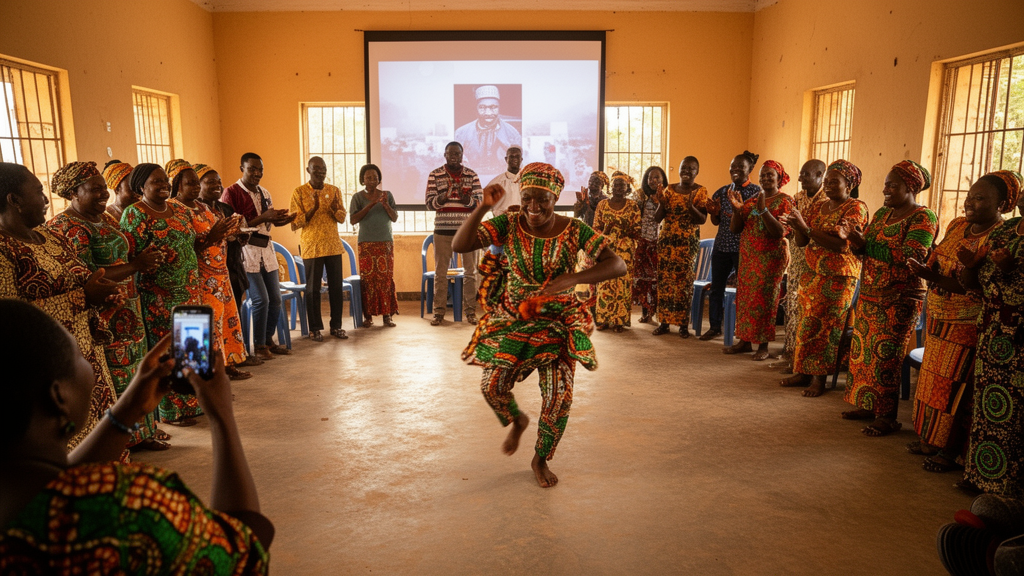
In the crowded landscape of global health messaging, few tools are as universally understood as dance. A new pilot study from Nigeria suggests that when eye health education is wrapped in culturally resonant music and movement, the message does not just reach people—it changes what they know and what they intend to do. The research, published in PLOS Global Public Health, tested a multimodal, dance-integrated educational video package designed to improve knowledge, attitudes, and preventive intentions related to eye conditions among Nigerian adults, and the early results point to a strikingly scalable model for health communication in resource-limited settings.
The study, led by Ngozi Precious Uwagboe and colleagues, was conducted between April 11 and June 22, 2025. Adults were recruited through optometry clinics and community outreach programmes, then asked to view a series of culturally tailored educational videos. Each video addressed at least one major eye condition—myopia, cataract, or glaucoma—as well as general eye health topics, including common myths and preventive practices. The design was a pre-post pilot: participants’ knowledge and intentions were measured before and immediately after the intervention, and changes were assessed using paired statistical comparisons, with additional subgroup analyses stratified by educational attainment.
The 438 participants who took part were predominantly young and relatively well educated. According to the study, 77.7 percent were aged 18 to 44 years, 52.5 percent were female, and 75.1 percent had higher education. Notably, 80.0 percent already reported existing health-promoting behaviours, and 79.7 percent considered regular eye examinations important before the intervention began. This baseline matters: when a population starts with fairly positive attitudes, there is limited room for improvement, making any measurable gains in knowledge and intention all the more meaningful.
The headline finding concerns perceived knowledge. Before watching the videos, only 42.0 percent of participants rated their eye health knowledge as good; afterwards, that figure rose to 68.0 percent—an absolute increase of 26.0 percentage points and a relative increase of 61.9 percent, which reached statistical significance with a p-value of 0.013. The effect size, measured by Cramér’s V of 0.279, indicates a moderate association between the intervention and the change in self-assessed knowledge. In practical terms, participants did not merely sit through the videos; they came away feeling substantially better informed about their eyes.
More importantly, the gains were not purely a matter of confidence. Objective eye health knowledge scores—measured through factual questions rather than self-report—increased by 52.4 percentage points, also statistically significant at p = 0.013, though with a smaller effect size (Cramér’s V = 0.069). The divergence between the two effect sizes is instructive: participants’ subjective sense of learning outpaced the measurable knowledge gain, a pattern common in educational interventions. Still, a jump of more than fifty percentage points in tested knowledge after a single video package is a remarkable immediate effect for any health education tool, let alone one delivered through an artistic medium.
Behavioural intentions moved in the same direction. Participants reported increased willingness to adopt protective practices, including wearing sunglasses, reducing screen time, and attending regular eye examinations. The overall intention to visit an eye clinic rose by 10 percent, although this particular change did not reach statistical significance (p = 0.443). The authors attribute this plateau to a ceiling effect: with nearly 80 percent of participants already valuing regular eye examinations at baseline, there was little room for the aggregate figure to climb further. In other words, the intervention may have consolidated existing intentions rather than creating new ones—a valuable outcome in its own right.
Where the intervention truly distinguished itself was among participants with lower educational attainment. The largest improvements in willingness to attend regular check-ups occurred among those with secondary education, whose willingness surged from 27.5 percent to 96.3 percent (p < 0.001), and among those with primary or no formal education, whose willingness rose from 41.4 percent to 96.6 percent (p < 0.001). These are extraordinary shifts. Health communication frequently struggles to reach people outside formal educational systems, because written materials and jargon-heavy messaging assume literacy and familiarity with medical concepts. Dance, by contrast, is culturally embedded and universally accessible, transmitting information through rhythm, narrative, and visual demonstration rather than text.
The implications for global eye health are considerable. Vision impairment affects hundreds of millions of people worldwide, and a large share of the burden is preventable or treatable—cataract surgery, glaucoma management, and refractive error correction are among the most cost-effective interventions in medicine. Yet in many low- and middle-income countries, people present late, when conditions have already advanced, often because they do not recognise symptoms, hold misconceptions about causes, or underestimate the value of routine examination. Myths about eye health, from harmful traditional remedies to fatalism about vision loss, remain widespread. An educational medium that can dismantle these barriers without requiring literacy, and that people actively enjoy, addresses one of the stubborn bottlenecks in preventive eye care.
The study’s multimodal design deserves attention as well. By combining music, dance, and structured educational content, the video package engaged multiple channels of communication simultaneously—emotional, narrative, and factual. Research in health psychology has long suggested that messages delivered through engaging, culturally congruent formats are better remembered and more persuasive than purely didactic ones. The Nigerian context, with its rich traditions of music and dance as vehicles for storytelling and social commentary, makes the approach especially well suited. The videos did not treat culture as decoration; they treated it as the delivery system itself.
As a pilot study, the research has clear limits that the authors and readers must weigh. The sample was young, urban-leaning, and highly educated, with strong baseline health behaviours—hardly the population with the greatest unmet eye health needs. The measurements captured immediate effects only, not whether participants actually booked appointments, wore sunglasses, or reduced screen time weeks or months later. The non-significant change in clinic-visit intention illustrates how ceiling effects can mask or dilute impact. Future studies will need to follow participants over time, reach populations with lower baseline engagement, and test whether the dance-integrated format retains its power at scale and across different cultural settings. Even so, the direction of the findings is compelling: knowledge rose sharply, intentions strengthened most where they were weakest, and the medium itself proved feasible to deploy in clinics and community outreach. If subsequent trials confirm these effects, dance-integrated video education could become a low-cost, high-reach tool for eye health promotion—proof that sometimes the most effective public health technology is not a new drug or device, but a well-told story set to music.
Subject of Research: Dance-integrated educational videos for improving eye health knowledge and preventive intentions among Nigerian adults
Article Title: Feasibility and immediate effects of a multimodal, dance-integrated educational video package on eye health knowledge and intentions in Nigeria: A pre-post pilot study
Article References: Uwagboe, N. P., Obia, A. I., Nwaolai, O. L., Gadimoh, P., Alari, E. O., Yanney, C. N., Eseme, N. J., & Osuagwu, U. L. (2026). Feasibility and immediate effects of a multimodal, dance-integrated educational video package on eye health knowledge and intentions in Nigeria: A pre-post pilot study. PLOS Global Public Health, 6(10), e0005585. https://doi.org/10.1371/journal.pgph.0005585
Image Credits: AI Generated
DOI: 10.1371/journal.pgph.0005585
Keywords: eye health, health education, dance, Nigeria, public health, glaucoma, cataract, myopia, health communication, pilot study, preventive behaviour, global health
Cite Scienmag News
Courtney Benton. (October 14, 2026). Dance-Powered Videos Boost Eye Health Knowledge in Nigerian Adults. Scienmag. https://scienmag.com/dance-powered-videos-boost-eye-health-knowledge-in-nigerian-adults/
Courtney Benton. "Dance-Powered Videos Boost Eye Health Knowledge in Nigerian Adults." Scienmag, 14 October 2026, https://scienmag.com/dance-powered-videos-boost-eye-health-knowledge-in-nigerian-adults/. Accessed 14 October 2026.
Courtney Benton. "Dance-Powered Videos Boost Eye Health Knowledge in Nigerian Adults." Scienmag. October 14, 2026. https://scienmag.com/dance-powered-videos-boost-eye-health-knowledge-in-nigerian-adults/


