


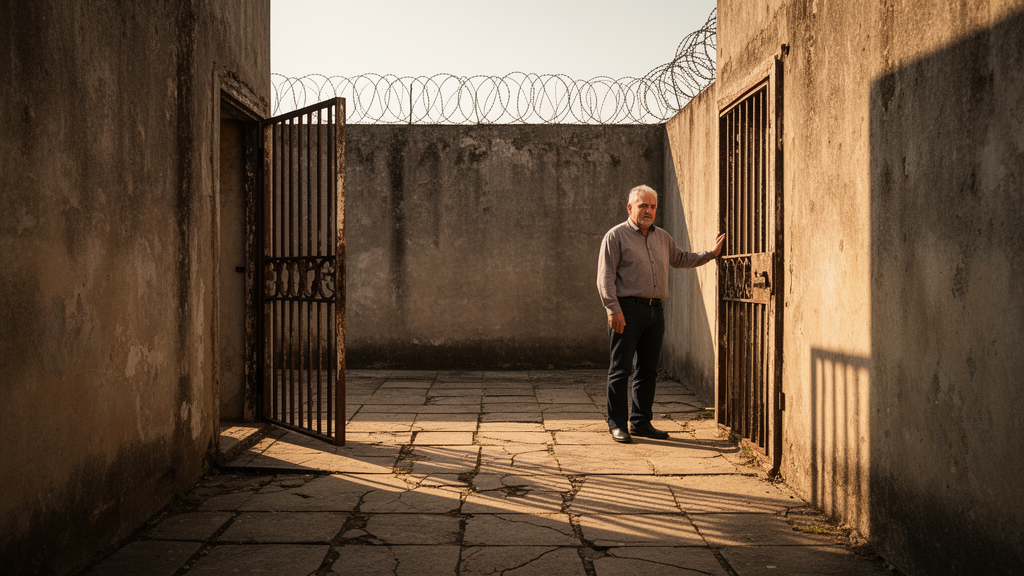
Prisons are usually described in the language of walls, bars, and perimeter fences, but a new study argues that the most enduring architecture of incarceration may be temporal rather than spatial. In research published in Humanities and Social Sciences Communications, Rama Al-Rabady of Al-Ahliyya Amman University and Maram Al-Najjar of the Hashemite University examine how imprisonment is experienced in space and time at two Jordanian facilities, the Juwaida and Swaqa Correctional and Rehabilitation Centers. Their analysis, framed through Michel Foucault’s concept of heterotopia, suggests that the prison does not simply confine bodies; it installs a rhythm of life that continues to structure a person’s subjectivity long after the gate opens.
Foucault introduced heterotopia as a way of thinking about spaces that are set apart from ordinary life yet simultaneously reflect, contest, and invert it. Prisons are among his canonical examples: they are real places, not imaginary ones, but they operate according to rules of closure, surveillance, and exclusion that mark them as fundamentally other. Al-Rabady and Al-Najjar take this framework and test it against interview evidence from a Middle Eastern carceral context, a setting that remains strikingly underrepresented in the empirical literature on incarceration, which has historically drawn most of its data from North American and European institutions.
The study rests on phenomenologically oriented semi-structured interviews with three groups of participants: nine people who had formerly been incarcerated, seven state officials, and six human rights experts. The researchers obtained approval from the Hashemite University Institutional Review Board, with procedures conducted in accordance with the 1964 Declaration of Helsinki. Only formerly incarcerated people were interviewed; no currently incarcerated individuals took part. Safeguards for this vulnerable population included neutral interview locations chosen by participants, the right to withdraw at any time without consequence, no identifying information retained beyond study codes, and verbatim transcription when participants declined audio recording. No compensation was offered and no deception was involved.
From this material, the authors identify two overlapping registers through which the Jordanian prisons operate as heterotopias: deviation and compensation. In Foucault’s typology, heterotopias of deviation are spaces that house people whose behavior or condition diverges from required norms, with prisons, psychiatric hospitals, and rest homes as classic examples. Heterotopias of compensation, by contrast, create an alternative order intended to make up for a perceived deficiency in the surrounding society. The finding that both registers are active in the same institutions suggests that the Jordanian facilities are not merely sites of exclusion but also claim a corrective or rehabilitative function, a duality captured in their official designation as correctional and rehabilitation centers.
The spatial dimension of the analysis centers on what the authors describe as spatial crisis and opacity. Prisons are deliberately opaque institutions: what happens inside them is hidden from public view, and that opacity shapes how incarcerated people, officials, and rights advocates each understand the institution. For those inside, the prison’s spatial order disciplines movement, sightlines, and social contact in ways that reorganize the body’s habitual relationship to space. For those outside, including the human rights experts interviewed in the study, the opacity of the institution is itself part of the problem, making accountability and oversight difficult. The prison thus functions as a space whose very illegibility is a constitutive feature rather than an incidental flaw.
The study’s most original theoretical contribution, however, lies in time. Foucault’s fourth principle of heterotopia concerns heterochronia, the idea that heterotopic spaces accumulate and organize time differently from ordinary life. A museum, for instance, hoards centuries of artifacts in a single room; a prison, in Foucault’s account, imposes an absolute break in a person’s biographical time, a period of removal from the temporal flow of society. Al-Rabady and Al-Najjar extend this principle by documenting a post-release temporal condition they name stuck time, a state in which the temporal discipline of the prison persists beyond formal release and continues to organize a person’s experience of the world.
Stuck time describes an internalized rhythmicity. The schedules, waiting, counting of days, and enforced stillness that define carceral life do not simply end at release; they linger as a temporal habit that structures how formerly incarcerated people plan, anticipate, and inhabit their days. Post-release temporal disruption is already well established in Western carceral scholarship, where researchers have documented how people leaving prison struggle with the abrupt shift from highly regimented time to unstructured freedom. What has been missing, the authors argue, is a theoretical account of this disruption as a heterochronic afterlife, a continuation of the prison’s distinctive temporality rather than a mere adjustment problem. By naming and conceptualizing this afterlife, the study gives the phenomenon a place within Foucauldian spatial theory.
This reframing has consequences for how the reach of incarceration is understood. If heterochronia extends beyond spatial boundaries, then the prison’s heterotopic power is not contained by its walls. The institution produces what the authors call an internalized rhythmicity that continues to structure subjectivity long after release, meaning that the carceral experience cannot be measured solely in years served. The temporal afterlife of imprisonment becomes a form of ongoing punishment that no release date terminates, a finding with implications for rehabilitation policy, reentry support, and the design of post-release services in Jordan and beyond.
The empirical value of the work lies partly in its geography. Interview-based evidence from Middle Eastern carceral contexts is rare, and the study offers a documented account of how imprisonment is lived in two specific Jordanian institutions. By grounding an abstract theoretical framework in the testimony of formerly incarcerated people, state officials, and human rights experts, the authors demonstrate that heterotopic analysis remains productive when it is stretched to accommodate temporal persistence. The concept, they show, can travel: it illuminates not only the enclosed space of the prison but the extended time that follows it.
The research also carries methodological weight. The authors’ careful attention to ethical safeguards, including participant-chosen interview locations, witness-documented verbal consent where written consent was unsafe, and the exclusion of currently incarcerated participants, reflects the sensitivity required when studying people who have passed through opaque state institutions. The study was received in May 2026, accepted in September 2026, and published on 14 October 2026 as an open-access article, making the full text, supplementary interview questions, and supplementary tables freely available. For a field in which the lived experience of incarceration outside the West is rarely documented in participants’ own words, the study opens a window onto institutions designed to remain closed, and it proposes that the deepest mark a prison leaves may be measured not in meters of wall but in the time it takes a freed person to stop living on prison time.
Subject of Research: The lived spatial and temporal experience of imprisonment and post-release life in two Jordanian prisons, analyzed through Foucault's concept of heterotopia
Article Title: The carceral heterotopia: spatial crisis, opacity, and post-release temporality in two Jordanian prisons
Article References: The carceral heterotopia: spatial crisis, opacity, and post-release temporality in two Jordanian prisons. (n.d.). https://doi.org/10.1038/s41599-026-09158-9
Image Credits: AI Generated
DOI: 10.1038/s41599-026-09158-9
Keywords: heterotopia, Foucault, prisons, Jordan, stuck time, heterochronia, post-release, carceral geography, spatial crisis, opacity, phenomenology, incarceration
Cite Scienmag News
Courtney Benton. (October 14, 2026). Inside Jordan’s Prisons: How Incarceration Warps Space and Time Long After Release. Scienmag. https://scienmag.com/inside-jordans-prisons-how-incarceration-warps-space-and-time-long-after-release/
Courtney Benton. "Inside Jordan’s Prisons: How Incarceration Warps Space and Time Long After Release." Scienmag, 14 October 2026, https://scienmag.com/inside-jordans-prisons-how-incarceration-warps-space-and-time-long-after-release/. Accessed 14 October 2026.
Courtney Benton. "Inside Jordan’s Prisons: How Incarceration Warps Space and Time Long After Release." Scienmag. October 14, 2026. https://scienmag.com/inside-jordans-prisons-how-incarceration-warps-space-and-time-long-after-release/


