


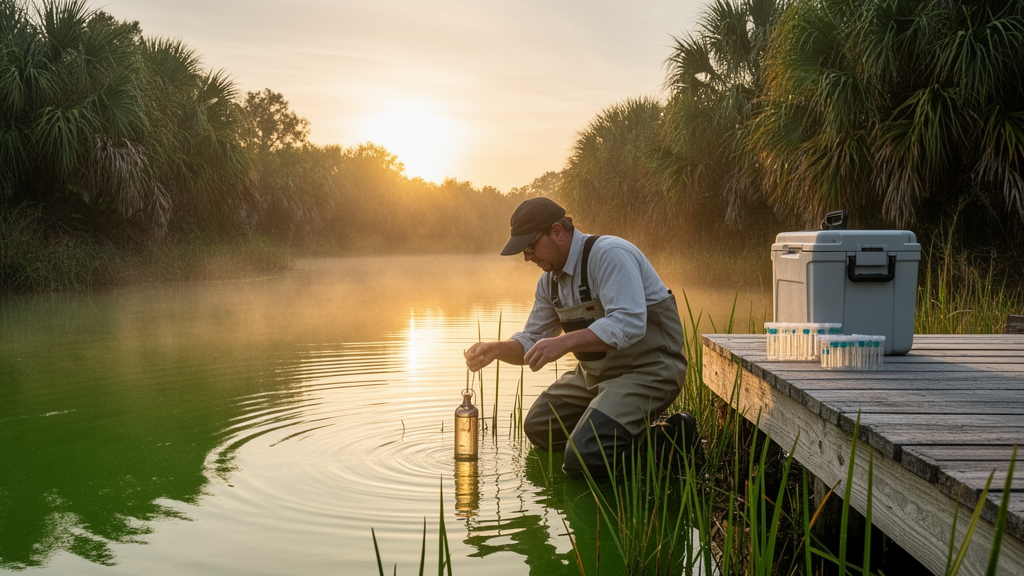
A synthetic chemical that most people have never heard of is quietly drifting through the lakes and wastewater streams of Tallahassee, Florida, and a new study shows that its movements are governed by something as ordinary as the weather. Researchers at the FAMU-FSU College of Engineering and Florida A&M University tracked 1,4-dioxane, a colorless and highly water-soluble compound classified as a likely human carcinogen by the U.S. Environmental Protection Agency, across four local lakes and a municipal wastewater treatment plant over multiple seasons. Their findings, published in the journal Environmental Monitoring and Assessment, reveal a striking pattern: concentrations peak in spring and fall to their lowest levels in summer, a rhythm driven largely by rainfall, dilution, and the hydrology of the watersheds that feed each lake.
1,4-Dioxane is not a chemical that anyone deliberately adds to the environment in large quantities. Instead, it arrives as an unintended byproduct. It forms during the manufacture of ethoxylated chemicals, including many detergents, shampoos, and cosmetics, and it was historically used as a stabilizer in chlorinated solvents such as 1,1,1-trichloroethane. Because it is fully miscible with water, has a low octanol-water partition coefficient, and resists both volatilization and biodegradation under typical conditions, it moves through soil and groundwater far more readily than most industrial contaminants. Conventional water treatment struggles to remove it, which is why regulators and scientists have grown increasingly concerned about its presence in drinking water sources across the United States and around the world.
The research team, led by Sarajeen Saima Hoque and Youneng Tang of Florida State University’s Department of Civil and Environmental Engineering together with Amita Jain of Florida A&M University’s Center for Water Resources, set out to answer a deceptively simple question: how do seasons and geography shape the amount of 1,4-dioxane in a real urban and agricultural landscape? They sampled surface water from four lakes in and around Tallahassee and wastewater at multiple treatment stages at the city’s water reclamation facility, measuring concentrations in the laboratory and pairing the results with field measurements of water temperature and precipitation records from NASA’s Prediction of Worldwide Energy Resources database.
The seasonal signal was unmistakable. In both surface water and wastewater, 1,4-dioxane concentrations were highest during spring and lowest during summer. Regression analyses showed that the concentrations were negatively correlated with both water temperature and precipitation. In other words, the hotter and wetter the conditions, the lower the measured concentrations. The explanation the authors point to is dilution: Florida’s intense summer rains and thunderstorms flush large volumes of water through the landscape, spreading the chemical across a much larger volume and washing it out of the system. In drier spring conditions, when flows are lower and contaminant inputs are not offset by heavy runoff, the chemical becomes more concentrated.
Geography told an equally compelling story. The lake with the highest concentrations was Lake Talquin, a reservoir associated with a large mixed-use watershed and a long residence time, meaning water and anything dissolved in it lingers there for an extended period. That combination, a broad catchment carrying runoff from varied land uses and a slow turnover of water, gives contaminants ample opportunity to accumulate. At the opposite end of the spectrum, the lake with the lowest concentration had limited connectivity to surrounding contamination sources and a smaller, more isolated drainage area. The contrast underscores a principle that water quality managers know well but rarely see quantified for this particular chemical: the architecture of a watershed, not just the presence of pollution sources, determines how much of a persistent contaminant ends up in the water.
One of the most dramatic findings involved hurricanes. When major storms struck the region, 1,4-dioxane concentrations in the lakes responded immediately. But the direction and magnitude of the response varied from lake to lake, depending on the balance between two competing effects. Storms can increase the input of dioxane by mobilizing contaminated runoff from urban and industrial surfaces, yet they simultaneously deliver enormous volumes of relatively clean rainwater that dilute whatever is already in the lake. Which effect wins depends on the characteristics of each watershed and the state of the lake at the time. This nuance matters for anyone trying to predict how extreme weather, which is becoming more frequent in a warming climate, will affect contaminant levels in surface waters.
The wastewater side of the study produced perhaps the most surprising result of all. The highest 1,4-dioxane concentration measured in the entire study was found not in the raw influent entering the treatment plant but in the tertiary effluent, the water that has passed through the most advanced stage of treatment. The researchers suggest a counterintuitive explanation: the chemical may be formed in situ during treatment itself, when chlorination oxidizes precursor compounds that are structurally related to dioxane. If confirmed, this would mean that a disinfection step designed to protect public health may inadvertently be creating a persistent contaminant in the very water destined for discharge into the environment. Similar formation pathways have been suspected in other treatment contexts, but documenting the pattern at a working municipal plant adds weight to a growing concern in the water treatment community.
Statistical analysis confirmed that the patterns were not random noise. The study found significant seasonal, spatial, and treatment-stage effects on 1,4-dioxane concentrations, with p-values below 0.05 for each factor. That triple confirmation matters because it suggests the findings are robust enough to inform monitoring strategy. If regulators know that spring is the season of peak concentrations, that lakes with large, well-connected, mixed-use watersheds are the most vulnerable, and that tertiary treatment can raise rather than lower dioxane levels, they can target their sampling resources far more effectively than a calendar-blind, location-blind program would allow.
The broader context makes the study timely. 1,4-Dioxane has been detected in drinking water systems across the United States, and monitoring efforts in places like North Carolina’s Cape Fear River basin have traced elevated levels to industrial discharges. Recent reviews describe it as a contaminant of emerging concern with significant regulatory disparities between jurisdictions: some states have adopted health advisory limits in the parts-per-trillion range while federal drinking water standards remain absent. The compound’s persistence means that once it enters an aquifer or a lake, it does not simply disappear. Biodegradation is possible under specific conditions, and researchers, including the Tallahassee team, have explored microbial approaches to breaking the chemical down, but natural attenuation in surface waters is slow and unreliable.
For the residents of Tallahassee and the millions of people living in similar landscapes across the humid southeastern United States, the study carries a practical message. The risk posed by 1,4-dioxane in surface water is not static. It breathes with the seasons, surges with storms, and shifts with the geography of the land. Wet summers offer a natural reprieve through dilution, while dry springs concentrate whatever is flowing through the system. Lakes like Talquin, with their large watersheds and long water residence times, act as slow-motion reservoirs of contamination, while smaller, isolated water bodies fare better. And the wastewater treatment plant, rather than being a barrier, may be a source, at least when chlorination chemistry is involved. As the EPA weighs how to regulate this likely carcinogen and utilities grapple with the cost of removing it, studies like this one provide the local, seasonal, and process-level detail that turns a national problem into something that can actually be managed, one watershed and one treatment plant at a time.
Subject of Research: Seasonal and spatial variation of 1,4-dioxane contamination in surface waters and wastewater in Tallahassee, Florida
Article Title: Seasonal variation and geographical distribution of 1,4-dioxane in surface waters and wastewaters in Tallahassee, Florida, USA
Article References: Hoque, S. S., Jain, A., & Tang, Y. (2026). Seasonal variation and geographical distribution of 1,4-dioxane in surface waters and wastewaters in Tallahassee, Florida, USA. Environmental Monitoring and Assessment, 198(10), Article 1041. https://doi.org/10.1007/s10661-026-15897-8
Image Credits: AI Generated
DOI: 10.1007/s10661-026-15897-8
Keywords: 1,4-dioxane, surface water, wastewater, seasonal variation, water quality, watershed, dilution, hurricanes, chlorination, emerging contaminants, Florida, environmental monitoring
Cite Scienmag News
Violet Maxwell. (October 14, 2026). Hidden Contaminant Rises and Falls with the Seasons in Florida’s Waters. Scienmag. https://scienmag.com/hidden-contaminant-rises-and-falls-with-the-seasons-in-floridas-waters/
Violet Maxwell. "Hidden Contaminant Rises and Falls with the Seasons in Florida’s Waters." Scienmag, 14 October 2026, https://scienmag.com/hidden-contaminant-rises-and-falls-with-the-seasons-in-floridas-waters/. Accessed 14 October 2026.
Violet Maxwell. "Hidden Contaminant Rises and Falls with the Seasons in Florida’s Waters." Scienmag. October 14, 2026. https://scienmag.com/hidden-contaminant-rises-and-falls-with-the-seasons-in-floridas-waters/


