


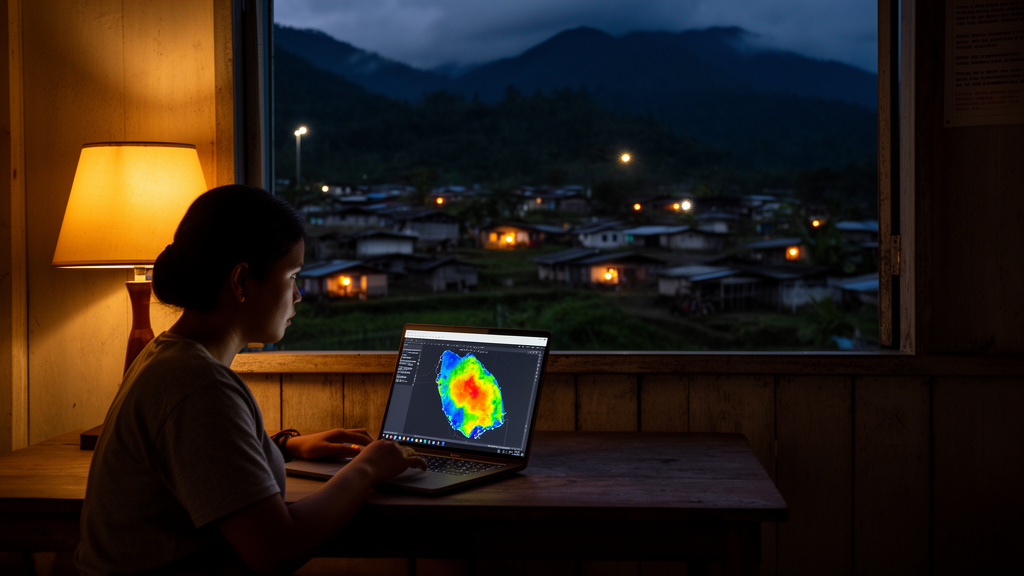
In the poorest region of Luzon in the Philippines, more than six in ten households lack adequate access to the internet, yet only a small fraction go without electricity, according to a study combining machine learning with econometric modeling on local household census data. The research, published in SN Social Sciences, examined three often-overlooked dimensions of deprivation—energy poverty and two forms of digital poverty—using records from the country’s Community-Based Monitoring System (CBMS).
The scale of the gaps varied sharply. Internet poverty was the most prevalent condition, affecting 60.85 percent of households, followed by cellphone poverty at 32.73 percent, while energy poverty—the lack of electricity access—stood at just 4.41 percent. Notably, these figures coexist with very high levels of conventional deprivation in the same population: 63.69 percent of households fell below the income poverty line and 51.12 percent experienced food poverty. The authors argue that despite poverty’s multidimensional nature, energy and digital access deprivation have received limited attention in poverty measurement and policy design.
Methodologically, the study fused two analytical traditions. Logistic regression, a standard econometric tool, was used to identify which socioeconomic and structural factors significantly influence the likelihood of each type of deprivation. The analysis pointed to a cluster of predictors: income status, housing conditions, access to water and sanitation, and exposure to disasters all significantly shaped whether a household experienced energy or digital deprivation. These associations highlight how infrastructure gaps compound existing vulnerabilities rather than appearing randomly across communities.
On top of the econometric layer, the researchers trained machine learning classifiers using only the statistically significant predictors from the regression stage. Model performance differed by outcome. A Random Forest model achieved the highest accuracy in classifying energy poverty, while a Support Vector Machine (SVM) performed best for classifying digital access poverty. The strong predictive results suggest that household-level CBMS records, already collected across the Philippines, contain enough signal to target populations where electricity, internet, or cellphone access is missing—without waiting for full infrastructure surveys.
The study is a single-region analysis of the poorest province-level area of Luzon, so the prevalence rates and predictor relationships describe that setting specifically rather than the country as a whole. As an observational analysis, it identifies associations between structural factors and deprivation, not causal effects of any single intervention. Even so, the authors frame the results as evidence of persistent structural inequalities and argue that the approach supports targeted, data-driven policy: identifying which households face which access gap could help officials direct electrification, connectivity, and device subsidy programs more precisely than income-based poverty lists alone.
Subject of Research: Predicting energy and digital access poverty in the Philippines using machine learning and econometric modeling of household survey data
Article Title: Predicting energy and digital access poverty to inform social policy in the Philippines: a fusion of machine learning and econometric modeling
Article References: Onsay, E. A. (2026). Predicting energy and digital access poverty to inform social policy in the Philippines: a fusion of machine learning and econometric modeling. SN Social Sciences, 6(11), Article 573. https://doi.org/10.1007/s43545-026-01846-2
Image Credits: AI Generated
DOI: 10.1007/s43545-026-01846-2
Keywords: energy poverty, digital divide, Philippines, machine learning, logistic regression, Random Forest, Support Vector Machine, CBMS, poverty measurement, social policy, Predicting, energy
Cite Scienmag News
Teresa Odom. (October 23, 2026). Machine Learning Maps Energy and Digital Poverty in Philippines’ Poorest Luzon Region. Scienmag. https://scienmag.com/machine-learning-maps-energy-and-digital-poverty-in-philippines-poorest-luzon-region/
Teresa Odom. "Machine Learning Maps Energy and Digital Poverty in Philippines’ Poorest Luzon Region." Scienmag, 23 October 2026, https://scienmag.com/machine-learning-maps-energy-and-digital-poverty-in-philippines-poorest-luzon-region/. Accessed 23 October 2026.
Teresa Odom. "Machine Learning Maps Energy and Digital Poverty in Philippines’ Poorest Luzon Region." Scienmag. October 23, 2026. https://scienmag.com/machine-learning-maps-energy-and-digital-poverty-in-philippines-poorest-luzon-region/


