


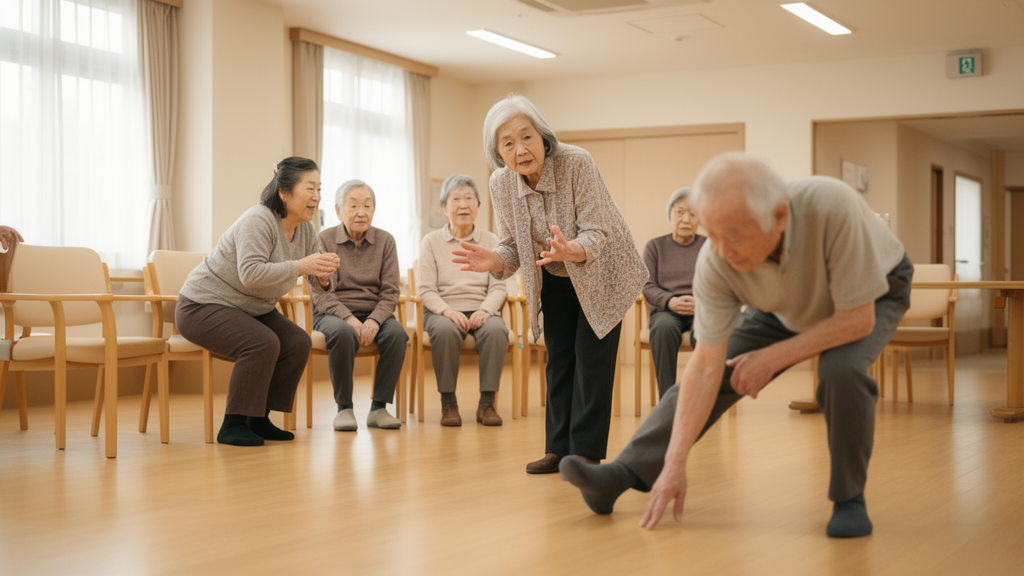
Older adults who reported richer social interaction were more likely to have normal motor function nine years later, according to a longitudinal observational study published in Discover Social Science and Health. The analysis drew on the Community Empowerment and Care Cohort Study in suburban central Japan and followed participants from 2011 to 2020, tracking how multidimensional social engagement relates to physical capability over an extended period.
The research team focused on 304 adults aged 65 and older who had no motor impairment at baseline and completed the follow-up. Social interaction was measured with the Index of Social Interaction (ISI), a multidimensional questionnaire, while motor function was evaluated with the Kihon Checklist. After adjusting for age, instrumental activities of daily living status, and baseline motor function score, participants with higher total ISI scores showed significantly higher odds of having normal motor function at follow-up, with an odds ratio of 1.21 (95% confidence interval: 1.01–1.47; p = 0.044).
Among the ISI subscales, social curiosity showed a significant association with motor function at follow-up, with an odds ratio of 1.39 (95% confidence interval: 1.01–1.92; p = 0.045). The authors suggest that baseline social interaction, particularly social curiosity, may be a relevant predictive factor for later motor function among community-dwelling older adults.
The authors are explicit that the design limits interpretation. Because the analysis was observational and conditioned on survival and continued participation, the findings should be interpreted as predictive associations rather than causal effects. The conditioning also narrows the population to which the estimates apply, since participants who died or dropped out during the nine-year window were not represented in the final analysis.
For now, the takeaway is measured: in this Japanese cohort, higher baseline social interaction scores went hand in hand with better odds of normal motor function at follow-up, and the association held after adjustment for age, daily living status, and baseline motor performance. Whether cultivating social interaction can itself protect mobility remains an open question for future research.
Subject of Research: Longitudinal association between multidimensional social interaction and motor function in community-dwelling older Japanese adults
Article Title: Association between social interactions and motor function in community-dwelling older Japanese adults
Article References: Zhao, R., Gao, H., Liu, Y., Imaizumi, A., Li, S., Zhang, J., Qian, M., Cui, M., Wang, M., Sawada, Y., Kakuda, A., Jiao, D., & Anme, T. (2026). Association between social interactions and motor function in community-dwelling older Japanese adults. Discover Social Science and Health. https://doi.org/10.1007/s44155-026-00497-1
Image Credits: AI Generated
DOI: 10.1007/s44155-026-00497-1
Keywords: social interaction, motor function, older adults, social curiosity, Index of Social Interaction, Kihon Checklist, longitudinal study, cohort study, Japan, healthy aging, Association, between
Cite Scienmag News
Courtney Benton. (October 23, 2026). Social Curiosity Linked to Better Motor Function in Older Japanese Adults. Scienmag. https://scienmag.com/social-curiosity-linked-to-better-motor-function-in-older-japanese-adults/
Courtney Benton. "Social Curiosity Linked to Better Motor Function in Older Japanese Adults." Scienmag, 23 October 2026, https://scienmag.com/social-curiosity-linked-to-better-motor-function-in-older-japanese-adults/. Accessed 23 October 2026.
Courtney Benton. "Social Curiosity Linked to Better Motor Function in Older Japanese Adults." Scienmag. October 23, 2026. https://scienmag.com/social-curiosity-linked-to-better-motor-function-in-older-japanese-adults/


