

Thursday, October 22, 2026
Science
No Result
View All Result
  • Login
  • HOME
  • SCIENCE NEWS
  • CONTACT US
  • HOME
  • SCIENCE NEWS
  • CONTACT US
No Result
View All Result
Scienmag
No Result
View All Result
Home Science News Agriculture

Lightweight AI detects potato leaf diseases under field conditions

October 22, 2026
in Agriculture
Alan Morgan
By Alan Morgan Scienmag Editorial Profile - Precision Agriculture
Reading Time: 3 mins read
0
Lightweight AI detects potato leaf diseases under field conditions

Lightweight AI detects potato leaf diseases under field conditions

65
SHARES
587
VIEWS
Share on FacebookShare on Twitter
ADVERTISEMENT

A lightweight artificial-intelligence model developed for detecting potato leaf diseases achieved 90.6% mAP50 on the DLOP dataset while using 6.5 million parameters and 15.6 GFLOPs, according to research published in BMC Plant Biology. The FEPL-DETR system was designed to locate diseased lesions on potato foliage under complex field conditions and was also tested on an edge-computing device.

Potato foliar diseases pose a threat to crop growth and yield, making timely and accurate disease detection important for early intervention and field management. Reliable detection remains challenging in field environments, where lesions may have varied edges, textures and irregular boundaries. FEPL-DETR is an adaptation of the efficient detection transformer RT-DETR, with three principal components intended to improve lesion representation, feature integration and training supervision.

Its first component is a Faster Frequency-domain Dynamic Convolution CSPDarknet backbone, which was built to adaptively represent lesion edges, textures and irregular boundaries. The second is BF-RepELAN, a feature network that incorporates RepNCSPELAN4 into a bidirectional multi-scale fusion topology. Together, these modules are intended to strengthen the representation of disease-related features at different scales.

The third component is DSI-GAM, a semantic-distillation framework adapted to FEPL-DETR. The researchers used it to strengthen semantic supervision during training. The model therefore combines a more adaptive visual backbone, multiscale feature processing and a training framework designed to provide additional semantic guidance.

On the DLOP dataset, FEPL-DETR reached 90.6% mAP50 and 65.4% mAP50:95. Compared with RT-DETR-R18, the model improved mAP50 by 5.7 percentage points and mAP50:95 by 0.6 percentage points. Its parameter count was 67.0% lower and its computational cost was 72.6% lower than that comparator, indicating a substantial reduction in model size and processing demand while maintaining the reported detection results.

The edge-device test found that FEPL-DETR processed 13.1 frames per second when deployed on an NVIDIA Jetson Orin Nano. This result demonstrates operation on a resource-constrained device in the study’s tested deployment setup. The reported speed should be understood in that context rather than as a general guarantee of performance across all hardware or field conditions.

External-dataset evaluations also indicated that the model could generalize beyond the DLOP dataset. The supplied research evidence does not specify the additional datasets, image sources or measured results from those evaluations, so the extent of that generalization cannot be independently characterized from the abstract. It does establish that the authors assessed performance beyond the primary dataset.

The work is a computational detection study, not a trial of disease-control outcomes. The reported results concern model accuracy, computational efficiency and inference speed; they do not establish effects on treatment decisions, crop yield or farm productivity. The article was published as open-access, peer-reviewed research in BMC Plant Biology and was available as an early version subject to further editing before replacement by the final Version of Record. Within the reported scope, FEPL-DETR offers a compact computer-vision approach for potato leaf-disease detection, including operation on edge hardware.

Subject of Research: Lightweight transformer-based detection of potato leaf diseases under complex field conditions

Article Title: FEPL-DETR: an efficient lightweight detector for potato leaf diseases under complex field conditions

Article References: Hou, Q., Zhang, Z., Tian, Y., Fu, Q., & Deng, L. (2026). FEPL-DETR: an efficient lightweight detector for potato leaf diseases under complex field conditions. BMC Plant Biology. https://doi.org/10.1186/s12870-026-10190-9

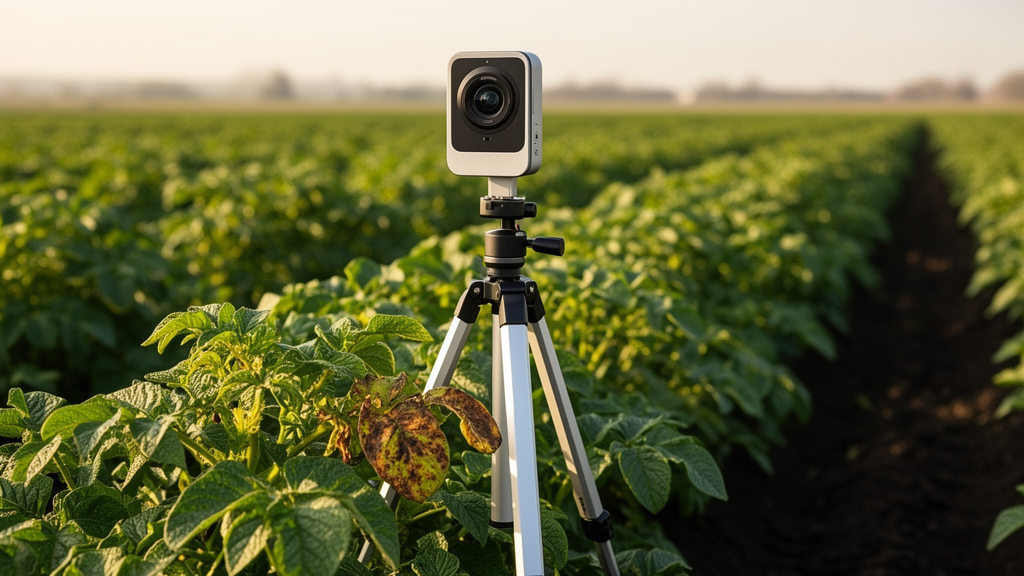
Image Credits: AI Generated

DOI: 10.1186/s12870-026-10190-9

Keywords: potato diseases, machine learning, object detection, FEPL-DETR, RT-DETR, edge computing, plant pathology, computer vision, crop monitoring, efficient detection, efficient, lightweight

Cite Scienmag News

Alan Morgan. (October 22, 2026). Lightweight AI detects potato leaf diseases under field conditions. Scienmag. https://scienmag.com/lightweight-ai-detects-potato-leaf-diseases-under-field-conditions/

Alan Morgan. "Lightweight AI detects potato leaf diseases under field conditions." Scienmag, 22 October 2026, https://scienmag.com/lightweight-ai-detects-potato-leaf-diseases-under-field-conditions/. Accessed 22 October 2026.

Alan Morgan. "Lightweight AI detects potato leaf diseases under field conditions." Scienmag. October 22, 2026. https://scienmag.com/lightweight-ai-detects-potato-leaf-diseases-under-field-conditions/


Tags: adaptive lesion boundary representationcomputer visioncrop monitoringearly intervention in potato crop managementedge computingedge computing for crop health monitoringefficientefficient detectionefficient detection transformer for agricultureFEPL-DETRfield-based plant disease diagnosislightweightlightweight crop disease detection modellow-parameter AI for agricultureMachine learningmulti-scale feature fusion for plant lesionsobject detectionplant pathologypotato diseasesPotato leaf disease detection AIreal-time potato disease identificationrobust disease detection under complex field conditionsRT-DETRsemantic distillation in plant disease models
Share26Tweet16
Previous Post

BMJ commentaries link military emissions and spending to climate and security risks

Next Post

Experimental study links graphene wrinkle sharpness to strong flexoelectric response

Related Posts

Wheat in Crisis: Variability of Wheat Area in Lebanon 2017–2025
Agriculture

Wheat in Crisis: Variability of Wheat Area in Lebanon 2017–2025

October 22, 2026
High-dose sheep manure improves black cumin oil composition in field trial
Agriculture

High-dose sheep manure improves black cumin oil composition in field trial

October 22, 2026
Tea resistance to anthracnose links enzymes, flavonoids and gene regulation
Agriculture

Tea resistance to anthracnose links enzymes, flavonoids and gene regulation

October 21, 2026
Sensitive LC–MS/MS Method Detects Beta-Casomorphin 5 in Pasteurized Milk
Agriculture

Sensitive LC–MS/MS Method Detects Beta-Casomorphin 5 in Pasteurized Milk

October 21, 2026
Genome-wide analysis identifies six mangrove bZIP genes induced by multiple stresses
Agriculture

Genome-wide analysis identifies six mangrove bZIP genes induced by multiple stresses

October 21, 2026
Research report: The regulatory role of DzERF94 in carotenoid biosynthesis during ripening in durian (Durio zibethinus) pulp
Agriculture

Research report: The regulatory role of DzERF94 in carotenoid biosynthesis during ripening in durian (Durio zibethinus) pulp

October 21, 2026
Next Post
Experimental study links graphene wrinkle sharpness to strong flexoelectric response

Experimental study links graphene wrinkle sharpness to strong flexoelectric response

  • Mothers who receive childcare support from maternal grandparents show more optimized

    Mothers who receive childcare support from maternal grandparents show more parental warmth, finds NTU Singapore study

    27656 shares
    Share 11059 Tweet 6912
  • University of Seville Breaks 120-Year-Old Mystery, Revises a Key Einstein Concept

    1061 shares
    Share 424 Tweet 265
  • Bee body mass, pathogens and local climate influence heat tolerance

    682 shares
    Share 273 Tweet 171
  • Researchers record first-ever images and data of a shark experiencing a boat strike

    546 shares
    Share 218 Tweet 137
  • Groundbreaking Clinical Trial Reveals Lubiprostone Enhances Kidney Function

    531 shares
    Share 212 Tweet 133
Science

Embark on a thrilling journey of discovery with Scienmag.com—your ultimate source for cutting-edge breakthroughs. Immerse yourself in a world where curiosity knows no limits and tomorrow’s possibilities become today’s reality!

RECENT NEWS

  • Sacred Fir Survivors Show Subtle Genomic Signs of Selection
  • Experimental study links graphene wrinkle sharpness to strong flexoelectric response
  • Lightweight AI detects potato leaf diseases under field conditions
  • BMJ commentaries link military emissions and spending to climate and security risks

Categories

  • Agriculture
  • Anthropology
  • Archaeology
  • Athmospheric
  • Biology
  • Biotechnology
  • Blog
  • Bussines
  • Cancer
  • Chemistry
  • Climate
  • Earth Science
  • Editorial Policy
  • Marine
  • Mathematics
  • Medicine
  • Pediatry
  • Policy
  • Psychology & Psychiatry
  • Science Education
  • Science News
  • Social Science
  • Space
  • Technology and Engineering

Subscribe to Blog via Email

Enter your email address to subscribe to this blog and receive notifications of new posts by email.

Join 5,151 other subscribers

© 2025 Scienmag - Science Magazine

Welcome Back!

Login to your account below

Forgotten Password?

Retrieve your password

Please enter your username or email address to reset your password.

Log In
No Result
View All Result
  • HOME
  • SCIENCE NEWS
  • CONTACT US

© 2025 Scienmag - Science Magazine

Discover more from Science

Subscribe now to keep reading and get access to the full archive.

Continue reading