


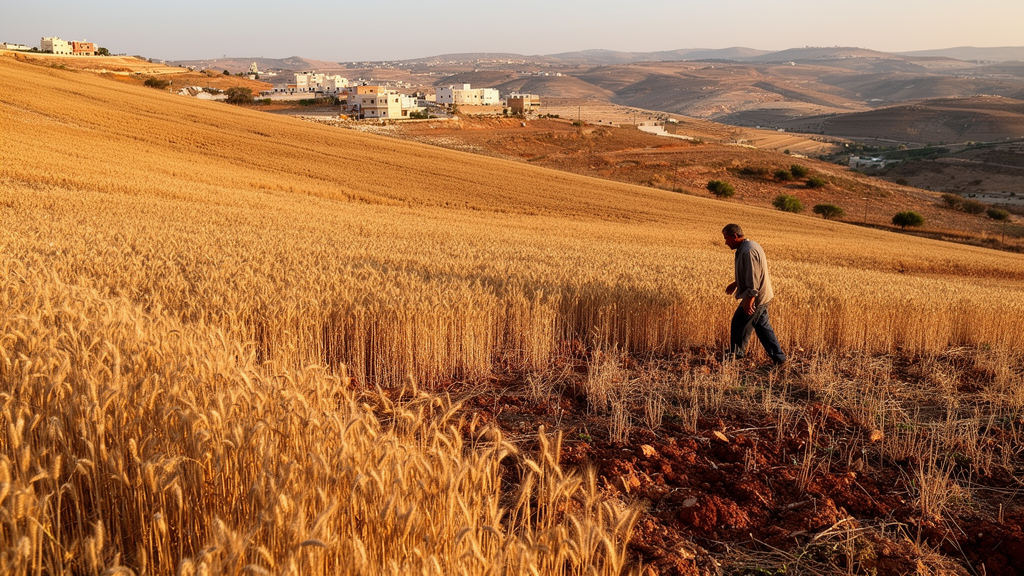
Lebanon’s wheat area shifted sharply across eight crop seasons, with national estimates ranging from about 27,212 hectares in 2018–2019 to 69,194 hectares in 2022–2023, according to a national remote-sensing study covering 2017–2018 through 2024–2025. The most pronounced contractions coincided with major changes in the country’s financial and security conditions: a 52% decline in 2021–2022, when production costs surged and subsidies weakened, followed by decreases of about 34% in 2023–2024 and 38% in 2024–2025, as conflict with Israel disrupted farming in southern areas. The researchers associated these patterns with economic shocks, conflict, displacement and crop rotation, while emphasizing that several seasonal estimates are operational approximations rather than fully validated measurements.
The study combined multi-temporal Sentinel-2 satellite observations, Google Earth Engine and a supervised Random Forest classifier to map Lebanon’s principal land-cover classes at 10-meter resolution. The analysis covered five classes: wheat, bare soil, built-up land, forest and non-wheat vegetation. A model trained on 2019–2020 reference data performed best when transferred to other seasons, with overall accuracy values of 0.90–0.94 and Cohen’s kappa coefficients of 0.88–0.92 for adjacent seasons. Across the full time series, overall accuracy reached 87%, while wheat producer and user accuracies exceeded 0.90 in most seasons. On average, 81% of surveyed wheat fields were mapped correctly across the four seasons for which suitable reference data were available.
Reference observations came from ground surveys conducted by the National Council for Scientific Research and the Directorate General of Cereals and Beetroot for 2017–2018, 2018–2019, 2019–2020 and 2022–2023. These were supplemented with manually interpreted high-resolution Google Earth imagery for other land-cover classes. The datasets were deliberately limited to 550 points per season, or 110 per class, to represent a monitoring system capable of operating during crises when field access and logistical support were restricted. The researchers also computed transition matrices between consecutive maps to identify implausible land-cover changes. Pixels classified as built-up or forest in at least four of the eight maps were retained in those classes throughout the series, reducing an unlikely forest-to-vegetation transition from 26% to 3% and a wheat-to-built-up transition from 20% to 5% in the affected comparisons.
Simple pixel counting was not treated as the final measure of cultivated area because misclassified or omitted fields can bias the result. Instead, the researchers applied random stratified sampling to estimate wheat proportions and 95% confidence intervals in the four seasons with reference observations. For the other seasons, they calibrated pixel counts against those reference-based estimates using a linear relationship with an R² of 0.9. The mapped area was underestimated by pixel counting in every season except 2018–2019, with biases ranging from 657 hectares, or about 1%, to 4,272 hectares, or almost 14%. Because several seasons lacked direct field samples, the missing estimates used a static average error rate of 14%. The researchers also recalculated uncertainty using the maximum observed rate of 18%; the directions of the temporal changes and overall trends remained unchanged under that sensitivity test.
Wheat area fell 10% between 2017–2018 and 2018–2019, recovered by a similar proportion in 2019–2020 and then expanded by 43% in 2020–2021. The researchers associated the latter increase with a counter-cyclical response to Lebanon’s widening food-security crisis. Government seed distribution, advance financing from wholesalers, support for domestic production and emergency interventions following the 2020 Beirut port explosion all coincided with the expansion. Return migration toward family farms, the appeal of wheat as a source of food and cash income, and the emergence of a local pasta manufacturer purchasing Lebanese durum wheat may also have strengthened incentives to cultivate. The expanded area was 83% above the average of the preceding three years even as production costs rose 40%, suggesting that concerns about bread availability and household resilience temporarily outweighed conventional expectations about how farmers would respond to rising costs.
The 2021–2022 season brought a different balance. Production costs expressed in Lebanese pounds rose 327%, the largest single-year increase in the study, while the parallel exchange rate deteriorated 252% and food-price inflation reached 440%. Diesel rose from 315,000 Lebanese pounds per 20 liters in 2021 to 841,000 pounds in 2022. Fertilizer that had cost about 253 US dollars per ton from 2017 through 2020 increased to 385 dollars in 2021 and 596 dollars in 2022, while local wheat-seed prices increased by approximately 22% in 2021. Government support weakened, farmers had restricted access to credit and were required to settle arrears, and imported inputs became sharply more expensive when converted into local currency. The researchers interpreted the resulting 52% area contraction as evidence that cultivation had become financially untenable, especially for small farmers lacking working capital.
Wheat then rebounded to its highest mapped extent in 2022–2023, a season in which the Lebanese economy began a partial shift toward dollarization and prices showed some stabilization. Although costs in Lebanese pounds continued rising, the increase was driven mainly by currency depreciation rather than rising dollar-denominated input prices, and the real burden measured in bread-bundle equivalents declined. High international wheat prices also made domestic production more attractive. Food inflation moderated from its 2021–2022 peak to 310.8%, and farmers’ adaptation and optimization of input choices may have supported renewed investment in wheat. The analysis therefore links the recovery to a combination of economic stabilization, currency effects, market prices and farmer adaptation rather than to a single cause, and it does not statistically isolate the contribution of each factor.
The renewed decline beginning in 2023–2024 coincided with the escalation of conflict between Israel and Lebanon, particularly in the south. The study recorded 8,574 attacks in Nabatiyeh and 4,657 in South Governorate by the end of 2024, compared with 762 in Baalback-Hermel, 267 in Bekaa and 10 in Akkar. Average wheat loss in the southern region reached 47% in 2023–2024 and 61% in 2024–2025. Around 900,000 people were reported displaced by December 2023, reducing access to fields and agricultural labor, while damage to infrastructure impeded movement of inputs and produce. The transition from wheat to bare soil rose from 9% to 24% in 2024–2025. The researchers described displacement and insecurity as likely constraints on sowing, although the observational analysis establishes temporal and geographic associations rather than a precise measure of each mechanism’s contribution.
Seasonal precipitation was almost uncorrelated with wheat area, producing a correlation of −0.01 even during the largest changes in cultivated extent. More than 80% of wheat plots in the Bekaa Plain receive supplemental irrigation, which can buffer irregular rainfall and reduce direct dependence on precipitation when deciding whether to plant. Water access may still matter indirectly: crisis conditions can raise fuel costs for pumping, increase purchased irrigation costs and make manual irrigation labor-intensive. Crop rotation also helps explain why relatively few mapped parcels remained in wheat during consecutive seasons; an average of 22% transitioned from wheat to vegetation, consistent with rotations involving potatoes and vegetables. The study did not estimate crop yield, directly survey farmer decisions or separate all causal effects statistically. The authors therefore characterize the analysis as a preliminary national baseline and identify continuous ground-reference collection, crop-yield estimates and region-specific socioeconomic surveys as priorities for future monitoring.
Subject of Research: National remote-sensing analysis of Lebanon’s wheat-area variability from 2017–2018 through 2024–2025 during overlapping economic, security and climatic crises.
Article Title: Wheat in Crisis: Variability of Wheat Area in Lebanon 2017–2025
Article References: Ibrahim, M., Faour, G., Le Page, M., Montginoul, M., Bitar, A. A., Komati, B., & Jarlan, L. (2026). Wheat in Crisis: Variability of Wheat Area in Lebanon 2017–2025. npj Sustainable Agriculture, 4(1), Article 86. https://doi.org/10.1038/s44264-026-00184-3
Image Credits: AI Generated
DOI: 10.1038/s44264-026-00184-3
Keywords: Lebanon, wheat cultivation, remote sensing, Sentinel-2, agricultural crisis, food security, Random Forest, conflict and agriculture, crop area, input costs, crop rotation, Wheat
Cite Scienmag News
Alan Morgan. (October 22, 2026). Wheat in Crisis: Variability of Wheat Area in Lebanon 2017–2025. Scienmag. https://scienmag.com/wheat-in-crisis-variability-of-wheat-area-in-lebanon-2017-2025/
Alan Morgan. "Wheat in Crisis: Variability of Wheat Area in Lebanon 2017–2025." Scienmag, 22 October 2026, https://scienmag.com/wheat-in-crisis-variability-of-wheat-area-in-lebanon-2017-2025/. Accessed 22 October 2026.
Alan Morgan. "Wheat in Crisis: Variability of Wheat Area in Lebanon 2017–2025." Scienmag. October 22, 2026. https://scienmag.com/wheat-in-crisis-variability-of-wheat-area-in-lebanon-2017-2025/


