


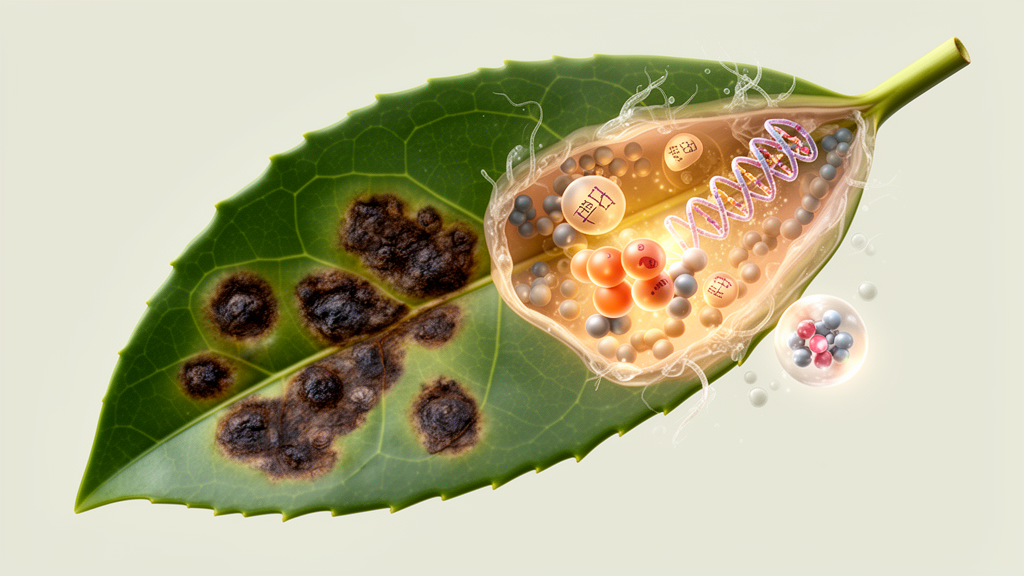
A multi-omics study of inoculated tea leaves found that the anthracnose-resistant cultivar ‘Shuixian 7’ showed faster and stronger changes in defense-enzyme activity than the susceptible cultivar ‘Lingtou Dancong’. The experiment also identified selective changes in flavonoids, genes associated with plant–pathogen interactions, and a highly expressed respiratory burst oxidase homolog gene, CsRbohC.
Researchers used Camellia sinensis leaves from the germplasm nursery at South China Agricultural University. They inoculated the leaves with Colletotrichum camelliae, the pathogen responsible for tea anthracnose, after isolating, purifying and identifying the fungus through morphological and molecular methods. The team also optimized fungal sporulation conditions; a culture medium containing potassium dihydrogen phosphate, sodium dihydrogen phosphate and sodium bicarbonate enhanced the pathogen’s sporulation capacity.
Measurements of superoxide dismutase, peroxidase and phenylalanine ammonia-lyase revealed significant differences between the two cultivars under anthracnose stress. Although both showed similar overall response trends, ‘Shuixian 7’ displayed more intense and rapid changes. The analysis established a link between defense-enzyme activity and reactive oxygen species during the pathogen-induced stress response.
Metabolome sequencing at one and five days after inoculation detected hundreds of differential metabolites in ‘Shuixian 7’ compared with ‘Lingtou Dancong’. Flavonoids constituted the predominant class. Quercetin-3-O-glucoside, quercetin, kaempferol-3-O-galactoside and quercetin-3-O-sophoroside were significantly upregulated in the resistant cultivar, whereas acacetin, luteolin, apigenin-7-O-neohesperidoside and apigenin-6-C-glucoside were downregulated. Thus, the response involved specific changes within the flavonoid group rather than a uniform increase or decrease across all measured flavonoids.
The researchers then evaluated eight metabolites in in vitro antifungal assays at equivalent concentrations. Quercetin had the strongest inhibitory effect on C. camelliae among the eight compounds tested. This result demonstrated inhibition under the laboratory assay conditions; the reported experiment did not test quercetin as a treatment for infected tea plants or establish its effect at commercial scale.
RNA sequencing covered five infection time points and identified differentially expressed genes that were primarily enriched in metabolic pathways and plant–pathogen interactions. Together with the enzyme assays and metabolome analysis, the transcriptomic results described a multi-layered response involving changes in gene expression, metabolite abundance and the activities of selected defense-related enzymes.
The team also examined respiratory burst oxidase homolog, or Rboh, genes across the Camellia sinensis genome. Seven Rboh family members were identified, and bioinformatic characterization of their expression was combined with the infection transcriptomic data. CsRbohC was characterized as highly expressed in that dataset. The study identified it as a candidate associated with regulation during biotic stress, but the reported results do not establish that CsRbohC alone determines resistance.
Overall, the controlled comparison provides evidence that resistant ‘Shuixian 7’ combines rapid, stronger defense-enzyme responses with a selective flavonoid profile and broader regulation of metabolic and plant–pathogen interaction pathways. The reported scope includes experimental inoculation of two cultivars, selected metabolite-sampling times, five transcriptomic time points and in vitro fungal inhibition. The supplied findings do not include the underlying numerical enzyme measurements, metabolite quantities, statistical effect sizes, complete replicate information or field outcomes, so the full causal network and performance under other growing conditions remain unresolved.
Subject of Research: Multi-omics analysis of enzyme, metabolite and gene responses in tea cultivars inoculated with the anthracnose pathogen.
Article Title: Multi-omics profiling of defense enzymes and phenylpropanoid regulation in Camellia sinensis post-Colletotrichum camelliae inoculation
Article References: Li, M., Chen, X., Chen, X., Huang, Y., & Zeng, Z. (2026). Multi-omics profiling of defense enzymes and phenylpropanoid regulation in Camellia sinensis post-Colletotrichum camelliae inoculation. BMC Plant Biology. https://doi.org/10.1186/s12870-026-09843-6
Image Credits: AI Generated
DOI: 10.1186/s12870-026-09843-6
Keywords: tea anthracnose, Camellia sinensis, Colletotrichum camelliae, plant defense, flavonoids, multi-omics, RNA sequencing, defense enzymes, reactive oxygen species, resistant cultivar, profiling, defense
Cite Scienmag News
Juliet Wilcox. (October 21, 2026). Tea resistance to anthracnose links enzymes, flavonoids and gene regulation. Scienmag. https://scienmag.com/tea-resistance-to-anthracnose-links-enzymes-flavonoids-and-gene-regulation/
Juliet Wilcox. "Tea resistance to anthracnose links enzymes, flavonoids and gene regulation." Scienmag, 21 October 2026, https://scienmag.com/tea-resistance-to-anthracnose-links-enzymes-flavonoids-and-gene-regulation/. Accessed 21 October 2026.
Juliet Wilcox. "Tea resistance to anthracnose links enzymes, flavonoids and gene regulation." Scienmag. October 21, 2026. https://scienmag.com/tea-resistance-to-anthracnose-links-enzymes-flavonoids-and-gene-regulation/


