


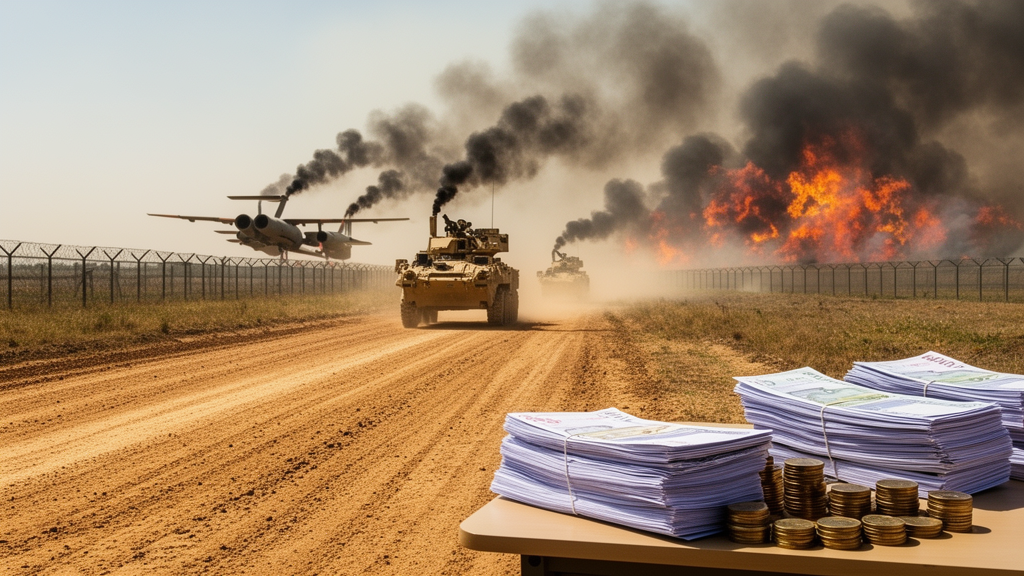
Two commentaries published in The BMJ argue that treating climate change as a threat multiplier can encourage governments to increase military expenditure while overlooking the greenhouse-gas emissions produced by armed forces, the arms industry and warfare. In the first commentary, Neta Crawford of the University of St Andrews says this framing ignores how war and routine military activities—including powering bases and supplying energy for training and mobility—can themselves amplify climate change. The articles are expert commentaries rather than empirical studies or evaluations of particular policies.
Crawford notes that the annual greenhouse-gas emissions of the US Department of Defence are larger than the annual emissions of many countries. The arms industry is another major source of emissions, while wars can cause large spikes in emissions, particularly when targets include oil and natural-gas infrastructure. She acknowledges that the military has an enormous emissions footprint that can be reduced, but argues that substantial reductions will occur only if armed forces reduce their overall size and footprint and transition to lower-emitting doctrines, including doctrines that do not require long-range aircraft missions.
Rather than financing defence by taking money from health, environmental protection and the energy transition, Crawford argues that governments should increase spending in those areas. She does not reject the need for defence. Instead, she calls for attention to how effective protection can be provided at lower emission levels and reduced cost. Her central argument is that expanded military expenditure does not by itself resolve the security risks associated with climate change when the armed forces and their supporting activities contribute to those risks.
A second commentary, by Mohammed Abba-Aji at Washington University and Nason Maani at the University of Edinburgh, warns that rising defence budgets may weaken security in another sense by diverting public resources from climate, education and other human needs. The article reports that world military expenditure reached $2,887 billion (£2,182 billion; €2,575 billion) in 2025, approaching 2.5% of world output. Official development assistance fell to $174 billion in 2025, described in the commentary as the largest annual reduction on record. These reported spending trends are not results from a causal analysis, but they frame the authors’ assessment of trade-offs between military and social expenditure.
Abba-Aji and Maani describe a potentially reinforcing cycle in which climate stress contributes to resource conflicts, which are then used to justify increased military spending. Such spending can divert funds from measures that could help interrupt the cycle. They further argue that wealthier governments need not participate directly in these conflicts to influence them: supplying arms that sustain them while reducing aid to affected states can contribute to the conditions associated with instability. Their proposed response is to weigh the health and climate implications of military-versus-social spending decisions and to direct a share of security funding toward climate adaptation, especially in vulnerable regions. They conclude that a government’s duty to protect citizens should include protection from climate-change effects, threats to health and environmental damage as well as protection against aggression.
Subject of Research: Military expenditure, armed-forces emissions, climate change and public security
Article Title: Investing more in the military is not a solution to climate change, and may cost us our security
Article References: Investing more in the military is not a solution to climate change, and may cost us our security. Original publication (Bibliographic details unavailable.)
Image Credits: AI Generated
DOI: Not provided
Keywords: military emissions, defence spending, climate change, armed forces, greenhouse gases, public security, climate adaptation, official development assistance, arms industry, BMJ commentaries, Investing, military
Cite Scienmag News
Sloane Callahan. (October 22, 2026). BMJ commentaries link military emissions and spending to climate and security risks. Scienmag. https://scienmag.com/bmj-commentaries-link-military-emissions-and-spending-to-climate-and-security-risks/
Sloane Callahan. "BMJ commentaries link military emissions and spending to climate and security risks." Scienmag, 22 October 2026, https://scienmag.com/bmj-commentaries-link-military-emissions-and-spending-to-climate-and-security-risks/. Accessed 22 October 2026.
Sloane Callahan. "BMJ commentaries link military emissions and spending to climate and security risks." Scienmag. October 22, 2026. https://scienmag.com/bmj-commentaries-link-military-emissions-and-spending-to-climate-and-security-risks/


