

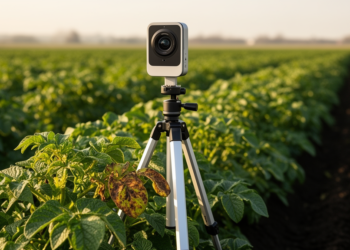
Lightweight AI detects potato leaf diseases under field conditions
A lightweight detection model achieved 90.6% mAP50 for potato leaf-disease localization while using fewer parameters and less computation than RT-DETR-R18.
A lightweight detection model achieved 90.6% mAP50 for potato leaf-disease localization while using fewer parameters and less computation than RT-DETR-R18.

A two-season Chinese field study found that fused UAV spectral, texture, LiDAR and temporal features with random forest produced the ...
A new study demonstrates that combining fiber optic reflectance and terahertz spectroscopy can detect potato late blight before visible symptoms ...
Researchers showed that simple curve-based rules applied to freely available Sentinel-2 and Sentinel-1 satellite data can accurately retrieve five key ...
An eight-year satellite study of an Azerbaijani apple orchard shows NDVI can reliably predict yields only for individual plots of ...
Researchers have shown that real-time mass spectrometry and electronic noses can detect the chemical distress signals maize plants emit when ...
Researchers combined a CNN-LSTM deep learning network pre-trained on radiative transfer simulations with transfer learning to estimate potato leaf area ...
A new comprehensive review maps the rapid progress of agricultural robotics across harvesting, weeding, precision farming, and livestock management, while ...
A new Nature Food commentary argues that improving global crop yield estimation demands better accuracy assessment and a clearer understanding ...

Embark on a thrilling journey of discovery with Scienmag.com—your ultimate source for cutting-edge breakthroughs. Immerse yourself in a world where curiosity knows no limits and tomorrow’s possibilities become today’s reality!