


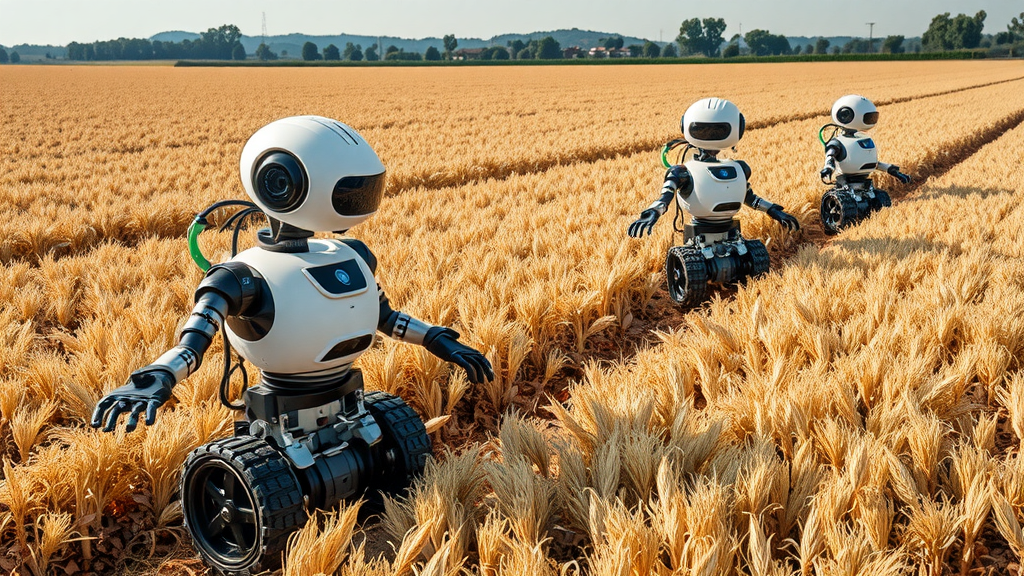
A quiet revolution is unfolding across the world’s farmland, one articulated arm and autonomous wheel at a time. A new state-of-the-art review published in the International Journal of Intelligent Robotics and Applications takes stock of how robotics is reshaping agriculture, from the strawberry rows of Japan to the wheat belt of China, and delivers a sober assessment of the technical, economic, and regulatory obstacles standing between laboratory prototypes and everyday farm machinery. The review, authored by Md. Kamaruzzaman and Sarita Pandey of The Neotia University in Kolkata and Md. Azharuddin of Aliah University, synthesizes decades of research into crop monitoring, precision farming, harvesting, and livestock management, and argues that the coming decade will be defined not by whether robots can farm, but by whether farmers can afford them, trust them, and regulate them effectively.
The case for agricultural robotics rests on an uncomfortable arithmetic. Global population continues to climb while arable land per capita shrinks, and the research literature the authors draw upon cites stark figures on the interaction between food production, biodiversity protection, and demographic pressure. At the same time, crop losses to pests remain enormous, with published estimates in the review’s underlying literature suggesting that weeds, pathogens, and insects claim a substantial share of potential harvests worldwide. Machines that can patrol a field around the clock, distinguish a weed seedling from a crop plant with millimetre precision, and apply inputs only where needed promise a way to close that gap while reducing chemical use and soil compaction. It is this convergence of necessity and capability, the authors argue, that has moved agricultural robotics from an academic curiosity to a strategic imperative.
Harvesting remains the most visible and most demanding application. The review traces a lineage of fruit-picking machines stretching back more than two decades, including early autonomous cucumber harvesters developed in the Netherlands, robotic apple pickers demonstrated in Europe and Washington State, and strawberry-harvesting robots field-tested in Japan, where elevated-trough growing systems were specifically engineered to make fruit accessible to manipulators. The technical hurdles are formidable: fruit detection under variable lighting, occlusion by leaves and branches, collision-free motion planning for redundant seven-link manipulators, and end-effectors gentle enough not to bruise delicate produce. Modern systems increasingly fuse RGB-D cameras, structured-light vision, and LiDAR to localize fruit in three dimensions, while deep learning approaches trained on orchard imagery have dramatically improved detection rates for apples, mangoes, and sweet peppers. Yet the review notes that even the best prototypes still lag human pickers in speed and reliability, which is why commercial deployment has concentrated on high-value crops where labor scarcity is most acute.
Weeding, by contrast, has emerged as one of the closer-to-market successes. Because mechanical weed control replaces herbicides rather than replicating human dexterity, the tolerances are more forgiving. The review catalogs a rich history of vision-guided weeders, from early mobile robots with camera-based perception for mechanical weed control to four-wheel-steered platforms that detected weeds among sugar beet, and micro-robots designed for paddy fields in Asia. Recent systems use plant classification algorithms to identify crop rows and intra-row weeds, then actuate targeted hoes, tines, or micro-sprays. Improved convolutional neural networks have pushed maize seedling detection to new levels of accuracy under complex field conditions, and researchers have demonstrated robotic in-row weed control in commercial vegetable production. For organic farmers in particular, who cannot rely on selective herbicides, these machines represent a genuine transformation in weed management economics.
Precision seeding, transplanting, and field scouting round out the ground-robot portfolio documented in the review. Wheat precision-seeding robots have been tested at scale in China, autonomous rice seeders have operated in dry paddy fields in Thailand, and high-speed plug seedling transplanting robots have been designed and simulated for greenhouse nurseries. Phenotyping platforms such as the BoniRob field robot can measure individual plants repeatedly across a season, feeding plant breeders with data impossible to collect by hand. Coverage path planning has matured into a discipline of its own, with genetic algorithms optimizing driving angles and track sequences, and three-dimensional planning methods minimizing skipped or overlapped swaths on undulating terrain. Navigation, once dependent on buried cables or manual guidance, now relies on satellite positioning fused with machine vision and LiDAR-based tree recognition, allowing platforms to localize themselves inside orchards where sky visibility is compromised.
Above the crops, a parallel fleet has taken to the air. The review surveys the role of unmanned aerial vehicles in remote sensing and precision agriculture, including autonomous UAVs with onboard vision-based decision making and fleets of mini aerial robots coordinated for efficient area coverage. Drone-acquired imagery, analyzed with spectral-spatial methods, has been used to detect and count tomatoes from the sky, while LiDAR and vision sensors mounted on aircraft and ground vehicles have mapped almond orchard canopy volume, flower density, and yield. Vineyard yield estimation by dedicated scouting robots has moved into preliminary commercial trials in Europe. Together, these aerial systems give growers a synoptic view of field variability that ground robots complement with close-range, high-resolution measurements, forming what the authors describe as an increasingly integrated sensing and actuation architecture.
Livestock management, though less glamorous, is identified as a growing frontier. Autonomous robots have been tested for measuring air quality inside livestock buildings, navigating the cluttered, dusty, and corrosive environments of animal housing with surprising accuracy. The review notes that such applications demand robustness traits quite different from field machinery, including resistance to ammonia, washdown sanitation, and safe operation around unpredictable animals. Meanwhile, cooperative robotics, in which multiple machines share tasks and information, is flagged as an emerging paradigm that could let small, cheap robots collectively accomplish what would otherwise require an expensive, heavy single platform, thereby reducing soil compaction and spreading risk across redundant units.
The heart of the review lies in its unsparing analysis of what still blocks adoption. Technically, agricultural environments are adversarial: mud, dust, rain, and unstructured vegetation confound sensors designed for factory floors; energy density limits endurance; and perception systems must generalize across cultivars, seasons, and lighting regimes. Economically, the authors point to long-standing feasibility studies showing that agricultural robots must compete with machinery whose costs are amortized over enormous acreage, and that adoption depends on farm size, labor markets, and payback periods that vary wildly between regions. Regulatory considerations, from safety certification of machines operating near humans to liability for autonomous decisions, remain fragmented and largely undeveloped. The review also highlights data ownership and interoperability questions as machines from different manufacturers must eventually share fields, infrastructure, and information.
The path forward, the authors conclude, runs through artificial intelligence, machine learning, and their fusion with the Internet of Things and big data analytics. Recent literature they cite documents AI-driven autonomous robots for precision agriculture, machine learning methods for crop disease detection, and IoT-enabled smart irrigation systems that couple sensor networks with robotic actuation. But the review’s most emphatic recommendation is interdisciplinary: robust algorithms, standardized protocols, and cost-effective designs will emerge only when roboticists work alongside agronomists, economists, and policymakers rather than in parallel silos. If that collaboration materializes, the authors argue, agricultural robotics can underpin farming systems that are simultaneously more productive, more sustainable, and more resilient to labor shortages and climate stress, turning a generation of promising prototypes into the quiet workhorses of the world’s farms.
Subject of Research: Application of robotics, artificial intelligence, and automation technologies to agriculture, including crop monitoring, precision farming, harvesting, and livestock management
Article Title: A state-of-the-art review on robotics in agriculture: research challenges and future directions
Article References: Kamaruzzaman, M., Pandey, S., & Azharuddin, M. (2026). A state-of-the-art review on robotics in agriculture: research challenges and future directions. International Journal of Intelligent Robotics and Applications. https://doi.org/10.1007/s41315-026-00584-1
Image Credits: AI Generated
DOI: 10.1007/s41315-026-00584-1
Keywords: agricultural robotics, precision agriculture, harvesting robots, weeding robots, crop monitoring, artificial intelligence, machine learning, Internet of Things, UAV drones, livestock management, field robotics, sustainable farming
Cite Scienmag News
Denise Maddox. (September 12, 2026). Robots in the Field: New Review Maps Agricultural Robotics Challenges Ahead. Scienmag. https://scienmag.com/robots-in-the-field-new-review-maps-agricultural-robotics-challenges-ahead/
Denise Maddox. "Robots in the Field: New Review Maps Agricultural Robotics Challenges Ahead." Scienmag, 12 September 2026, https://scienmag.com/robots-in-the-field-new-review-maps-agricultural-robotics-challenges-ahead/. Accessed 5 October 2026.
Denise Maddox. "Robots in the Field: New Review Maps Agricultural Robotics Challenges Ahead." Scienmag. September 12, 2026. https://scienmag.com/robots-in-the-field-new-review-maps-agricultural-robotics-challenges-ahead/


