


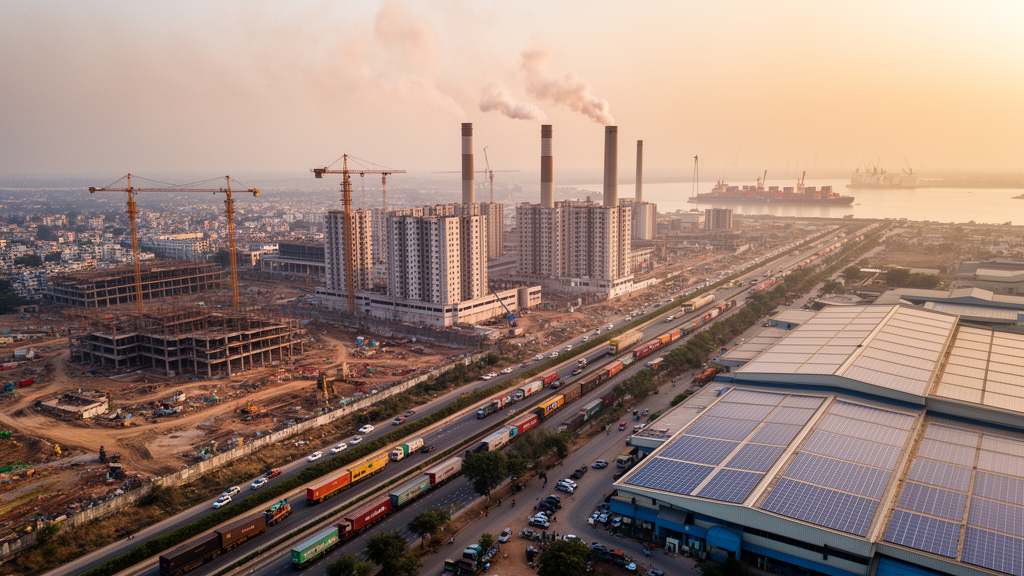
India’s economic growth and inflationary pressure were significantly associated with increased carbon dioxide emissions over the long term in an analysis covering 1970–2022. The study examined India’s macroeconomic relationship with emissions using Autoregressive Distributed Lag (ARDL) and non-linear ARDL (NARDL) models to estimate short-run and long-run dynamics and test whether positive and negative shocks produced different effects. The ARDL results showed a significant positive long-run relationship between both economic growth and inflation and CO₂ emissions.
In statistical terms, higher growth and higher inflation were associated with larger emissions over the long-run horizon. The finding makes macroeconomic stability and environmental sustainability a connected policy issue for India, although the analysis does not establish that either factor alone caused the observed emissions changes. The relationship varied between time horizons.
Inflation had a negative short-run association with CO₂ emissions, indicating that emissions were lower when inflation was higher in the shorter period estimated by the model. The researchers associated this pattern with the possibility that inflationary conditions temporarily coincide with reduced economic activity, but the result is a statistical relationship rather than proof of a single mechanism. The non-linear estimates provided no strong evidence of asymmetry in the principal comparisons.
Positive and negative shocks to economic growth or inflation generally appeared to have broadly similar effects on emissions. One narrower result was that negative inflation shocks were associated with lower emissions in the short run, consistent with a temporary environmental improvement during disinflation. This short-run pattern did not reverse the finding of higher long-run emissions under the ARDL estimates.
To improve the robustness of the analysis, the models included natural resource rents, electricity consumption and natural gas consumption as control variables. The study was therefore a macroeconomic time-series analysis of India rather than a direct assessment of particular emissions sources, household behavior or individual climate policies. Its results describe statistical associations across more than five decades and do not demonstrate that every increase in growth or inflation necessarily produces a corresponding emissions increase.
The research also used a non-linear framework capable of distinguishing positive from negative shocks, while the ARDL model assessed how growth, inflation and emissions were related across short and long periods. This combination allows apparently contrasting findings to coexist: inflation can have a negative short-run coefficient alongside a positive long-run coefficient, and negative inflation shocks can reduce emissions temporarily without providing strong evidence of a lasting difference between shock directions. The authors’ policy interpretation is that inflation management and the transition toward cleaner energy sources should be considered together.
Their findings support an integrated approach that accounts for the long-run statistical association between macroeconomic variables and emissions while advancing cleaner energy. Overall, the study identifies a measurable long-run association between India’s economic growth, inflation and CO₂ emissions between 1970 and 2022. Its central result is not that short-term emissions effects during inflationary or disinflationary periods are identical, but that the available non-linear evidence does not strongly support systematically different effects for positive and negative shocks.
The findings frame emissions management as a challenge that must be addressed alongside broader macroeconomic objectives.
Subject of Research: Statistical associations between India’s growth, inflation and CO₂ emissions from 1970 to 2022
Article Title: Impact of inflation and economic growth on environmental sustainability of the Indian economy
Article References: Panda, L., Mohanty, S., Chakraborty, S., & Jampala, M. B. (2026). Impact of inflation and economic growth on environmental sustainability of the Indian economy. Discover Sustainability. https://doi.org/10.1007/s43621-026-04422-z
Image Credits: AI Generated
DOI: 10.1007/s43621-026-04422-z
Keywords: India, CO₂ emissions, economic growth, inflation, environmental sustainability, ARDL, NARDL, macroeconomics, natural resource rents, energy consumption, Impact, economic
Cite Scienmag News
Sloane Callahan. (October 22, 2026). India’s Growth and Inflation Linked to Higher Long-Run CO₂ Emissions. Scienmag. https://scienmag.com/indias-growth-and-inflation-linked-to-higher-long-run-co%e2%82%82-emissions/
Sloane Callahan. "India’s Growth and Inflation Linked to Higher Long-Run CO₂ Emissions." Scienmag, 22 October 2026, https://scienmag.com/indias-growth-and-inflation-linked-to-higher-long-run-co%e2%82%82-emissions/. Accessed 22 October 2026.
Sloane Callahan. "India’s Growth and Inflation Linked to Higher Long-Run CO₂ Emissions." Scienmag. October 22, 2026. https://scienmag.com/indias-growth-and-inflation-linked-to-higher-long-run-co%e2%82%82-emissions/


