


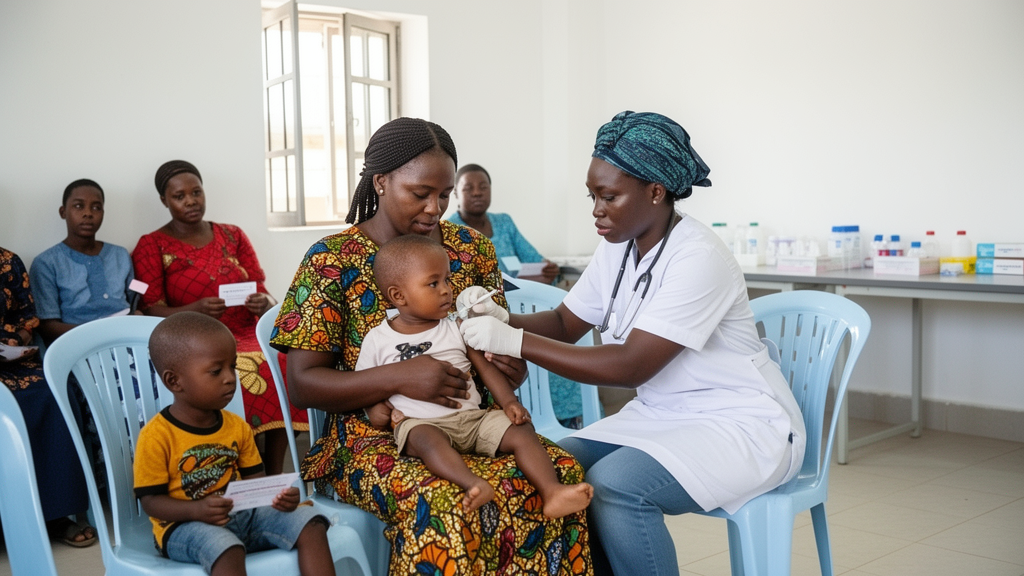
Nigeria’s Big Catch-up immunisation initiative reached 75% of its target children with Penta3 in Rivers State and 70% with Penta2 in Bauchi State across three rounds, according to a sequential explanatory mixed-methods case study. The campaign ran between December 2024 and April 2025 and targeted children aged 12–59 months who had missed vaccinations. The study examined planning, implementation and monitoring at five purposively selected sites across the two states; it was not designed to measure results across every Nigerian state or for every eligible child.
Researchers collected Big Catch-up monitoring data from rounds 1–3 and conducted 67 key-informant interviews and 18 focus groups between July and August 2025. Participants were purposively sampled programme managers, partners, routine-immunisation providers and community members. The investigators analysed the quantitative data descriptively, examined qualitative material thematically and triangulated findings across the datasets. Their case-study scope provides operational lessons from the selected sites, rather than a controlled estimate of the effects of individual campaign measures.
Planning drew on collaboration among government, partners and communities, existing immunisation governance structures and staff, detailed microplanning with geospatial mapping, and vaccine forecasting and allocation tailored to individual facilities. Implementation combined service-delivery strategies adapted to local conditions with community mobilisation through leaders and groups, plus communication tailored to reach children who had missed vaccinations and address sociocultural barriers. Outreach reached the most children in both states. The age distribution of children reached also differed: Bauchi reached more children aged 24–59 months, while Rivers reached more aged 12–23 months. These findings describe strategies used and children reached in the documented campaign, not a test of which strategy independently produced the reported coverage.
Monitoring practices included age-segregated reporting tools, real-time digital data, daily review meetings, supportive supervision and ward-level data validation. The researchers reported that these practices enabled feedback, rapid problem-solving and quality control during the campaign. Big Catch-up also depended in part on unpaid volunteers, even though its operating model largely used routine immunisation systems rather than a parallel structure. The study did not report whether any single planning, implementation or monitoring measure caused the observed reach.
The authors concluded that identifying and vaccinating children who had missed vaccinations with catch-up doses was feasible when adequate resources, coordination and community engagement were available. They recommended formal policy to make catch-up vaccination a continuous component of routine immunisation, supported by domestic financing, integration into existing systems, operational flexibility and formalised roles for community volunteers. These are policy conclusions from the case study, which examined two states and five selected sites rather than the programme’s full geographic reach or long-term sustainability.
Subject of Research: Evaluation of Nigeria’s Big Catch-up immunisation initiative for children aged 12–59 months
Article Title: Reaching zero-dose children: lessons learned from the planning, implementation, and monitoring of Nigeria’s Big Catch-up initiative
Article References: Obi-Jeff, C., Abdulganiyu, A. O., Okeke, C., Ahunam, C. P., Olanrewaju, C., Muhammed, M. T., Oluropo, R., Arowosegbe, M., Oguntimehin, F., & Uzochukwu, B. (2026). Reaching zero-dose children: lessons learned from the planning, implementation, and monitoring of Nigeria’s Big Catch-up initiative. International Journal for Equity in Health. https://doi.org/10.1186/s12939-026-03088-3
Image Credits: AI Generated
DOI: 10.1186/s12939-026-03088-3
Keywords: Nigeria, Big Catch-up, routine immunisation, zero-dose children, Penta2, Penta3, vaccination coverage, community engagement, outreach services, immunisation monitoring, Reaching, zero-dose
Cite Scienmag News
Courtney Benton. (October 22, 2026). Big Catch-up reached most targeted children in Nigerian case study. Scienmag. https://scienmag.com/big-catch-up-reached-most-targeted-children-in-nigerian-case-study/
Courtney Benton. "Big Catch-up reached most targeted children in Nigerian case study." Scienmag, 22 October 2026, https://scienmag.com/big-catch-up-reached-most-targeted-children-in-nigerian-case-study/. Accessed 22 October 2026.
Courtney Benton. "Big Catch-up reached most targeted children in Nigerian case study." Scienmag. October 22, 2026. https://scienmag.com/big-catch-up-reached-most-targeted-children-in-nigerian-case-study/


