


High in the Eastern Cordillera of Colombia, a string of lakes supplies drinking water, irrigates dairy pastures and potato fields, and anchors local livelihoods for thousands of people. Yet the microscopic organisms that drift in these waters have remained largely invisible to science. A new exploratory study published in the journal Biogeosciences offers one of the first detailed looks at the bacterial communities of four Andean highland lakes, using DNA sequencing to catalog thousands of microbial lineages and to predict what those communities might be capable of doing. The results paint a picture of striking diversity, unexpected functional potential, and the faint genetic signatures of bacteria that include species of potential health relevance, all while the authors caution that their limited sampling provides a baseline rather than a definitive diagnosis of ecosystem health.
The research team, led by Andrés Gómez-Palacio of the Universidad Pedagógica y Tecnológica de Colombia in Tunja, sampled six water bodies’ worth of material from four contrasting lake systems: Fúquene Lagoon, Tota Lake, Calderona Lagoon, and Colorado Lagoon. Five samples were collected during 2019, spanning April through November, while a sixth sample from Tota, originally collected in December 2018 and previously reported by an earlier study, was reprocessed with the same bioinformatic workflow as a historical reference. The four lakes differ dramatically in origin and setting. Fúquene sits in an intramontane basin shaped by Pleistocene tectonics, erosion and sedimentation; Tota is Colombia’s largest high-mountain lake, with an extensive late-Quaternary sedimentary record; Calderona is a small glacial lake ringed by páramo vegetation within a protected natural park; and Colorado is a lower-elevation wetland lagoon surrounded by Andean forest near the foothills of the Páramo de Iguaque.
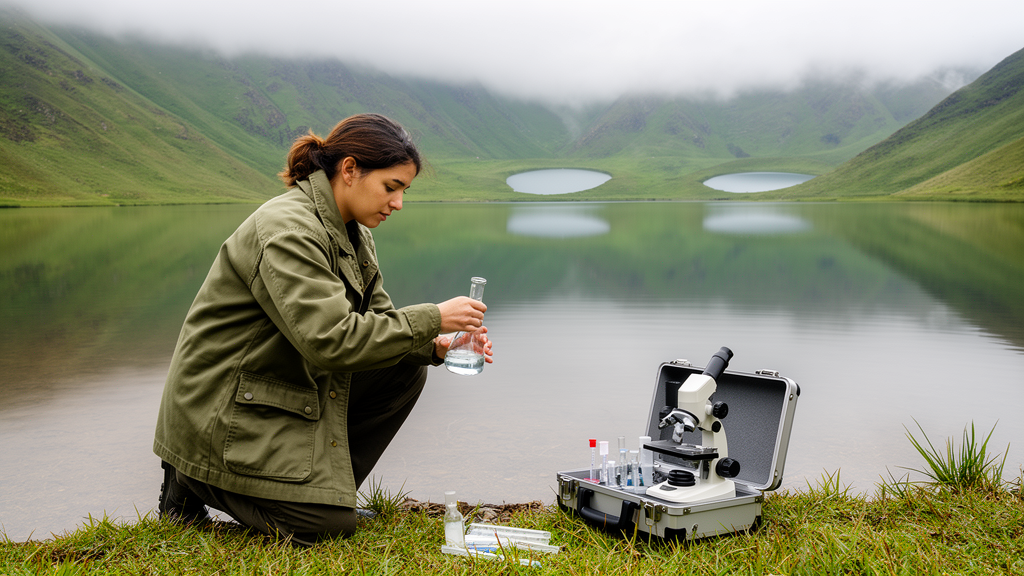
Field collection followed a careful protocol designed to capture the free-floating planktonic bacteria of the open water. Roughly 1.7 liters of water were drawn from a single depth within the sunlit photic zone using a Schindler–Patalas-type sampler, guided qualitatively by Secchi-disk readings of water transparency. After prefiltering to remove large debris and organisms, the microbial cells were concentrated onto sterile filter units carrying 0.22-micrometer membranes, preserved with a DNA-stabilizing reagent, and transported under refrigeration to the laboratory. DNA was extracted using a modified CTAB-based protocol chosen to strip away polysaccharides and other inhibitors common in environmental samples, and the V3–V4 region of the bacterial 16S rRNA gene was amplified with widely used primers before paired-end sequencing on an Illumina MiSeq platform.
The bioinformatic processing relied on DADA2, a widely adopted pipeline that corrects sequencing errors to infer exact amplicon sequence variants, or ASVs, which offer finer resolution than traditional operational taxonomic units. After quality filtering, denoising, chimera removal and taxonomic screening, the team retained 3,153 ASVs from 556,915 raw reads, averaging more than 92,000 reads per sample before filtering. Taxonomic assignment against the RDP training set recovered 34 bacterial phyla plus the archaeal phylum Euryarchaeota, 179 families and 366 genera. Five phyla dominated the collective community: Actinobacteria accounted for 34.5 percent of sequences, Proteobacteria 29.7 percent, Bacteroidetes 12.7 percent, Cyanobacteria 8.5 percent and Verrucomicrobia 7.9 percent. Roughly 80 percent of the detected phyla each contributed less than 1 percent of total abundance, a strongly right-skewed distribution typical of natural microbial assemblages.
At the level of individual samples, the communities diverged in ways that caught the researchers’ attention. Calderona was dominated by just a handful of genera, with Polynucleobacter reaching 29.5 percent and Flavobacterium 20.3 percent of its community, while Colorado hosted an abundance of Phragmitibacter at 24.2 percent and the highest relative abundance of Planctomycetes at 11.3 percent. Fúquene, by contrast, showed the greatest richness and diversity, measured using coverage-standardized Hill numbers that weight common and rare taxa differently. Rarefaction curves approached asymptotes in all samples, suggesting the sequencing depth captured most of the detectable diversity. A principal coordinates analysis of Bray–Curtis dissimilarities separated the samples along two axes explaining 67.6 percent of the compositional variation, with the two Fúquene samples plotting close together and apart from the Tota samples, and the two protected or remote lakes, Calderona and Colorado, occupying the opposite side of the ordination.
Among the low-abundance taxa were several genera with well-known disease associations. Sequences assigned to Mycobacterium appeared in Fúquene and Tota, prompting an exploratory phylogenetic analysis in which those ASVs were aligned with 96 reference 16S sequences and placed on a maximum-likelihood tree built with IQ-TREE 2. Some ASVs fell within well-supported clades containing references annotated as Mycobacterium celatum, M. noviomagense, M. szulgai, M. pseudokansasii and M. cookii, while others occupied less-resolved positions among multiple species. Leptospira-assigned ASVs occurred in Fúquene and Tota at relative abundances of 0.01 to 0.36 percent, and Legionella-assigned ASVs appeared in all six samples at 0.11 to 4.60 percent, peaking in Calderona. The authors are emphatic that these genus-level assignments do not establish species identity, cell viability, pathogenicity or any risk to humans or aquatic animals, because the short V3–V4 region cannot reliably discriminate among closely related species and no culture or viability testing was performed.
To probe what these communities might be capable of, the team applied PICRUSt2, a computational tool that predicts gene-family abundances and metabolic pathways from 16S data by phylogenetically placing each ASV among reference genomes. Sample-level weighted Nearest Sequenced Taxon Index values ranged from 0.160 to 0.181, indicating reasonable proximity to sequenced relatives, and 82 percent of ASVs passed the per-ASV quality threshold. Among the 30 most abundant predicted pathways were categories associated with naphthalene degradation, bacterial chemotaxis, biofilm formation, bacterial secretion systems, flagellar assembly, pyrimidine metabolism, folate biosynthesis and sphingolipid metabolism. An ordination of the predicted functional profiles separated the samples even more sharply than the taxonomic data, with the first two axes explaining 79.3 percent of the variation. The researchers stress that these are predictions of genomic potential, not evidence that the genes are present, expressed or active, and that pathway labels borrowed from organisms such as Escherichia coli or Pseudomonas aeruginosa merely reflect database nomenclature and homologous genes.
Equally instructive is what the study cannot say. Because the sampling was limited, unbalanced and not fully contemporaneous, with each lake represented by one or two single-depth samples and no concurrent measurements of nutrients, dissolved oxygen, chlorophyll, pH, temperature or conductivity, the authors deliberately refrained from hypothesis testing, statistical significance claims or causal attribution. Differences between the two Tota samples, separated by nearly a year, cannot be interpreted as seasonal change, and the proximity of same-lake samples in the ordination is not evidence of temporal stability. The team also detected low-abundance sequences from methanogenic archaea, including Methanobacterium, Methanothrix, Methanocella and Methanosarcina, but the bacterial-targeting primers likely underrepresented archaeal diversity, and no methane fluxes were measured to confirm active methanogenesis. This restraint reflects a growing insistence in microbial ecology that community snapshots must be paired with environmental and functional data before ecological stories can be told.
Even so, the survey carries weight as a first descriptive baseline for systems under mounting pressure. Previous work has documented nutrient enrichment and moderate eutrophication in Fúquene and Tota, linked to fertilizer use in green-onion cultivation, aquaculture and domestic wastewater, and the broader literature shows that eutrophication, sedimentation and hydrological alteration can reshape freshwater microbial communities and the biogeochemical cycles they mediate. The Colombian samples also share dominant phyla with bacterial assemblages reported from high-altitude and polar lakes on the Qing-Tibetan Plateau and in the Arctic and Antarctic, reinforcing the view that cold and high-elevation lake microbiomes are highly heterogeneous rather than uniform. The authors propose that future work combine replicated, contemporaneous sampling with physicochemical measurements, shotgun metagenomics and targeted validation assays to determine whether the lineages and functional potentials glimpsed here translate into real ecological processes. For now, the waters of the Colombian Andes have yielded their first molecular census, and it suggests there is far more beneath the surface than meets the eye.
Subject of Research: Bacterial community composition and predicted functional profiles in Colombian Andean highland lakes assessed by 16S rRNA gene amplicon sequencing
Article Title: Exploratory characterization of bacterial communities and predicted functional profiles in six water samples from four Colombian Andean lakes using 16S rRNA gene amplicon sequencing
Article References: Gómez-Palacio, A., Marín-Suarez, J., Pedroza-Ramos, A., & Aranguren-Riaño, N. (2026). Exploratory characterization of bacterial communities and predicted functional profiles in six water samples from four Colombian Andean lakes using 16S rRNA gene amplicon sequencing. Biogeosciences, 23(18), 6725-6739. https://doi.org/10.5194/bg-23-6725-2026
Image Credits: AI Generated
Keywords: 16S rRNA sequencing, Colombian Andes, highland lakes, microbial ecology, PICRUSt2, biodiversity, freshwater microbiome, Mycobacterium, Legionella, Leptospira, biogeosciences, One Health
Cite Scienmag News
Morgan Morrow. (October 9, 2026). Hidden Microbial Worlds Revealed in Four Colombian Andean Lakes. Scienmag. https://scienmag.com/hidden-microbial-worlds-revealed-in-four-colombian-andean-lakes/
Morgan Morrow. "Hidden Microbial Worlds Revealed in Four Colombian Andean Lakes." Scienmag, 9 October 2026, https://scienmag.com/hidden-microbial-worlds-revealed-in-four-colombian-andean-lakes/. Accessed 9 October 2026.
Morgan Morrow. "Hidden Microbial Worlds Revealed in Four Colombian Andean Lakes." Scienmag. October 9, 2026. https://scienmag.com/hidden-microbial-worlds-revealed-in-four-colombian-andean-lakes/


