


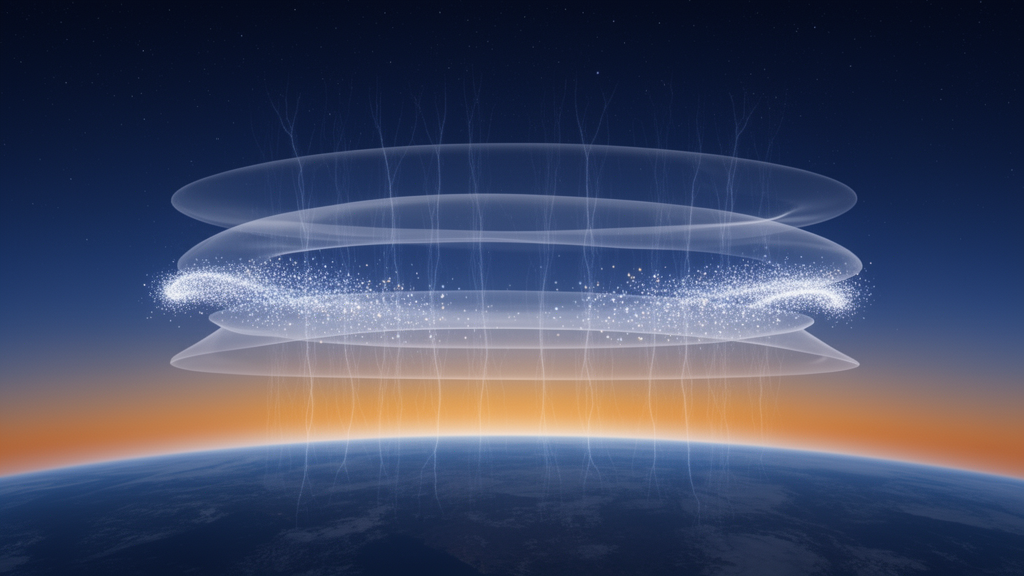
High above our heads, more than 100 kilometers up, the tenuous air of the upper atmosphere does something surprising: it helps conduct electricity. In the ionosphere-thermosphere region, where the neutral atmosphere overlaps with a sea of charged particles, winds in the thin air constantly push and pull on electric currents that link our planet to the solar wind. For decades, scientists modeling this region have relied on a convenient shortcut: collapse the three-dimensional complexity of the ionosphere into a flat, two-dimensional spherical shell, and represent the winds with a single average value — or ignore them altogether. A new study published in Annales Geophysicae by Spencer Mark Hatch of the University of Bergen and colleagues argues that this shortcut is fundamentally flawed, and that the mathematics of height-integrated electrodynamics demands not one neutral wind, but two.
The heart of the problem lies in the ionospheric Ohm’s law, the equation that describes how electric currents flow perpendicular to Earth’s magnetic field. In its full, altitude-resolved form, the current density depends on the electric field, the magnetic field, and the local neutral wind, weighted by two key electrical properties of the ionosphere: the Pedersen conductivity, which governs current flow along the electric field, and the Hall conductivity, which governs current flow perpendicular to it. Both conductivities vary strongly with altitude, peaking in the E region between roughly 100 and 130 kilometers. So do the winds. When researchers integrate the Ohm’s law over altitude to obtain the height-integrated version used in countless empirical models and data assimilation schemes, they implicitly assume that the wind does not vary with height — an assumption that decades of rocket measurements have shown to be wildly unrealistic.
Hatch and his team show that when the wind’s altitude dependence is properly retained, the height-integrated Ohm’s law splits into two distinct wind terms: one weighted by the Hall conductivity profile and one weighted by the Pedersen conductivity profile. These are not mathematical curiosities. Because the Hall and Pedersen conductivity profiles peak at different altitudes, and because the wind shears dramatically between 80 and 140 kilometers, the two weighted winds generally point in different directions and have different magnitudes. The distinction only vanishes in idealized cases — when the wind is constant with altitude, or when the two conductivity profiles differ by no more than a constant factor — conditions that real measurements almost never satisfy.
To quantify just how different these two winds can be, the team turned to a rare and precious dataset: horizontal wind profiles derived from trimethylaluminum chemical release experiments carried aboard sounding rockets launched from the Poker Flat Research Range in Alaska between 2007 and 2018. When TMA vapor is released in the upper atmosphere, the glowing trail is tracked by ground cameras, allowing scientists to triangulate the wind with remarkable precision. The researchers combined fifteen such wind profiles with conductivity profiles calculated from measurements by the Poker Flat Incoherent Scatter Radar, supplemented by the NRLMSIS 2.0 empirical atmospheric model and the International Reference Ionosphere 2016 model. For each rocket flight, they computed both the Hall-weighted and the Pedersen-weighted neutral winds.
The results are striking. The magnitudes of both weighted winds fall in the range of roughly 10 to 100 meters per second — equivalent, in terms of their electromagnetic effect, to electric fields of about 0.5 to 5 millivolts per meter, which is far from negligible in auroral electrodynamics. More importantly, the difference between the two winds grows with geomagnetic activity, measured by the Kp index: the more disturbed the space environment, the larger the gap between the Hall-weighted and Pedersen-weighted winds. Interestingly, the two vectors also become more aligned with each other as activity increases, even as their magnitudes diverge. This is the first experimental comparison of the two wind terms, and it makes clear that collapsing them into a single number is not a benign simplification.
The study also delivers a blow to a widely used rule of thumb. In 1995, researchers suggested on the basis of simulations that the so-called effective neutral wind — the wind relevant for height-integrated Joule heating — could be approximated by the wind measured at 160 kilometers altitude, and this convention has been adopted in subsequent observational studies. Hatch’s team tested this idea against their rocket data and found it wanting: for the majority of their fifteen profiles, using the 160-kilometer wind produced larger errors than simply assuming the wind was zero. The statistically best proxy for the Pedersen-weighted wind turned out to be the wind at the altitude where the Pedersen conductivity peaks, typically between 115 and 128 kilometers. For the Hall-weighted wind, ironically, assuming zero wind incurred the lowest median error of any proxy tested. All proxies, however, carried errors of at least several tens of meters per second, suggesting there are no easy fixes for the wind problem.
The consequences extend to one of the most important quantities in space physics: Joule heating, the frictional warming of the upper atmosphere as electric currents push against it. The team proved analytically, using the Cauchy–Bunyakovsky–Schwarz inequality, that the commonly used expression for height-integrated Joule heating in terms of height-averaged quantities is mathematically guaranteed to be a lower bound on the true heating rate. When they compared the lower-bound approximation against the true wind contribution computed from full altitude profiles, they found underestimations ranging from 9 to 96 percent, with the gap narrowing as geomagnetic activity increased. During quiet periods, both the magnitude and the direction of the wind influence total Joule heating; during active periods, the wind matters primarily through its orientation relative to the plasma convection, either reducing or enhancing the total heating depending on geometry.
These findings ripple outward into the broader architecture of space weather modeling. The key equation linking magnetosphere and ionosphere in many global models assumes a neutral wind that is zero or constant with altitude — an assumption the new analysis shows cannot be justified in a rigorous height-integrated framework. More advanced formulations, such as the treatment published by Arthur Richmond in 1995, do account for the three-dimensional wind field and are used in state-of-the-art coupled models like WACCM-X and TIE-GCM, but they remain unused in a large fraction of experimental studies and assimilation techniques, largely because comprehensive three-dimensional measurements of the coupled system are so scarce. The team also verified that their quasi-steady approximation is robust: in the altitude range where conductivities peak, ion inertial effects remain at least an order of magnitude smaller than collisional drag even under extreme conditions.
There is practical hope in the results as well. Because the Pedersen-weighted wind is best approximated by the wind near the Pedersen conductivity peak, measurements confined to a narrow altitude band around 100 to 120 kilometers could substantially improve height-integrated estimates. This points to the utility of Fabry–Perot interferometers tuned to the 557.7-nanometer green line of atomic oxygen, which peaks in emission between roughly 100 and 130 kilometers — in contrast to the red-line instruments that probe the higher F region and are less relevant here. Next-generation incoherent scatter radar facilities such as EISCAT_3D may also contribute wind estimates in this critical altitude range. One caveat is that auroral precipitation can shift the green-line emission layer across a broad span of altitudes, complicating the interpretation of such measurements.
Ultimately, the study is both a warning and an invitation. It warns that the two-dimensional picture of ionospheric electrodynamics, however convenient, hides a genuine ambiguity: there is no single neutral wind that can represent the winds’ effect on height-integrated currents and heating. And it invites the community to invest in the measurements — from sounding rockets, green-line interferometers, and advanced radars — that would allow the ambiguity to be resolved. As researchers increasingly join the chorus calling for more neutral wind observations, this work shows that even a single well-placed wind measurement near the Pedersen conductivity peak could sharpen our understanding of how the Sun’s energy flows into, and heats, the atmosphere we live beneath.
Subject of Research: The role of neutral winds in height-integrated ionosphere-thermosphere electrodynamics
Article Title: What is the neutral wind in height-integrated ionospheric electrodynamics?
Article References: Hatch, S. M., Burchill, J., Vanhamäki, H., de Mesquita, R. L. A., & Laundal, K. M. (2026). What is the neutral wind in height-integrated ionospheric electrodynamics?. Annales Geophysicae, 44(2), 715-729. https://doi.org/10.5194/angeo-44-715-2026
Image Credits: AI Generated
DOI: 10.5194/angeo-44-715-2026
Keywords: ionosphere, thermosphere, neutral wind, Joule heating, Pedersen conductivity, Hall conductivity, sounding rockets, Poker Flat, space weather, magnetosphere-ionosphere coupling, incoherent scatter radar, Fabry-Perot interferometer
Cite Scienmag News
Violet Maxwell. (October 9, 2026). Two Winds, Not One: Rethinking Neutral Winds in Ionospheric Electrodynamics. Scienmag. https://scienmag.com/two-winds-not-one-rethinking-neutral-winds-in-ionospheric-electrodynamics/
Violet Maxwell. "Two Winds, Not One: Rethinking Neutral Winds in Ionospheric Electrodynamics." Scienmag, 9 October 2026, https://scienmag.com/two-winds-not-one-rethinking-neutral-winds-in-ionospheric-electrodynamics/. Accessed 9 October 2026.
Violet Maxwell. "Two Winds, Not One: Rethinking Neutral Winds in Ionospheric Electrodynamics." Scienmag. October 9, 2026. https://scienmag.com/two-winds-not-one-rethinking-neutral-winds-in-ionospheric-electrodynamics/


