


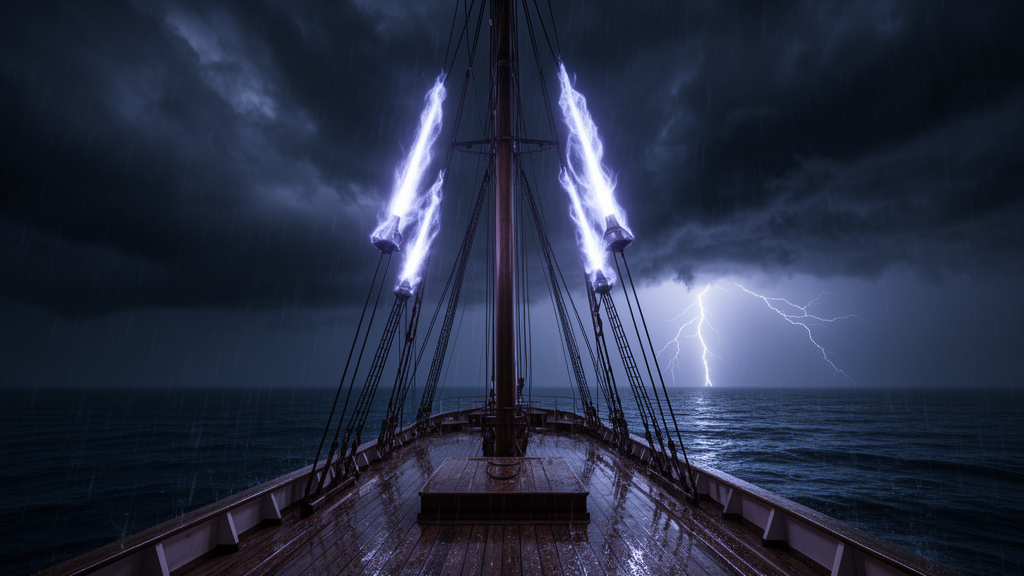
For centuries, sailors watching ghostly blue flames dance across their ship’s masts believed they were seeing a divine omen. Roman soldiers reported that the tips of their spears spontaneously caught fire in the first century BCE, and Pliny the Elder described a luminous appearance that occasionally attached itself to javelins and parts of ships. Today we know this eerie glow as St. Elmo’s fire, a visible manifestation of a process called point discharge, and a new historical review published in the journal History of Geo- and Space Sciences argues that this humble phenomenon quietly shaped nearly every milestone in the science of atmospheric electricity. The review, by Blair McGinness, R. Giles Harrison, Karen Aplin, and Martin Airey of the University of Reading and the University of Bristol, traces how a simple electrical process observed for millennia became the workhorse of some of the most consequential experiments in geophysics.
Point discharge occurs when the atmospheric electric field becomes intensified at a sharp point, such as the tip of a mast, a blade of grass, or a metal electrode. When the local field enhancement is strong enough, collisions between charged particles ionise the surrounding air, creating a conductive region that allows a current to flow between the object and the atmosphere. This is known as a corona discharge, and the resulting point discharge current can sometimes produce a glow visible to the naked eye. The polarity and magnitude of the current depend on the properties of the electric field driving it, which makes the effect not just a curiosity but a measurable signal. Instruments built around this principle, known as point discharge sensors, are strikingly simple: a sharp point mounted on a mast, connected to a meter that records the current. That simplicity, the review notes, gives them significant advantages over more complicated devices such as field mills, particularly in harsh or remote environments.
The eighteenth century brought the first crucial steps toward understanding the electrical nature of the atmosphere. Benjamin Franklin’s famous kite experiment of 1752 drew sparks from a storm cloud, while contemporaries including Le Monnier, Canton, and Mazeas showed that electrical charge was present even in fair weather. Franklin himself, in minutes dated 7 November 1749, suggested that St. Elmo’s fire could be produced by electrical fire drawn from a cloud into a lightning rod, an early recognition that the mysterious glow was electrical in origin. By identifying electricity in the atmosphere, these investigations laid the foundation for everything that followed. Yet the deepest mysteries remained unsolved well into the twentieth century, and it was there that point discharge would play its most dramatic role.
By the early 1900s, scientists knew that the Earth’s surface was negatively charged relative to the atmosphere, that the air was conductive, and that ions were present throughout the atmosphere. This created a paradox: if the atmosphere conducts, the Earth’s charge should rapidly dissipate, yet it clearly persisted. C. T. R. Wilson proposed in 1903 that positively charged rain might carry negative charge down to the surface in stormy regions, replenishing what fair weather conduction currents drained away. But measurements by George Simpson in 1909 and 1912, using a galvanised iron rain receiver connected to a tipping bucket gauge, showed the opposite: rain of all types brought predominantly positive charge to the ground. The precipitation theory collapsed, and a new explanation was urgently needed.
Wilson’s response, published in 1921, would change atmospheric science forever. Analysing electric field changes during lightning strikes, he found that most strikes transferred negative charge from cloud to ground, consistent with a positive dipole structure in thunderclouds. To reconcile this with Simpson’s positively charged rain, Wilson invoked point discharge. He argued that positive ions emitted from sharp points on blades of grass and tree leaves could reverse the polarity of falling raindrops, so that rain leaving the cloud base negatively charged arrived at the surface positively charged. Combined with a current flow above the clouds, this mechanism would maintain the charge separation between the Earth’s surface and the ionosphere. These arguments formed the basis of Wilson’s global atmospheric electric circuit, a concept that continues to provide explanatory value in atmospheric electricity today.
Confirmation soon followed, again through point discharge. In 1936, Whipple and Scrase analysed continuous records from a point discharge sensor at Kew Observatory, a galvanometer connected to a sharp point on a tall mast. They developed a parameterisation relating discharge current to the potential gradient, allowing currents to be converted into electric field measurements, and they observed a diurnal variation in the net discharge outflow that correlated closely with the global frequency of thunderstorms, with a Pearson correlation coefficient of 0.76. When compared with the celebrated Carnegie curve, the diurnal variation in fair weather potential gradient measured by the research ship Carnegie and dependent on Universal Time rather than local time, the agreement was striking. This linked disturbed weather regions to fair weather regions across the planet and stands as a milestone confirmation of Wilson’s global circuit.
The dispute over thundercloud polarity demanded direct measurement inside the clouds themselves, and once again point discharge provided the answer. Simpson and Scrase’s alti-electrograph, flown on balloons between 1934 and 1936 in seventy soundings, used point discharge electrodes extending above and below the instrument. Current polarity was recorded by pole-finding paper, on which a deposit of Prussian blue built up at the anode as current flowed between the electrodes. Recovered after parachute descent, the instrument revealed that thunderclouds carry a main negative charge region with a positive region above, and frequently a smaller positive region at the cloud base, an electrical tripole that matches our modern understanding of thunderstorm charge structure remarkably well. The discovery of the lower positive charge region explained Simpson’s positively charged rain and ended the long controversy between Wilson and Simpson.
Point discharge instruments then took flight in ever more ambitious forms. Belin modified radiosondes in 1948 to transmit discharge measurements without needing instrument recovery, and Chapman used similar radiosonde packages in the 1950s to probe thundercloud structure and demonstrate that blizzard electrification was not limited to the ground. Weber and Few’s coronasonde of 1978, described as inexpensive and easy to use, became a standard tool for quantitative measurements inside electrified clouds. Most dramatically, Ruhnke designed a rocket-borne point discharge sensor in 1971, with a sharpened tungsten steel electrode capable of surviving accelerations up to 50 g and sampling at 25 Hz, to profile electric fields through clouds too quickly for balloons or aircraft. Even the atmosphere of Venus was probed this way: the Soviet Venera 13 and 14 landers carried a point discharge electrode in their Groza-2 instrumentation package in 1982, and recent work has attempted to reconstruct the sensor’s design through electrostatic modelling.
On the ground, researchers grappled with how much charge naturally occurring point discharge transfers to the Earth. In a striking 1928 experiment, Schonland and Wilson cut down a thorn tree, mounted it on an insulated platform, and measured the current flowing through it under thunderclouds, concluding that point discharge dominated charge transfer to the surface in disturbed weather. Later work by Maund and Chalmers in 1960 measured the reduction in potential gradient downwind of discharging trees, exploiting the fact that wind carries emitted ions as space charge, while Bent and colleagues in 1965 confirmed that trees produce space charge comparable to artificial points. John Chalmers, who authored seventeen papers on point discharge between 1941 and 1967, and Jhawar placed a living spruce tree between charged metal plates in 1967, deriving a mathematical relationship between applied voltage and discharge current through the entire tree. Together these studies established point discharge as an important pathway for negative charge to reach the Earth’s surface.
The review concludes that point discharge sensors, far from being museum pieces, remain valuable today. Their lack of moving parts makes them cheap, robust, and low-maintenance, ideal for deployments such as a month-long unmanned study of dust devils in the Chihuahuan desert of New Mexico, where they successfully recorded electrical signatures of the vortices that passed overhead. Modern designs with logarithmic response can span the several orders of magnitude of potential gradient found between fair and disturbed weather, and a recent sensor at the Reading University Atmospheric Observatory even helped diagnose anomalous readings caused by point discharge from the site’s own anemometers. As researchers continue refining the mathematical descriptions of sensor response, including newly identified sensitivities to displacement currents, the authors suggest that networks of inexpensive point discharge sensors, perhaps even operated by citizen scientists, could open a new chapter in a story that began with fire on the tips of Roman spears.
Subject of Research: The historical role of point discharge in the development of atmospheric electricity
Article Title: The role of point discharge in the historical development of atmospheric electricity
Article References: McGinness, B. P. S., Harrison, R. G., Aplin, K. L., & Airey, M. W. (2025). The role of point discharge in the historical development of atmospheric electricity. History of Geo- and Space Sciences, 16(2), 51-63. https://doi.org/10.5194/hgss-16-51-2025
Image Credits: AI Generated
Keywords: point discharge, atmospheric electricity, St. Elmo's fire, global atmospheric electric circuit, thunderclouds, corona discharge, C. T. R. Wilson, alti-electrograph, potential gradient, history of science, point discharge sensors, Venera missions
Cite Scienmag News
Russell Cooper. (October 9, 2026). St. Elmo’s Fire and the Hidden Current That Electrified Atmospheric Science. Scienmag. https://scienmag.com/st-elmos-fire-and-the-hidden-current-that-electrified-atmospheric-science/
Russell Cooper. "St. Elmo’s Fire and the Hidden Current That Electrified Atmospheric Science." Scienmag, 9 October 2026, https://scienmag.com/st-elmos-fire-and-the-hidden-current-that-electrified-atmospheric-science/. Accessed 9 October 2026.
Russell Cooper. "St. Elmo’s Fire and the Hidden Current That Electrified Atmospheric Science." Scienmag. October 9, 2026. https://scienmag.com/st-elmos-fire-and-the-hidden-current-that-electrified-atmospheric-science/


