


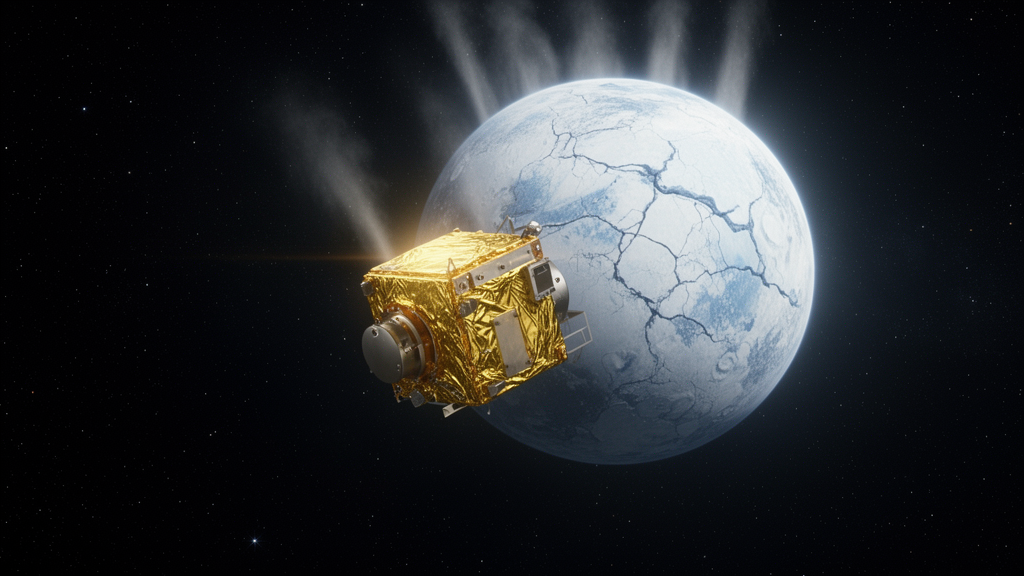
When Europe’s Jupiter Icy Moons Explorer swept past the Moon and Earth in August 2024, it performed a maneuver no spacecraft had ever attempted: a combined lunar-Earth gravity assist, choreographed so that the gravitational pulls of both bodies would bend the probe’s path in a single, propellant-saving stroke. But while navigators celebrated the trajectory milestone, a team of scientists led by Umberto De Filippis of Sapienza University of Rome was watching a different kind of signal. Aboard the spacecraft, a delicate instrument known as the High Accuracy Accelerometer, part of the 3GM radio science suite, was quietly recording every twitch, shudder and shove the spacecraft experienced during the two hours centered on the Moon’s closest approach. The results, published in Annales Geophysicae, reveal a spacecraft that is far more alive, and far more sensitive, than its designers might have imagined.
The High Accuracy Accelerometer, or HAA, is only the second spring-mass accelerometer ever flown on an interplanetary spacecraft, built on the heritage of the Italian Spring Accelerometer now operating on the BepiColombo mission. Its heart is a set of three sensors, each containing a proof mass whose tiny displacements are converted into voltage signals by capacitive pickups. Each sensing element behaves as a mechanical harmonic oscillator with a resonance frequency of about 3.6 hertz, and the instrument can resolve accelerations with a spectral density of roughly 8 x 10^-9 m s^-2 Hz^-1/2 across much of its measurement band. That sensitivity exists for a reason: the 3GM experiment, which will measure the gravity fields and tides of Ganymede, Callisto and Europa using Ka-band radio links, depends on knowing exactly which forces besides gravity are nudging the spacecraft. Fuel sloshing, solar radiation pressure and thermal effects can all masquerade as gravitational signals, and the HAA exists to separate them.
During the lunar-Earth gravity assist, JUICE passed within 750 kilometers of the lunar surface before skimming Earth at an altitude of about 6,800 kilometers a few hours later. The HAA was switched on two days before the encounter to allow passive thermal stabilization, then began collecting data roughly one hour before closest approach and continued until one hour after. The team focused on the Acc0 sensor, which proved both the most sensitive and the least noisy of the three axes. After applying a low-pass filter, removing a parabolic trend and correcting for temperature-induced artifacts using the proof-mass thermometer readings, the researchers compared the measurements against analytical predictions of the non-gravitational forces they expected the spacecraft to feel.
The most striking expected signal was the Moon’s own gravity gradient. Because the accelerometer’s proof masses sit at fixed offsets from the spacecraft’s center of mass, the Moon’s gravitational field tugs on them with slightly different strengths, producing a measurable differential acceleration that scales with the inverse cube of the distance to the Moon. The measured data matched the predicted gradient remarkably well for most of the encounter, a validation that matters enormously for the mission’s future. When JUICE arrives at Jupiter in July 2031, the same instrument will help calibrate the radio tracking data that will be used to map Ganymede’s gravity field up to degree and order 35 to 40, probe the extent of its subsurface ocean, and test whether Europa and Callisto are in hydrostatic equilibrium.
The eclipse delivered the second confirmed detection. As JUICE slipped into the Moon’s shadow, solar radiation pressure dropped by an amount too small to measure directly, but the sudden thermal shock was not. The abrupt loss of sunlight created steep temperature gradients between the front and back surfaces of the spacecraft’s 85-square-meter solar arrays, causing them to warp in a phenomenon engineers call a thermal snap. The team built a detailed thermal mathematical model of the honeycomb aluminum panels, solving the heat exchange equations between the two faces and validating the model against rear-surface thermistor telemetry. The predicted quasi-static displacement of the solar array tip came out at roughly 50 millimeters, corresponding to an angular deflection of about 0.3 degrees, and the modeled acceleration agreed closely with what the accelerometer actually recorded during the penumbra transitions.
After the spacecraft emerged back into full sunlight, the accelerometer picked up a clear periodic vibration. An amplitude spectral analysis showed that the dominant frequency matched the first out-of-plane structural mode of the solar array, confirming that the panels were ringing like a struck tuning fork after their thermal ordeal. A similar but weaker signature appeared at eclipse ingress, where the slower transition from light to shadow produced a gentler thermal gradient. These observations demonstrate that the HAA can serve as a real-time monitor of the spacecraft’s structural health, something the operations team had already exploited during the first six weeks after launch, when the instrument tracked the deployment of the solar panels, antennas and booms.
Then came the surprises. Two sharp spikes of about 10^-4 m s^-2 appeared at 20:42 and 21:26 UTC, and the team traced them to an unlikely culprit: the steerable telescope of the Submillimetre Wave Instrument, the only moving optical component on the spacecraft. At 20:41:58 UTC the telescope rotated 72 degrees to point nadir toward the Moon, and at 21:27 UTC it swung back 54 degrees for a backward-looking observation. Each rotation excited resonance modes of the spacecraft’s MAGboom structure at 0.44, 0.46 and 2.6 hertz, along with solar array modes at 0.13, 0.21 and 0.89 hertz. The vibrations showed up on all three accelerometer axes, and the team notes that dedicated tests will be needed to characterize whether such interference could degrade future radio science measurements.
The most scientifically intriguing event came shortly after JUICE crossed the lunar terminator at 21:18:35 UTC, when the spacecraft’s +Z and +X faces swung toward the sunlit lunar surface and absorbed a surge of reflected light and infrared radiation. The accelerometer recorded a distinct low-frequency acceleration of about 2 x 10^-6 m s^-2 along the -Z axis. The team’s leading explanation is an outgassing event: frozen contaminants, most likely water ice, had accumulated on the multilayer insulation of the +Z vault during the early cruise phase, and the sudden heating from the Moon’s illuminated surface triggered rapid sublimation. A remarkably similar event had been observed on BepiColombo during its Venus swing-by, giving the interpretation a useful precedent.
The outgassing left fingerprints in multiple independent datasets. The spacecraft’s attitude control system registered unmodeled torques from its reaction wheels as they fought to hold the commanded inertial attitude, and by combining the torque direction with the measured acceleration, the team estimated that the venting occurred roughly 50 centimeters from the spacecraft’s center of mass. An orbit determination analysis using X-band Doppler data from the New Norcia and Cebreros ground stations, processed with ESA’s GODOT software, independently confirmed a velocity change consistent with the accelerometer’s measurement. The HAA data itself indicated a velocity change of 0.7 plus or minus 0.1 millimeters per second along the -Z axis, with upper bounds of 0.3 and 5.4 millimeters per second on the other components.
By applying the conservation of momentum and assuming the escaping gas was water vapor with an effective exit velocity between 500 and 1,000 meters per second, the researchers calculated that the sublimated material weighed between 4 and 8 grams. A few grams of ice may sound trivial, but the detection carries real weight for the mission. Unmodeled accelerations of this kind, if left uncorrected, would contaminate the precision Doppler and range measurements that 3GM depends on to weigh the icy moons and search for their hidden oceans. The team emphasizes that collecting in-flight accelerometer data before the science phase begins will be fundamental to optimizing instrument configuration, refining operational strategies and maximizing the scientific return when JUICE finally settles into orbit around Ganymede, the largest moon in the Solar System and, if all goes well, the first known ocean world to be orbited by a spacecraft from Earth.
Subject of Research: High-accuracy accelerometer measurements of non-gravitational forces on the JUICE spacecraft during its lunar-Earth gravity assist flyby
Article Title: Analysis of 3GM High Accuracy Accelerometer data collected during JUICE lunar earth gravity assist
Article References: De Filippis, U., Cappuccio, P., Di Benedetto, M., di Stefano, I., Durante, D., & Iess, L. (2026). Analysis of 3GM High Accuracy Accelerometer data collected during JUICE lunar earth gravity assist. Annales Geophysicae, 44(2), 731-741. https://doi.org/10.5194/angeo-44-731-2026
Image Credits: AI Generated
DOI: 10.5194/angeo-44-731-2026
Keywords: JUICE, lunar-Earth gravity assist, High Accuracy Accelerometer, 3GM radio science, gravity gradient, thermal snap, solar array vibration, outgassing, water ice sublimation, ESA, Ganymede, spacecraft dynamics
Cite Scienmag News
Grant Pearson. (October 9, 2026). JUICE Accelerometer Catches Moon’s Gravity and a Surprise Water-Ice Burp During Historic Flyby. Scienmag. https://scienmag.com/juice-accelerometer-catches-moons-gravity-and-a-surprise-water-ice-burp-during-historic-flyby/
Grant Pearson. "JUICE Accelerometer Catches Moon’s Gravity and a Surprise Water-Ice Burp During Historic Flyby." Scienmag, 9 October 2026, https://scienmag.com/juice-accelerometer-catches-moons-gravity-and-a-surprise-water-ice-burp-during-historic-flyby/. Accessed 9 October 2026.
Grant Pearson. "JUICE Accelerometer Catches Moon’s Gravity and a Surprise Water-Ice Burp During Historic Flyby." Scienmag. October 9, 2026. https://scienmag.com/juice-accelerometer-catches-moons-gravity-and-a-surprise-water-ice-burp-during-historic-flyby/


