


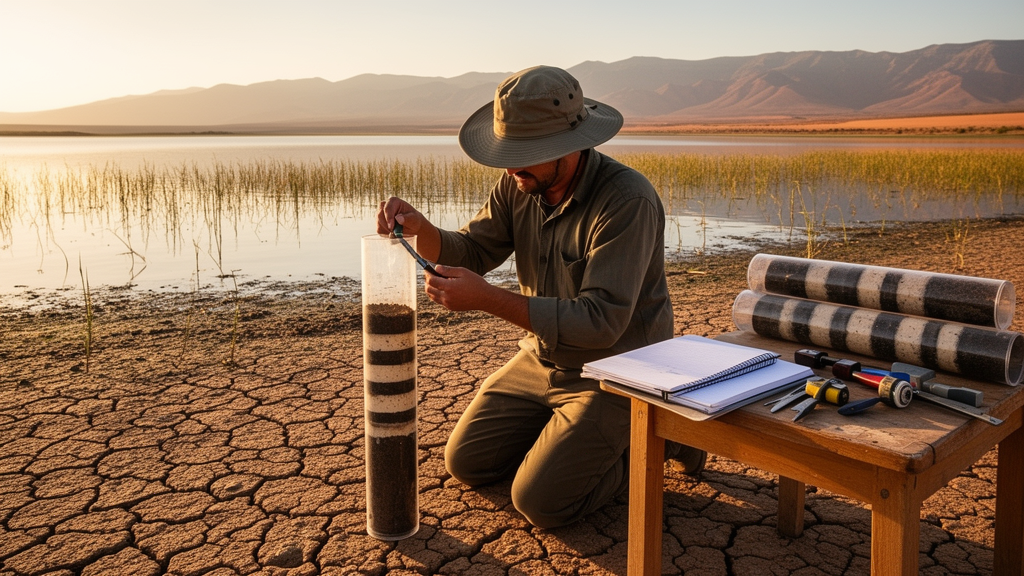
High in the Middle Atlas Mountains of Morocco, at more than 2,000 meters above sea level, a closed karst lake has been quietly recording the pulse of the North African climate for over eleven millennia. A team of researchers led by Johannes Schmidt of Leipzig University has now decoded that record in unprecedented detail, using a nearly 20-meter-long sediment core from Lake Sidi Ali to uncover repeating climate cycles that shaped water levels, vegetation, and erosion at the vulnerable desert margin of North Africa. The study, published in the journal Climate of the Past, combines high-resolution geochemical scanning with sophisticated frequency analyses to reveal that the region’s Holocene climate was governed not by one rhythm, but by two partly independent ones.
The significance of the location can hardly be overstated. Northwestern Africa and the Western Mediterranean are considered among the most climate-sensitive regions on Earth, yet the periodicities and forcing mechanisms behind their long-term environmental variability have remained poorly understood. Lake Sidi Ali sits at a transitional zone between Morocco’s wetter northwest and its arid southeast, and its hydrology is influenced by three major air masses: Atlantic, Mediterranean, and Saharan. With no significant surface inlet or outlet, a maximum water depth of 38 meters, and alkaline, evaporatively influenced waters, the lake functions as a sensitive natural rain gauge whose sediments preserve the chemical fingerprints of every shift in the precipitation-evaporation balance.
The core itself was recovered in 2012 from the deepest point of the lake using a floating platform and a piston corer, yielding 19.63 meters of finely layered gyttja. The team dated the sequence with a robust chronology built from 26 radiocarbon measurements on pollen concentrates, supplemented by lead-210 and cesium-137 dating for the most recent layers. Onto this temporal framework they overlaid an extraordinary dataset: more than 17,800 X-ray fluorescence measurements taken at one-millimeter intervals along the core, calibrated against quantitative benchtop XRF analyses to convert raw scanning intensities into true elemental concentrations. Elements such as calcium, strontium, iron, titanium, potassium, and silicon each tell a different story about what was happening in and around the lake.
The analytical heart of the study lies in two complementary statistical techniques. Redfit spectral analysis, which works with unevenly spaced data, breaks each proxy time series into its constituent periodicities and tests them against a conservative red-noise background to weed out spurious cycles. Wavelet analysis then adds the dimension of time, revealing when particular cycles were strong, when they weakened, and when they vanished altogether. By correlating the statistically significant spectra of eighteen XRF-based proxies with one another, the researchers identified three distinct groups of elements that behave in concert through the frequency domain, which they termed Redfit Proxy Groups.
The first group, dominated by calcium, strontium, and related elemental ratios, displays persistent cycles of roughly 2,000 and 1,000 years, along with a cluster of multi-centennial periodicities between about 340 and 700 years. These soluble elements are classic indicators of authigenic carbonate precipitation, which in an alkaline lake like Sidi Ali is controlled by the ratio of precipitation to evaporation. Crucially, the same 1,000-year rhythm appears in the oxygen isotope record of ostracod shells from the same core, where elevated values mark episodes of reduced effective moisture. The team links these millennial dry phases, clustered in the Early and Middle Holocene, to the well-known North Atlantic cooling events, suggesting a long-range teleconnection between ocean conditions in the far North Atlantic and winter rainfall over the Western Mediterranean.
Independent proxies reinforce this hydroclimatic interpretation. The abundance of Atlas cedar pollen, a tree highly sensitive to prolonged summer drought, follows the same 1,000-year beat during the Early Holocene, while total organic carbon shows a clear 2,000-year cycle that mirrors the carbonate signal in reverse. Even the potassium-to-titanium ratio, previously shown by provenance studies to trace dust arriving from the Sahara, falls within this group, with a notable peak around 4,200 years ago corresponding to a hyper-arid phase in the central Sahara. Together, these lines of evidence paint the first proxy group as a recorder of the lake’s water balance, paced by North Atlantic and solar forcing.
The second proxy group, comprising iron, titanium, potassium, silicon-to-titanium ratios, and sulfur, behaves entirely differently. Its dominant periodicities are approximately 3,500 and 1,500 years, and these elements are conventionally interpreted as tracers of detrital input from the catchment and of lake productivity. Magnetic susceptibility, an independent erosion proxy measured directly on the core, shows the same spectral signature, as does the coarse-grained sediment fraction delivered from the steep surrounding slopes. Intriguingly, the 1,500-year cycle only emerges clearly after the Middle Holocene, hinting that the sensitivity of catchment processes to external forcing shifted through time, possibly as vegetation cover and human land use began to modify the landscape’s response to rainfall.
A third, smaller group consisting of manganese and the iron-to-manganese ratio records redox-sensitive chemistry at the lake floor, governed by stratification and mixing of the water column. Its mixed periodicity pattern, borrowing elements from both of the other groups, suggests it integrates hydrological and detrital influences rather than reflecting a single forcing mechanism. The researchers are careful to note that spectral similarity alone does not prove identical environmental causes; the process attribution rests on the convergence of the frequency-based groupings with independent geological and biological evidence from the same archive.
When the Sidi Ali cycles are compared with other regional archives, a coherent picture emerges. A Scottish peat record of North Atlantic storminess shows both the 2,000-year Hallstatt-type cycle and a 1,000-year cycle, while speleothems from Middle Atlas caves display comparable millennial and multi-centennial periodicities in their rainfall proxies. The multi-centennial modes at Sidi Ali, clustered around 700 and between 600 and 340 years, match solar cycles identified in cosmogenic isotope records and periodicities in a reconstructed North Atlantic Oscillation index, strengthening the case that westerly wind dynamics delivered these rhythms to Moroccan winter rain. A tentative 170-year cycle in redox-sensitive ratios may even echo the famous de Vries solar cycle, though the authors caution that chronological uncertainty makes such short periodicities statistically fragile.
The overarching conclusion is that Holocene environmental change at Lake Sidi Ali was structured by two partly decoupled regimes: a hydroclimatic regime of roughly 2,000- and 1,000-year cycles tied to precipitation and evaporation, and a catchment-related regime of roughly 3,500- and 1,500-year cycles tied to erosion, productivity, and terrestrial sediment supply. For a region projected to face severe drying in the coming decades, the message is sobering and useful in equal measure. The lake sediments demonstrate that rainfall at the North African desert margin has never varied randomly; it has oscillated to identifiable beats driven by ocean, atmosphere, and sun. Understanding those natural rhythms provides an essential baseline against which the magnitude and pace of future, human-driven hydroclimatic change in the Western Mediterranean can be judged.
Subject of Research: Holocene hydroclimatic variability and periodicity analysis of lake sediments at Lake Sidi Ali, Morocco
Article Title: Holocene hydroclimatic variability and multi-frequency analyses at Lake Sidi Ali (Morocco)
Article References: Schmidt, J., Reichert, M., Kertscher, C., Schneider, B., Dietze, E., Bergmann, L., Benkaddour, A., Mikdad, A., Pichat, S., Fletcher, W., Mischke, S., & Zielhofer, C. (2026). Holocene hydroclimatic variability and multi-frequency analyses at Lake Sidi Ali (Morocco). Climate of the Past, 22(8), 1537-1557. https://doi.org/10.5194/cp-22-1537-2026
Image Credits: AI Generated
Keywords: Lake Sidi Ali, Morocco, Holocene, paleoclimate, hydroclimate, XRF core scanning, wavelet analysis, Redfit spectral analysis, North Atlantic forcing, solar cycles, Middle Atlas, lake sediments
Cite Scienmag News
Sloane Callahan. (October 9, 2026). Moroccan Lake Sediments Reveal Hidden Rhythms of 11,000 Years of Climate Change. Scienmag. https://scienmag.com/moroccan-lake-sediments-reveal-hidden-rhythms-of-11000-years-of-climate-change/
Sloane Callahan. "Moroccan Lake Sediments Reveal Hidden Rhythms of 11,000 Years of Climate Change." Scienmag, 9 October 2026, https://scienmag.com/moroccan-lake-sediments-reveal-hidden-rhythms-of-11000-years-of-climate-change/. Accessed 9 October 2026.
Sloane Callahan. "Moroccan Lake Sediments Reveal Hidden Rhythms of 11,000 Years of Climate Change." Scienmag. October 9, 2026. https://scienmag.com/moroccan-lake-sediments-reveal-hidden-rhythms-of-11000-years-of-climate-change/


