


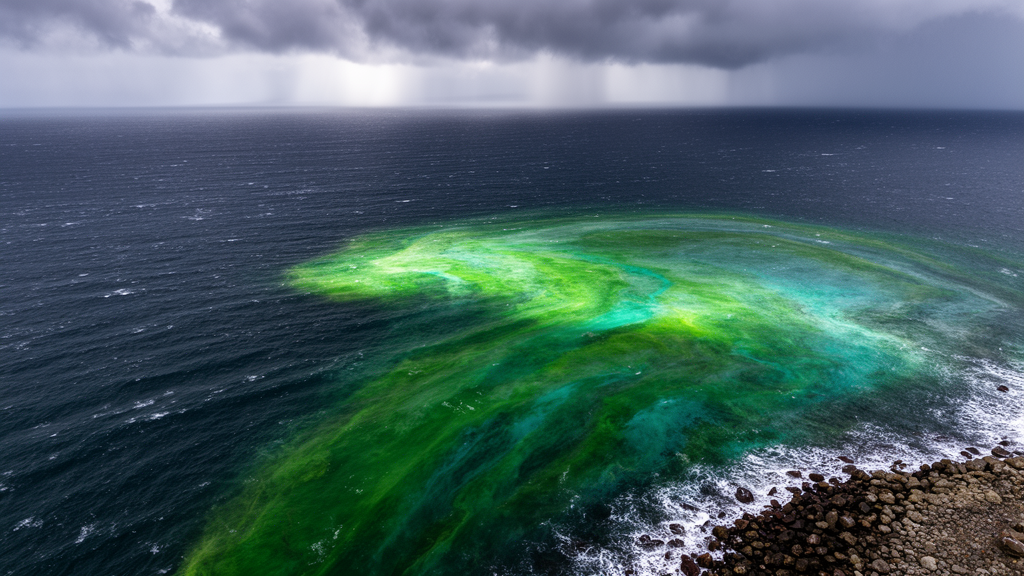
Every summer, the shallow coastal waters of the eastern English Channel should be a nutritional wasteland. By late spring, the great winter and spring blooms fuelled by months of accumulated river nutrients have collapsed, dissolved nitrogen, phosphate and silicate have been stripped to near-detection levels, and the microscopic algae that anchor the entire marine food web settle into a lean, low-biomass existence dominated by the tiniest cells in the sea. Yet year after year, chlorophyll readings in these waters spike without warning, and dense blooms of single algal species appear seemingly out of nowhere. A new decade-long study now offers a compelling explanation: the culprit is the weather itself, and specifically the episodic summer storms that sweep across north-western Europe.
The research, published in the journal Ocean Science by Harshal Chavan and colleagues at the Université du Littoral Côte d’Opale, examined how ten well-identified summer storms between 2012 and 2022 reshaped phytoplankton communities in the eastern English Channel. Drawing on an extraordinary archive of more than 1,800 flow cytometry samples collected along a high-resolution coastal-offshore transect near the Strait of Dover, the team matched weekly to fortnightly measurements of algal abundance with hourly meteorological data from Boulogne-sur-Mer and daily river inflow records from the small rivers Slack and Wimereux. Their conclusion is striking: storms are not random disruptions but recurrent structuring forces, each type of storm imprinting a distinct signature on which algae thrive and which collapse.
The technical heart of the study lies in how the researchers classified storm impacts. Storms were defined as periods when wind speeds exceeded the 90th percentile of a 25-year reference distribution, a threshold of 11.3 metres per second, with a window of three days on either side of the peak. Wind stress at the sea surface was calculated from wind speed using a standard drag-coefficient formulation, allowing the team to separate strongly windy events from calmer ones. Precipitation totals and mean river inflows over the storm window were classified as high or low using the 80th percentile of their June-July distributions, corresponding to thresholds of 16.12 millimetres of rain and 0.45 cubic metres per second of combined inflow. This framework produced three distinct storm archetypes: high river inflow events regardless of wind, high wind stress paired with low inflow, and low wind stress paired with low inflow.
The biological consequences of these archetypes could hardly have been more different. When storms delivered heavy rain and swollen rivers, nutrient-rich freshwater plumes surged into coastal waters, and diatoms responded explosively. After the storm of 20 June 2016, the rainiest and highest-inflow event in the record, diatom abundances across the transect rose five-fold, with maximum post-storm concentrations reaching 8.0 times ten to the fifth cells per litre. At a monitoring station in Boulogne, the chain-forming diatom Leptocylindrus danicus hit three million cells per litre, accounting for ninety percent of the microphytoplankton assemblage, while chlorophyll-a climbed to 9.6 micrograms per litre, three times the seasonal average. When a second storm struck on 2 July 2016, less than two weeks later, it doubled diatom abundances again, this time favouring Chaetoceros socialis, and pushed cryptophytes up more than four-fold while suppressing Synechococcus nearly three-fold.
Consecutive storms proved especially powerful. The back-to-back events of June and July 2016, and similar sequences in 2012 and 2013, sustained chlorophyll concentrations well above the June-July climatological mean of 3.20 micrograms per litre, in one case producing a four-fold increase. The researchers argue that successive storms keep the nutrient-laden coastal current, a narrow ribbon of water three to four kilometres wide fed by the Somme, Authie, Canche, Liane, Wimereux and Slack rivers, flowing northward into the Strait of Dover, effectively converting episodic rainfall into a sustained fertilisation regime. The Somme estuary alone delivers roughly 500 kilomoles of silicate and nitrate per day during June and July, and the study shows that storm-driven pulses of this enrichment repeatedly trigger monospecific diatom blooms in otherwise nutrient-starved summer waters.
Storms that brought strong winds but little freshwater told a different story. The event of 13 July 2015, the windiest of the low-inflow storms, generated intense turbulence in a stratified water column without adding riverine nutrients. Wind speeds of around eight metres per second are sufficient to break down summer stratification, pumping remineralised nutrients from deeper layers to the surface. Under these conditions, diatoms and picophytoplankton were suppressed while nanophytoplankton flourished. Nanoeukaryotes shifted from the 50th to above the 90th percentile of their seasonal distribution, reaching a post-storm mean of 2.2 million cells per litre, coccolithophorids peaked at 120,000 cells per litre near the coast, and cryptophytes rose strongly offshore. Meanwhile Synechococcus populations crashed nearly four-fold, from 21 million to 8.2 million cells per litre, and picoeukaryotes fell by more than half. With low inflows limiting silicate supply, diatom growth was constrained, leaving nitrogen and phosphate for the smaller nanoplankton to exploit.
The third archetype, weak winds and low inflow, produced perhaps the most surprising result. The short storm of 6 June 2022 arrived during a marine heatwave, with minimal mixing and almost no freshwater input. Rather than suppressing life, these calm, warm, nutrient-poor conditions amplified the smallest algae in the sea. Synechococcus surged from 630,000 to 15 million cells per litre across the transect, with an offshore maximum of 20 million, while picoeukaryotes rose to a post-storm mean of 24 million cells per litre, a statistically significant shift that also enriched the extreme tail of their distribution. By late June, offshore stations recorded Synechococcus abundances approaching 100 million cells per litre. The mechanism is one of competitive physiology: picophytoplankton possess a high surface-to-volume ratio that gives them a decisive advantage in scavenging scarce nutrients, and warm, stratified, sunlit waters are precisely their ideal habitat.
Statistically, the team avoided assumptions about normality by comparing pre-storm and post-storm abundances against empirical complementary cumulative distribution functions built from a decade of June-July observations. Values exceeding the 90th percentile of the seasonal climatology were flagged as extreme, and Anderson-Darling tests confirmed that the distributional shifts were significant, with p-values as low as 0.001 and tail-exceedance probabilities below ten to the minus seven. This rigorous, non-parametric approach matters because phytoplankton abundances are notoriously skewed, and it allowed the researchers to demonstrate that the post-storm communities were genuinely outside the normal seasonal envelope rather than merely noisy fluctuations around a mean.
The broader implications extend beyond the English Channel. Previous work had characterised summer phytoplankton succession in this region as largely stochastic, with drift mechanisms accounting for more than 69 percent of community turnover, without identifying any environmental driver. This study supplies that missing mechanism, showing that what looked like randomness is in fact a predictable response to storm type. It also connects to a global picture: satellite studies have long documented chlorophyll increases lasting one to three weeks after tropical cyclones, and warming-driven weakening of the polar-midlatitude temperature gradient is expected to make summer weather patterns in temperate Europe more persistent and extreme precipitation more frequent. If storms are the hidden architects of summer productivity in coastal seas, then shifting storm regimes under climate change could redraw the seasonal calendar of the base of the marine food web.
For the eastern English Channel, where chlorophyll concentrations have been declining for over a decade even as picophytoplankton increasingly dominate summer communities, the findings suggest that interannual variability in blooms may hinge on the delicate balance between wet, river-fed years and dry, windy ones. The authors propose that storm-driven dynamics deserve a place in phytoplankton prediction models, and their decade of evidence makes a strong case. A summer squall, it turns out, is not merely weather passing over the sea; it is a fertilisation event, a mixing engine and a selective filter, all in one, capable of resetting the ecological clock of an entire coastal ecosystem within days.
Subject of Research: Phytoplankton community responses to episodic summer storms in the eastern English Channel
Article Title: Phytoplankton community structure responses to episodic summer storms in a temperate coastal ecosystem
Article References: Chavan, H., Christaki, U., Artigas, L. F., & Schmitt, F. G. (2026). Phytoplankton community structure responses to episodic summer storms in a temperate coastal ecosystem. Ocean Science, 22(5), 2743-2777. https://doi.org/10.5194/os-22-2743-2026
Image Credits: AI Generated
Keywords: phytoplankton, summer storms, eastern English Channel, diatoms, Synechococcus, picophytoplankton, nanophytoplankton, river inflow, wind-driven mixing, chlorophyll-a, flow cytometry, coastal ecosystem
Cite Scienmag News
Violet Maxwell. (October 9, 2026). Summer Storms Rewrite the Rules of Coastal Plankton Blooms. Scienmag. https://scienmag.com/summer-storms-rewrite-the-rules-of-coastal-plankton-blooms/
Violet Maxwell. "Summer Storms Rewrite the Rules of Coastal Plankton Blooms." Scienmag, 9 October 2026, https://scienmag.com/summer-storms-rewrite-the-rules-of-coastal-plankton-blooms/. Accessed 9 October 2026.
Violet Maxwell. "Summer Storms Rewrite the Rules of Coastal Plankton Blooms." Scienmag. October 9, 2026. https://scienmag.com/summer-storms-rewrite-the-rules-of-coastal-plankton-blooms/


