


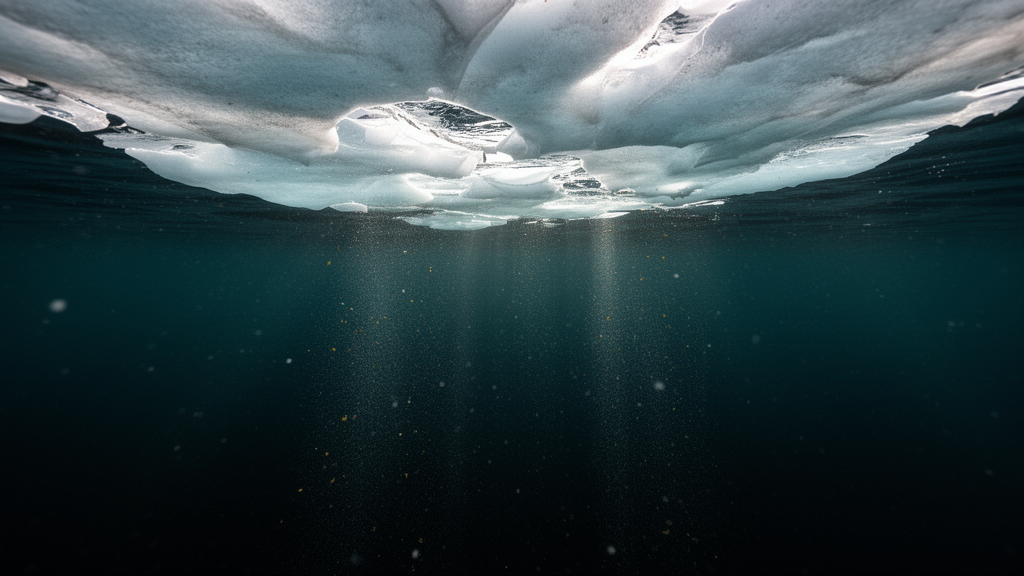
The icy waters at the top and bottom of the planet are doing something remarkable, and largely invisible to the policies meant to protect the climate. Across the Arctic and the Southern Ocean, marine ecosystems capture carbon dioxide, lock it into sediments and living tissue, and in some cases hold it in place for decades, centuries or longer. Yet according to a new international review published in Global Change Biology, the science underpinning these processes remains too incomplete, and the policy frameworks governing them too narrow, for polar blue carbon to receive the recognition and protection the authors believe it deserves.
The review, led by researchers from Aarhus University and conducted under the Horizon Europe project POMP — Polar Ocean Mitigation Potential — brings together what is currently known about carbon captured, stored or transported by marine ecosystems in polar regions. The authors assess which habitats may contribute to long-term carbon storage, why these systems have been largely absent from existing climate and conservation instruments, and what evidence gaps must be closed before they can be meaningfully integrated into climate strategies. Their conclusion is deliberately two-sided: the potential is real, but so are the uncertainties, and neither should be used as an excuse for inaction.
Blue carbon, as a concept, has so far been defined almost entirely by the tropics and temperate zones. Mangrove forests, salt marshes and seagrass meadows dominate the policy conversation because their carbon dynamics are comparatively well quantified, their extent is mappable from satellites, and their sediments accumulate organic matter at rates that can be measured with established methods. These ecosystems have earned places in national greenhouse gas inventories and in voluntary carbon market methodologies. Polar systems, by contrast, are almost entirely absent from such frameworks — a striking omission given that the Arctic and Antarctic together account for roughly one fifth of the global ocean and rank among the regions most rapidly transformed by climate change.
The review identifies a broad portfolio of polar habitats and pathways with plausible relevance to carbon storage. In the Arctic, salt marshes and seagrass meadows exist at the margins of a warming coastline, while kelp forests line rocky substrates in cold, nutrient-rich waters. In open water, phytoplankton drive the biological carbon pump, fixing carbon dioxide at the surface and exporting a fraction of it toward the deep ocean. Ice-associated algae, which grow within and beneath sea ice, add another, poorly quantified pathway. Fjords, continental shelves and deep-sea sediments act as receiving basins where organic carbon can accumulate and, under the right conditions, remain buried for long periods. Each of these systems operates differently, and each carries a different degree of confidence in its estimated contribution.
That confidence, the authors stress, is currently the weakest link. For many polar habitats, scientists lack robust estimates of even the most basic parameters: how much area the habitat covers, how much carbon it holds in living biomass and sediments, and how much of that carbon is genuinely sequestered over climatically relevant timescales rather than recycled back into the water column. The polar environment complicates measurement in ways that temperate blue carbon science rarely encounters. Sea ice limits access and remote sensing. Seasonal darkness compresses the growing season into a few intense months. Glacial runoff, sediment plumes and permafrost thaw introduce additional carbon sources whose origins and fates are difficult to disentangle. Warming, ice loss, coastal erosion and expanding human activity are simultaneously reshaping the very systems researchers are trying to quantify, meaning that a carbon stock measured today may not behave like the same stock a decade from now.
These dynamics cut in both directions, and the review is explicit about that asymmetry. Some habitats may grow in importance as carbon stores as conditions change — expanding seagrass meadows along newly ice-free coastlines, for example, or shifting plankton communities altering export efficiency. Others may be weakened or lost as warming, ice retreat, erosion and industrial pressure erode the conditions that allowed them to accumulate carbon in the first place. Thawing permafrost coasts can release stored carbon even as new vegetated habitats establish nearby. The net trajectory for any given region is therefore an open scientific question, not a foregone conclusion, and it is precisely this uncertainty that has kept polar systems outside formal policy recognition.
The authors are equally clear about what the current state of knowledge does not justify. Treating polar blue carbon as a conventional carbon-offset solution, they argue, would be premature and potentially dangerous. Carbon markets and offset schemes rest on assumptions that cannot yet be verified in polar marine systems: that emissions reductions are additional to what would have happened anyway, that stored carbon will remain locked away permanently, that measurements are accurate and comparable across sites, and that governance structures exist to enforce protection over the long term. In polar oceans, all four assumptions are currently shaky. Measurement standards are undeveloped, permanence is threatened by rapid environmental change, and much of the relevant ocean lies in areas with contested or fragmented jurisdiction.
“Polar blue carbon is not a shortcut around reducing CO2 emissions,” says Mikael Sejr, POMP coordinator at the Department of Ecoscience at Aarhus University. “The first priority must still be to phase out fossil fuels. But protecting carbon-rich marine ecosystems can be an important part of a broader climate and biodiversity strategy.” The distinction matters. Blue carbon protection, in this framing, is a complement to decarbonization rather than a substitute for it — a way of safeguarding natural carbon infrastructure that would otherwise be degraded, while the harder work of cutting emissions proceeds.
Lead author Nadescha Zwerschke of the Department of Biology at Aarhus University frames the urgency in similar terms. “Polar marine ecosystems are changing rapidly,” she notes. “Some habitats may become more important as carbon stores, while others may be weakened by warming, ice loss, erosion and increasing human pressure. We need to understand these systems much better — but we should not wait until all uncertainties are resolved before protecting the most vulnerable and carbon-rich habitats.” The argument echoes a familiar principle in environmental governance: precautionary protection does not require perfect knowledge, only a reasonable expectation that irreversible losses are possible and that waiting carries its own costs.
Toward that end, the review lays out four coordinated actions. First, sustained investment in polar blue-carbon research, targeting the fundamental gaps in extent mapping, carbon stock assessment and sequestration rates. Second, precautionary protection of habitats already known to be carbon-rich and vulnerable, so that existing stores are not destroyed while the science catches up. Third, management approaches that treat carbon storage and biodiversity as linked objectives rather than competing ones — a natural pairing, since many of the same ecosystems that sequester carbon also support the productivity and diversity that polar food webs depend on. Fourth, clearer policy pathways through which substantial natural carbon stores in polar marine ecosystems can eventually be recognized in national and international frameworks. The near-term priority, the authors conclude, is not to create new offset markets but to protect what exists and to build the scientific foundation on which future policy decisions can rest. As polar oceans warm faster than almost anywhere else on Earth, the window for doing both is narrowing.
Subject of Research: The status of polar blue carbon and its integration into marine climate and conservation policy
Article Title: Polar oceans store carbon — but policy is not yet ready to count it
Article References: Polar oceans store carbon — but policy is not yet ready to count it. (n.d.). Original publication
Image Credits: AI Generated
DOI: Not provided
Keywords: polar blue carbon, Arctic, Antarctic, carbon sequestration, climate policy, marine ecosystems, biodiversity, kelp forests, seagrass, ocean warming, POMP project, Global Change Biology
Cite Scienmag News
Violet Maxwell. (October 9, 2026). Polar oceans quietly lock away carbon, yet climate policy still overlooks them. Scienmag. https://scienmag.com/polar-oceans-quietly-lock-away-carbon-yet-climate-policy-still-overlooks-them/
Violet Maxwell. "Polar oceans quietly lock away carbon, yet climate policy still overlooks them." Scienmag, 9 October 2026, https://scienmag.com/polar-oceans-quietly-lock-away-carbon-yet-climate-policy-still-overlooks-them/. Accessed 9 October 2026.
Violet Maxwell. "Polar oceans quietly lock away carbon, yet climate policy still overlooks them." Scienmag. October 9, 2026. https://scienmag.com/polar-oceans-quietly-lock-away-carbon-yet-climate-policy-still-overlooks-them/


