


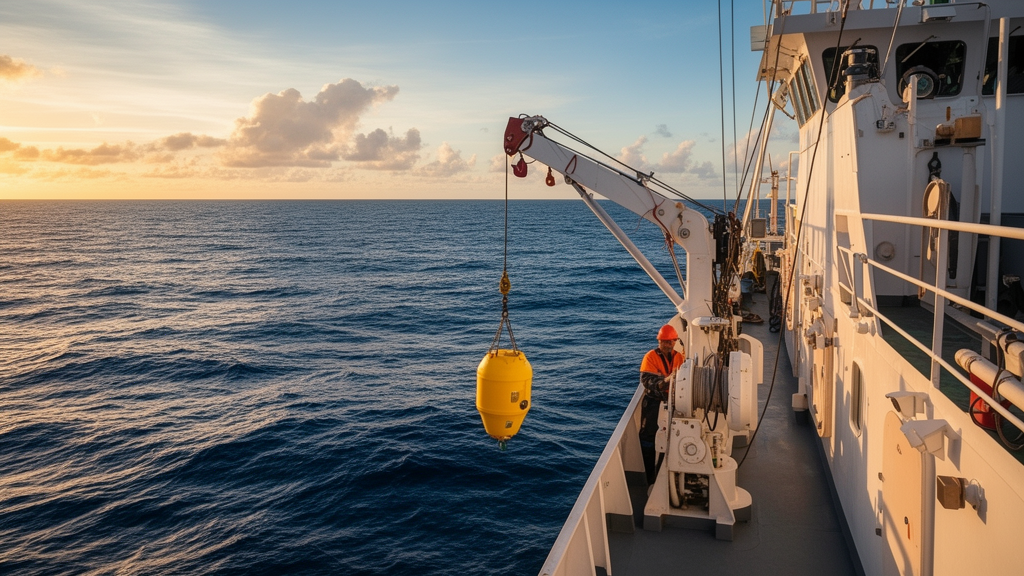
For nearly two decades, scientists have been able to account for almost every millimeter of global sea level rise, matching what satellites measure at the ocean surface with the sum of melting ice, shifting water masses and warming seawater. But when they zoomed in on one particular basin, the arithmetic stubbornly refused to add up. The North Atlantic, a region of outsized importance for the global climate system, has been the site of a persistent accounting failure: satellite altimetry reported more sea level rise than the known components could explain. A new study published in the journal Ocean Science by Zhe Song of the University of Toulouse and the University of Bretagne Occidentale, together with Anny Cazenave, William Llovel, Andrea Storto and Marie Bouih, revisits this puzzle and offers a compelling two-part solution: replace the satellite gravity estimate of ocean mass with an ocean reanalysis, and stop ignoring the deep ocean below 2000 meters.
The concept of a sea level budget is deceptively simple. Satellite altimeters measure the total height of the sea surface by bouncing radar pulses off the water, a quantity that includes everything: the expansion of seawater as it warms, the dilution or concentration of salt, and the sheer addition or redistribution of water mass. Independent observing systems can estimate each ingredient separately. The Argo program, a global fleet of nearly 4000 autonomous profiling floats, measures temperature and salinity in the upper 2000 meters of the ocean, allowing scientists to compute the steric component, the part of sea level change caused by density changes. The GRACE and GRACE Follow-On satellite missions, jointly operated by NASA and the German Aerospace Center, track Earth’s shifting gravity field to reveal where water mass is accumulating or draining. If everything is measured correctly, altimetry minus steric change should equal ocean mass change, and the residual, the difference between the two sides of the ledger, should be statistically indistinguishable from zero.
At the global scale, this budget closes reasonably well. But a recent study by Bouih and colleagues, published in 2025 in the same journal, examined regional budgets basin by basin over the 2004 to 2022 period and found something troubling. In the Pacific, Indian and South Atlantic oceans, the residuals were small enough to fall within data uncertainties. In the North Atlantic, however, strong positive residuals appeared no matter which estimate of ocean mass was used. The region was gaining sea level faster than the sum of its measured parts could account for, and the discrepancy was far too large to dismiss as random error. That finding set the stage for the new investigation, which systematically tests every link in the observational chain to find where the accounting breaks down.
The team assembled an unusually comprehensive toolkit. For total sea level, they used the Copernicus Climate Change Service’s daily gridded altimetry product, corrected for known instrumental drifts and for the ongoing rebound of the crust following the last ice age, the so-called glacial isostatic adjustment. For ocean mass, they averaged the latest Release 6 mascon solutions from three processing centers: the Center for Space Research in Texas, the Jet Propulsion Laboratory in California and the Goddard Space Flight Center in Maryland. For the steric component, they compared three independent Argo-based gridded products from the Scripps Institution of Oceanography, JAMSTEC in Japan and the Met Office Hadley Centre in the United Kingdom. Crucially, they added a fourth source of information that no float can provide: the CIGAR ocean reanalysis, a 32-member ensemble simulation based on the NEMO ocean model, forced by ERA5 atmospheric data and constrained by in situ temperature and salinity profiles, but deliberately not assimilating satellite altimetry, which makes it an independent check on the observed record.
The first clue emerged from comparing the steric products themselves. In the North Atlantic, temperature and salinity effects largely cancel each other out, a phenomenon known as thermohaline compensation. All four products showed strong positive thermosteric trends in the western basin, offset by negative halosteric trends, leaving a total steric signal much smaller than either component alone. This compensation means that salinity changes, negligible for global mean sea level, cannot be ignored in this region. The team also identified a technical wrinkle: some Argo floats have suffered a spurious salinity drift since 2016, and only the Scripps product corrects for it, while the JAMSTEC and EN4 products show suspicious anomalies that may reflect this uncorrected instrument problem. The researchers therefore relied on the Scripps product for their baseline calculations.
The more surprising discovery concerned the manometric component, the ocean mass term. When the team compared GRACE-based mass trends with those derived from the CIGAR reanalysis, by subtracting the local steric signal from the reanalysis’s sterodynamic sea level and adding the gravitational, rotational and deformation fingerprints of modern ice melt, the two maps told opposite stories. GRACE showed significant negative mass trends across most of the basin, weakening from east to west. The reanalysis showed positive trends in the east and negative trends in the west, separated by a striking dividing line that appears to follow the Mid-Atlantic Ridge. When the researchers computed an independent estimate of mass change by simply subtracting full-depth steric sea level from altimetry, the result agreed with the reanalysis in the eastern Atlantic and contradicted GRACE there, pointing a finger at possible problems in the satellite gravity data itself.
A likely culprit has recently been identified by other researchers. The GRACE mass estimates must be corrected for glacial isostatic adjustment, the slow rebound of the solid Earth after the disappearance of the great ice sheets. Traditional corrections assume that the Earth’s mantle has the same viscosity everywhere, but a 2026 study by Hightower and colleagues developed a three-dimensional GIA model based on seismic tomography and showed that lateral variations in mantle rheology substantially alter the correction in many regions, particularly across the entire Northeast Atlantic. Since the new sea level budget study used GRACE data with the traditional correction, the discrepancy between the satellite gravity and reanalysis mass estimates in the eastern basin may well stem from an inadequate GIA correction, a possibility the authors flag as a priority for future work.
The second piece of the puzzle was the deep ocean. Argo floats profile only the upper 2000 meters, leaving the vast volume of water below unobserved by the float array. Using the CIGAR reanalysis, which models the full ocean depth, the team computed the thermosteric contribution of water deeper than 2000 meters and added it to the budget. The effect was dramatic. Including the deep ocean reduced the mean residual trend by about 30 percent when the GRACE mass estimate was used. But when the reanalysis was used for both the mass term and the full-depth steric term, the residuals collapsed by roughly 90 percent compared with the upper-ocean-only calculation. The remaining residual trend was 0.24 plus or minus 0.22 millimeters per year, small enough that the North Atlantic sea level budget can finally be considered closed within the data uncertainties. By contrast, using the Scripps upper-ocean steric data combined with reanalysis deep-ocean information still left a residual of 0.88 plus or minus 0.20 millimeters per year, above the uncertainty range.
The implications reach beyond regional bookkeeping. The North Atlantic hosts the meridional overturning circulation, the system of currents that helps regulate climate on both sides of the Atlantic, and it is a region where heat is actively pumped into the deep ocean. If a substantial fraction of regional sea level rise is hiding below 2000 meters, then observing systems that stop at float depth will systematically misattribute that rise, and climate models that underrepresent deep warming will misproject regional sea level futures. The findings lend strong support to the One Argo initiative, an international effort to extend the float array into the deep ocean with sensors rated for full-depth profiling by 2030. Only direct deep measurements, the authors caution, can confirm whether the reanalysis-based deep warming estimate is accurate, since a reanalysis, however sophisticated, remains a model-based reconstruction rather than an observation.
Open questions remain. The reanalysis mass component shows a change in trend around 2016 whose origin is not yet explained, and the east-west disagreement between GRACE and the reanalysis demands resolution, whether through improved three-dimensional GIA corrections or through refinements in the gravity processing itself. But the central message of the study is one of reassurance and method. The North Atlantic was never hiding mysterious physics; it was hiding missing observations. Once the mass term is estimated with a physics-consistent reanalysis and the deep ocean is allowed to speak, one of the most stubborn discrepancies in regional sea level science quietly dissolves into the noise floor of the instruments, leaving a budget that finally balances.
Subject of Research: Closure of the regional North Atlantic sea level budget using satellite altimetry, GRACE gravimetry, Argo data and ocean reanalysis over 2004–2022
Article Title: North Atlantic sea level budget revisited
Article References: Song, Z., Cazenave, A., Llovel, W., Storto, A., & Bouih, M. (2026). North Atlantic sea level budget revisited. Ocean Science, 22(5), 2903-2914. https://doi.org/10.5194/os-22-2903-2026
Image Credits: AI Generated
Keywords: sea level budget, North Atlantic, satellite altimetry, GRACE, Argo floats, ocean reanalysis, deep ocean warming, steric sea level, ocean mass, glacial isostatic adjustment, thermohaline compensation, One Argo
Cite Scienmag News
Violet Maxwell. (October 9, 2026). Deep Ocean Warming and a Reanalysis Finally Close the Stubborn North Atlantic Sea Level Budget. Scienmag. https://scienmag.com/deep-ocean-warming-and-a-reanalysis-finally-close-the-stubborn-north-atlantic-sea-level-budget/
Violet Maxwell. "Deep Ocean Warming and a Reanalysis Finally Close the Stubborn North Atlantic Sea Level Budget." Scienmag, 9 October 2026, https://scienmag.com/deep-ocean-warming-and-a-reanalysis-finally-close-the-stubborn-north-atlantic-sea-level-budget/. Accessed 9 October 2026.
Violet Maxwell. "Deep Ocean Warming and a Reanalysis Finally Close the Stubborn North Atlantic Sea Level Budget." Scienmag. October 9, 2026. https://scienmag.com/deep-ocean-warming-and-a-reanalysis-finally-close-the-stubborn-north-atlantic-sea-level-budget/


