


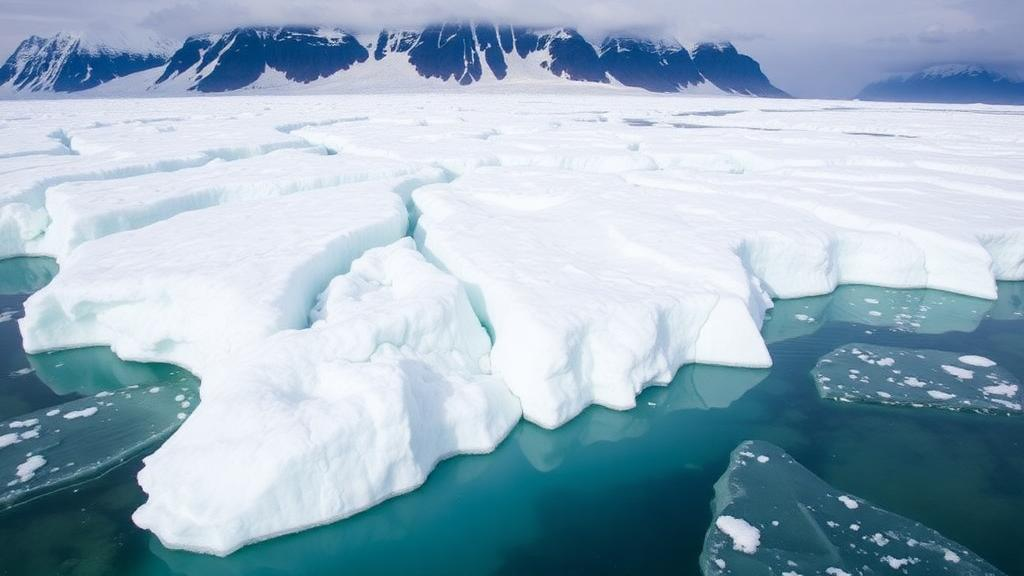
High in the mountains of southeast Alaska, a hidden layer of old snow is quietly failing at its most important job. That layer, known as firn, is the permeable, porous material through which fresh snow slowly compacts into glacier ice, and on the Juneau Icefield it has long acted like a giant sponge, soaking up summer meltwater and holding it back from rushing to the sea. A new study published in The Cryosphere by Annika N. Horlings of the University of Colorado Boulder and her colleagues shows that this sponge is thinning, warming, and losing its capacity to refreeze meltwater, with consequences that ripple outward from glacier dynamics to sea-level rise estimates and even the timing of salmon-friendly stream flows downstream.
The stakes are considerable. Alaskan glaciers collectively account for roughly 22 percent of global land-ice loss to the ocean and make up 38 percent of the world’s alpine glaciers currently undergoing accelerated thinning. Most of that loss happens through surface melt, and the firn layer sits directly in the path of that meltwater, controlling how quickly and in what volumes water travels from the glacier surface into the englacial and subglacial plumbing beneath. Yet the transit of meltwater through firn remains one of the more understudied corners of glaciology, particularly on temperate, high-melt, high-accumulation glaciers like those of Alaska, where accumulation zones sit almost entirely in the so-called wet-snow zone, a regime where snow is warm and some runoff occurs year after year.
To probe this system, the team combined two complementary approaches. In June and July 2024, they drilled thirteen firn cores at four sites across the icefield, including the Matthes and Llewellyn Glacier divide, the intersection of the Matthes and Gilkey Glaciers, the Northwest Branch of the Taku Glacier, and a firn-covered site in the Taku Glacier’s ablation zone. At each site they repeated the coring at intervals of one week to one month, measuring density, stratigraphy, and, using a dielectric permittivity sensor, the liquid water content of the snow and firn. They then contextualized these snapshots with simulations from the Community Firn Model, run from 1980 to 2019 using a downscaled surface mass-balance product calibrated against the icefield’s long historical measurement record.
The field results revealed a striking seasonal transformation. Mean firn density increased by up to 5 percent over the summer, and depth-averaged liquid water content climbed by as much as 71 percent at one site, with measured values typically ranging from 7 to 25 percent by volume. Those liquid water contents are far higher than the traditional definition of irreducible water saturation, the capillary-bound residual water that firn can hold, which is usually pegged at roughly 2 to 3 percent of unit volume. The implication is that meltwater is being generated faster than it can drain out of the firn, either because permeability is too low or because the hydraulic head is insufficient to push the water through, meaning the firn is actively storing liquid water during the early melt season.
Some of that stored water may be more than transient. At the ablation-zone site, liquid water was observed draining from the base of the first core retrieved in early June, a sign of temporary liquid-water storage near the firn-ice transition. Taken together with the high measured water contents, which match or exceed the range observed in Greenland’s well-documented firn aquifers, and with model results showing liquid water persisting between melt seasons at depth, the evidence points toward the possible existence of seasonal or even perennial firn aquifers on the Juneau Icefield. The authors are careful to note that without mid-winter observations they cannot confirm year-round persistence, but the possibility that aquifers may occur locally to regionally across the accumulation zone is a significant and unexpected finding for a temperate Alaskan glacier system.
The decadal modeling tells a starker story. Between 1980 and 2019, modeled firn thickness at the three accumulation-zone sites decreased at rates of 1.2 to 3.3 meters per decade, while firn-air content, the pore space available to hold water and buffer melt, declined at 0.43 to 0.83 meters per decade. A substantial share of that thinning occurred after 2010, driven by rising melt and declining snow accumulation. At one site, annual melt actually exceeded accumulation by 2019, suggesting the location may have shifted into the ablation zone altogether, consistent with recent icefield-wide rises in the equilibrium-line altitude. The climate data underlying these trends show winter temperatures warming at 0.23 to 0.34 degrees Celsius per decade, surface melt increasing at 0.11 to 0.16 meters of ice equivalent per year per decade, and snow accumulation falling at 0.12 to 0.16 meters per year per decade.
The pivotal mechanism, the researchers found, is something called cold content: the amount of energy required to bring the firn up to the melting point. On a nearly isothermal temperate glacier, cold content, not pore space, is the primary limit on how much meltwater can refreeze, because available pore space on the icefield exceeds 8 to 10 meters while total generated melt is an order of magnitude smaller. Modeled cold content in the upper 20 meters of firn declined at 0.57 to 0.86 megajoules per square meter per decade, and the number of days with near-zero cold content increased by 7.3 to 8.3 days per decade. As that thermal buffer eroded, meltwater runoff from the firn increased at 0.11 to 0.16 meters of ice equivalent per decade, refreezing decreased, and the onset of the spring runoff season shifted earlier by 4.1 to 6.3 days per decade.
Those hydrological shifts scale up to something tangible. By extrapolating the modeled runoff across the Taku Glacier’s 558-square-kilometer accumulation area, the team estimates that firn runoff may have increased by 2.1 to 4.4 times 10 to the 8 cubic meters of ice equivalent between 1980 and 2019, roughly 32 to 72 percent of the glacier’s total annual ablation. Earlier and larger pulses of meltwater reaching downstream environments could raise the likelihood of flooding and highly variable stream flow, and could alter stream temperature and clarity in ways that matter for species such as salmon, which depend on particular freshwater conditions. Because firn warming is less reversible than firn cooling, thanks to nonlinear densification feedbacks and latent heat released when meltwater refreezes, the likelihood of regenerating this lost buffering capacity is low.
The findings also complicate the accounting behind sea-level projections. Geodetic mass-balance methods, which convert measured volume changes to mass using density assumptions, may miss significant mass stored as transient liquid water or in firn aquifers, particularly when surveys are not timed to the end of the melt season. Liquid water also changes radar-wave velocity, introducing uncertainties of up to 45 percent in radar-derived snow water equivalent estimates, meaning even spring surveys on the Juneau Icefield must account for wet snow. As firn on the Juneau Icefield and similar temperate Alaskan glaciers continues to thin and warm, the authors conclude, more melt will be routed directly into runoff, and the inter-seasonal shifts in liquid-water retention will inject critical uncertainties into the mass-balance calculations on which sea-level rise estimates depend. Future work, they argue, should expand in-situ firn observations across the icefield and test how different climate forcings propagate through firn models, so that the fate of Alaska’s hidden snow sponge can be tracked with the precision the problem demands.
Subject of Research: Seasonal to decadal evolution of firn properties and meltwater hydrology on the Juneau Icefield, Alaska
Article Title: Seasonal to decadal evolution of firn properties and impacts on hydrology of the Juneau Icefield
Article References: Seasonal to decadal evolution of firn properties and impacts on hydrology of the Juneau Icefield. (n.d.). https://doi.org/10.5194/tc-20-5401-2026
Image Credits: AI Generated
Keywords: firn, Juneau Icefield, glacier hydrology, meltwater retention, firn aquifer, cold content, Alaska glaciers, sea-level rise, The Cryosphere, Community Firn Model, Taku Glacier, climate change
Cite Scienmag News
Sloane Callahan. (October 9, 2026). Alaska’s Juneau Icefield Is Losing Its Sponge: Firn Thins, Warms, and Sends Meltwater Straight to the Sea. Scienmag. https://scienmag.com/alaskas-juneau-icefield-is-losing-its-sponge-firn-thins-warms-and-sends-meltwater-straight-to-the-sea/
Sloane Callahan. "Alaska’s Juneau Icefield Is Losing Its Sponge: Firn Thins, Warms, and Sends Meltwater Straight to the Sea." Scienmag, 9 October 2026, https://scienmag.com/alaskas-juneau-icefield-is-losing-its-sponge-firn-thins-warms-and-sends-meltwater-straight-to-the-sea/. Accessed 9 October 2026.
Sloane Callahan. "Alaska’s Juneau Icefield Is Losing Its Sponge: Firn Thins, Warms, and Sends Meltwater Straight to the Sea." Scienmag. October 9, 2026. https://scienmag.com/alaskas-juneau-icefield-is-losing-its-sponge-firn-thins-warms-and-sends-meltwater-straight-to-the-sea/


