


Every day, roughly ten million plastic bags are discarded across Pakistan, and only a small fraction of them ever reach a dustbin. The rest clog drains, choke sewage channels, and litter open spaces, contributing to a waste crisis that the United Nations Development Programme estimates has blocked around eighty percent of the country’s drains. Now, a laboratory study from NED University of Engineering and Technology in Karachi and Monash University Malaysia suggests that this stubborn, low-value waste stream could have an unexpected destination: the very roads that traffic drives on every day. By substituting shredded polyethylene bags for a small share of the mineral aggregate in hot mix asphalt, the researchers found a dosage that actually strengthens the pavement while consuming plastic that would otherwise persist in the environment for decades.
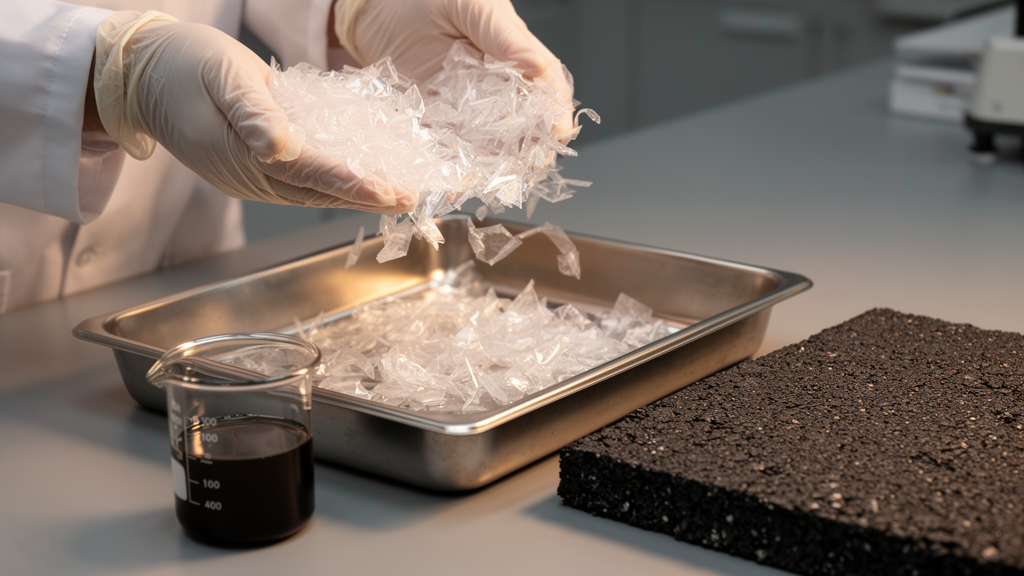
The study, published in Environmental Science and Pollution Research, is notable for the rigor of its experimental design and for the precision of its central finding. The team prepared three hundred Marshall specimens, the standard cylindrical samples used worldwide to characterize asphalt concrete, using locally quarried aggregates graded to Pakistan’s National Highway Authority specifications and a 60/70 penetration-grade binder from the national refinery. Into these mixes they substituted recycled plastic waste aggregate, or RPWA, produced from low-density polyethylene shopping bags at replacement levels ranging from 2.5 to 15 percent by weight. The plastic was manually sorted, washed in mild detergent, and shredded in a rotary granulator to particles between 1.18 and 2.36 millimeters, yielding a material with a bulk density of 0.38 to 0.42 grams per cubic centimeter, a specific gravity of about 0.92, and a softening threshold of 120 degrees Celsius.
The headline result is a sharply defined optimum. At 2.5 percent RPWA by weight, roughly six percent by volume, the modified mix achieved the highest Marshall stability of any plastic-containing sample, exceeding even the unmodified control in load-bearing capacity. The researchers attribute this gain to the plastic acting simultaneously as a fine filler and a binder modifier at low concentrations, improving cohesion and the interlocking between aggregate particles. But the benefit proved fragile. Beyond the 2.5 percent threshold, stability declined steeply, and at 15 percent replacement the mixes fell below the 9.81 kilonewton minimum required by standard specifications. The team describes this behavior as a kind of phase change: below the threshold, plastic particles reinforce the mineral skeleton; above it, they become soft, non-load-bearing inclusions that disrupt the stone-on-stone contact that gives asphalt its strength.
Statistical analysis reinforced the picture. Analysis of variance, conducted at a 95 percent confidence level after normality and homogeneity of variance were verified with Shapiro-Wilk and Levene’s tests, showed that RPWA content significantly influenced five of the parameters studied: flow, voids in mineral aggregate, voids filled with asphalt, stability, and the stability-flow quotient, with p-values below 0.01. Effect sizes ranged from medium to large, with unit weight, stability, and the stiffness index showing the strongest responses. Notably, air voids and voids filled with asphalt remained within acceptable design limits across all replacement levels, suggesting that the volumetric skeleton of the mix retained its structural soundness even as its mechanical character shifted.
That shift was most visible in the flow values, which measure how much a pavement deforms under load. Flow rose steadily with plastic content, and the overall mean of 4.44 millimeters exceeded the maximum acceptable limit of 3.5 millimeters, signaling greater plasticity and reduced resistance to rutting. The stability-flow quotient, a stiffness index directly proportional to rutting resistance, peaked at 2.5 percent RPWA and then declined consistently, indicating a progressive loss of internal friction and cohesion as plastic displaced mineral aggregate. The unit weight of the mixes fell in parallel, a direct consequence of the plastic’s low specific gravity compared with natural stone, and the researchers linked this density drop to significant changes in the mix’s volumetric behavior, particularly at higher replacement levels where aggregate packing appears to be restructured.
To translate these multidimensional results into a practical design recommendation, the team devised a novel composite performance score. The score assigns normalized values to each key Marshall criterion, stability of at least 9.81 kilonewtons, flow between 2 and 3.5 millimeters, air voids between 4 and 7 percent, and voids in mineral aggregate of at least 14 percent, rewarding parameters that fall within their target ranges and penalizing those that drift outside. Under this framework, the 2.5 percent RPWA mix scored highest among the modified samples, though still below the unmodified control, an honest reflection of the trade-off between sustainability and pure design performance. The score declined sharply beyond the optimum but remained within acceptable design ranges up to 10 percent replacement, giving engineers a workable window rather than a single fragile point.
The economics proved surprisingly favorable. The researchers estimated the cost of preparing one cubic meter of modified asphalt by adding collection and sorting fees, washing and shredding costs drawn from the recycling literature, a ten percent increment in labor, and a five percent surcharge on machinery to account for longer mixing times and abrasive wear. The total came to about 5,400 Pakistani rupees per cubic meter, against 5,325 for the conventional mix, an escalation of just 1.4 percent. For that marginal premium, a road built with the optimized mix would sequester plastic waste at scale, reduce demand for quarried aggregate, and deliver the highest load-bearing capacity of any modified formulation tested.
The context makes the finding more than an academic curiosity. Globally, only about nine percent of plastic waste is recycled, and production is expected to triple from last decade’s levels by 2060, overwhelming waste systems in developing countries that lack collection and sorting infrastructure. The construction sector, which consumes up to a fifth of global plastic production, offers a scale of demand that few other industries can match. Prior studies have shown that polyethylene-modified binders can improve rutting resistance and fatigue life, with one Indian study reporting 57 percent longer fatigue life and ten percent cost savings for LDPE-modified mixes. The present study extends that literature by treating plastic as an aggregate substitute rather than a binder additive, a route the authors note is generally more cost-effective, and by mapping the nonlinear response of an entire suite of Marshall properties rather than a single optimum.
The authors are careful about the limits of their evidence. Their conclusions rest on laboratory Marshall testing alone, without field trials, and they did not evaluate moisture sensitivity, fatigue, rutting under sustained high temperatures, long-term aging, or a full lifecycle cost analysis. Environmental questions also remain open, including the potential for microplastic release, chemical leaching, and fume emissions during hot mixing, as well as the fate of the plastic when the pavement is eventually milled. They recommend future work with finer increments of plastic content between zero and five percent, advanced performance testing of the optimal mix, trials with other polymer streams such as HDPE, PP, and PET, and pilot road projects to validate long-term durability.
Even with those caveats, the study offers a concrete, quantified pathway for a problem that has resisted most solutions: what to do with thin-film plastic bags that are too contaminated and too low-value to recycle conventionally. Because the optimal dosage is narrow, the researchers stress that strict quality control on batching would be essential in practice, and they suggest the approach is best suited initially to low and medium-traffic roads where the modest cost increase is justified by the environmental dividend. If field validation confirms the laboratory promise, the plastic bag that blocks a drain in Karachi today might, in a few years, be buried in the wearing course of the road beside it, locked into place by the same durability that once made plastic an environmental liability.
Subject of Research: Recycled plastic waste aggregate as a partial replacement for mineral aggregate in hot mix asphalt pavement design
Article Title: Viability of reducing plastic waste disposal by utilization in hot mix asphalt: a multicriteria analysis with cost considerations
Article References: Qadir, A., & Gazder, U. (2026). Viability of reducing plastic waste disposal by utilization in hot mix asphalt: a multicriteria analysis with cost considerations. Environmental Science and Pollution Research. https://doi.org/10.1007/s11356-026-38290-x
Image Credits: AI Generated
DOI: 10.1007/s11356-026-38290-x
Keywords: recycled plastic waste aggregate, hot mix asphalt, LDPE, Marshall stability, plastic waste management, sustainable pavements, Pakistan, polyethylene bags, ANOVA, performance score, circular economy, road construction
Cite Scienmag News
Violet Maxwell. (October 9, 2026). Plastic Bags in Pavements: Scientists Pinpoint the Sweet Spot for Turning Road Waste into Roads. Scienmag. https://scienmag.com/plastic-bags-in-pavements-scientists-pinpoint-the-sweet-spot-for-turning-road-waste-into-roads/
Violet Maxwell. "Plastic Bags in Pavements: Scientists Pinpoint the Sweet Spot for Turning Road Waste into Roads." Scienmag, 9 October 2026, https://scienmag.com/plastic-bags-in-pavements-scientists-pinpoint-the-sweet-spot-for-turning-road-waste-into-roads/. Accessed 9 October 2026.
Violet Maxwell. "Plastic Bags in Pavements: Scientists Pinpoint the Sweet Spot for Turning Road Waste into Roads." Scienmag. October 9, 2026. https://scienmag.com/plastic-bags-in-pavements-scientists-pinpoint-the-sweet-spot-for-turning-road-waste-into-roads/


