


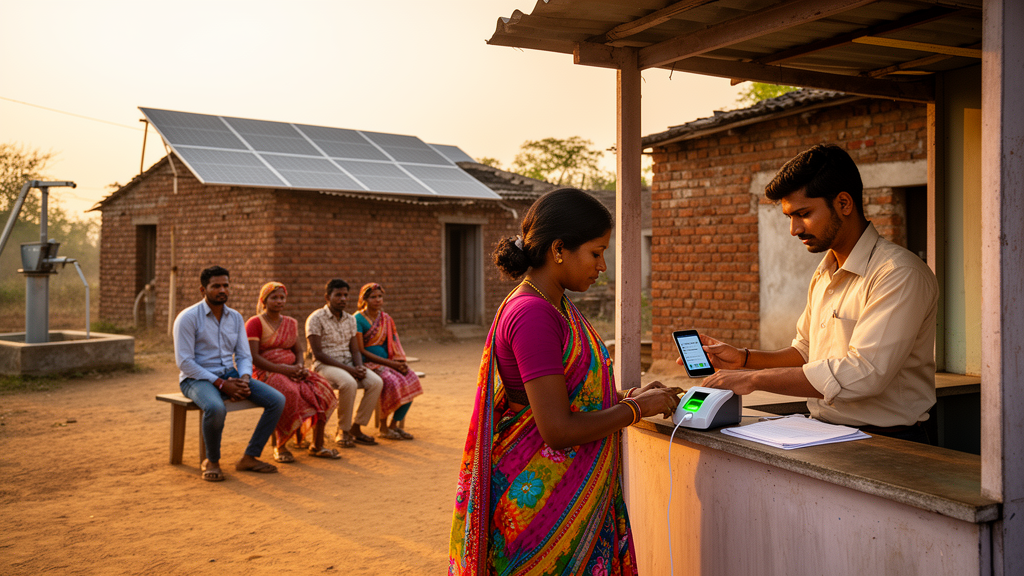
India has spent the better part of two decades building one of the largest financial inclusion projects in human history. Digital payment systems now reach hundreds of millions of people, mobile banking has moved money to villages that never had a branch, and ambitious government programs have opened bank accounts at a scale no country has attempted before. Yet a new study published in Discover Sustainability argues that this extraordinary expansion conceals a sobering paradox: the more people are brought into the formal financial system, the harder it becomes to reach those still left outside it. For the marginalized and indigenous communities who remain on the periphery of mainstream financial services, the promise of inclusion often stops at the account-opening stage, and that gap carries profound consequences for India’s commitments to the United Nations Sustainable Development Goals.
The research, led by Ram B. Ramachandran of the Jindal School of Banking and Finance at O.P. Jindal Global University, together with colleagues from Amity University, Flameback Capital, Third Bridge Group, and the Liberian Bank for Development and Investment, examines how financial exclusion is associated with barriers to achieving three specific SDG targets: eliminating poverty, which is SDG 1; creating decent work opportunities, which is SDG 8; and reducing inequalities, which is SDG 10. The authors draw on existing research, government data, and real-world case studies to map the terrain between formal financial access and genuine economic participation. Their central argument is that access and usage are not the same thing, and that India’s policy architecture has documented the access–usage divide extensively while offering comparatively few community-anchored institutional remedies for Scheduled Tribe populations.
The technical distinction at the heart of the paper is one that development economists have wrestled with for years. An account can be opened, a card can be issued, and a mobile wallet can be activated, all of which register statistically as inclusion. But if the account remains dormant, if the nearest banking touchpoint is hours away, if the interface is in a language the user cannot read, or if the household has no steady income to deposit, the infrastructure of inclusion produces no inclusion at all. The study identifies persistent challenges that are associated with limited participation in formal financial systems: geographical remoteness, cultural barriers, and financial illiteracy. Each of these operates differently. Remoteness is a problem of physical and digital infrastructure, cultural barriers concern trust, norms, and historical experience with institutions, and financial illiteracy concerns the knowledge required to convert access into use.
For indigenous and tribal communities in particular, these barriers compound one another. A household that is geographically isolated may also face cultural distance from banking institutions that were not designed with its needs in mind, and even when both obstacles are overcome, low financial literacy can prevent the household from using credit, savings, insurance, or payment tools productively. The authors frame this as a direct threat to the SDG commitment to leave no one behind. Poverty elimination depends on households being able to save safely, borrow affordably, and absorb shocks; decent work depends on enterprises, however small, being able to finance activity; and inequality reduction depends on the gap between the financially included and the excluded narrowing rather than widening. Where formal finance does not reach, these mechanisms fail silently, and the exclusion is invisible in aggregate statistics that celebrate rising account ownership.
The study’s analysis of government initiatives focuses on the Pradhan Mantri Jan Dhan Yojana, the flagship program that has driven India’s account-ownership revolution. The authors acknowledge both successes and limitations in current approaches. The program demonstrated that the state could mobilize the banking system to reach tens of millions of previously unbanked households, and it built the rails on which digital payments and direct benefit transfers now run. But the paper’s framing of the inclusion paradox suggests that the program’s remaining challenge is qualitatively different from its original one: the households that have not yet been reached are, by definition, the hardest to reach, and the tools that worked at scale may not work at the margins. Reaching the last mile requires a different institutional logic than reaching the median.
That is where the study’s principal contribution comes in. Rather than simply documenting the problem, the authors set new primary evidence from a tribal-focused grassroots organization, the Centre for Tribal and Rural Development Trust, alongside an established international community-owned bank model. The juxtaposition is deliberate. The CTRD Trust represents a locally embedded institution that works directly with tribal communities, understanding their circumstances and building financial capability from within, while the international community-owned bank model represents a mature example of what happens when ownership of financial infrastructure rests with the community it serves. From this pairing, the researchers derive an integrated, locally grounded policy package intended to bridge the gap between national-scale programs and community-level realities.
The logic of community-anchored finance rests on a simple institutional insight: trust and understanding are not features that can be bolted onto a banking product; they must be built into the institution itself. A grassroots organization embedded in a tribal community can adapt its outreach to local languages, seasonal income patterns, and social structures in ways that a centralized bank cannot. A community-owned bank, meanwhile, aligns the incentives of the financial institution with the welfare of its members, because the members are the owners. The study suggests that combining these principles with the scale and infrastructure of national programs offers a pathway toward inclusion that is both broad and deep, and that such locally-driven, participatory approaches embody the SDG commitment to leaving no one behind far better than top-down delivery alone.
The recommendations emerging from the research offer concrete guidance for three audiences. Policymakers are encouraged to design interventions that are participatory and locally driven rather than uniformly prescribed. Financial institutions are urged to look beyond account opening toward sustained usage, which means investing in financial literacy, appropriate products, and last-mile service points. Community organizations are positioned as essential intermediaries whose local knowledge can translate formal financial systems into forms that marginalized households can actually use. The emphasis throughout is on participation: communities should be partners in designing the financial services intended for them, not merely recipients of services designed elsewhere. This participatory principle, the authors argue, is not just ethically consistent with the SDGs but practically necessary, because services that ignore local realities simply do not get used.
The authors are careful about the limits of what their study can claim. Given its exploratory, descriptive design, the study reports associations rather than causal effects. In practical terms, this means the research can show that financial exclusion co-occurs with barriers to SDG achievement and that community-anchored models offer promising institutional remedies, but it cannot isolate the precise causal impact of any single intervention. That caution matters for policy translation: the integrated policy package the authors derive is a hypothesis grounded in evidence and institutional reasoning, not a proven prescription, and testing it at scale would require further empirical work. The research was approved by O.P. Jindal Global University’s Research and Ethics review Board in May 2026, with informed consent obtained for the primary interview conducted with the founder of the CTRD Trust, and the authors declare no competing interests.
The stakes of this research agenda extend well beyond India. The inclusion paradox the study identifies, in which the hardest-to-reach become progressively harder to include as aggregate coverage rises, is a structural feature of financial expansion everywhere, from sub-Saharan Africa to Southeast Asia. India’s experience is uniquely informative because of its scale: if the gap between access and usage can be closed for tribal and marginalized communities in a country of India’s size and diversity, the institutional lessons will travel. The study’s core message is that the next phase of financial inclusion will not be won by technology and mandates alone, but by institutions that communities own, trust, and shape. As the world measures progress toward the 2030 Sustainable Development Goals, the authors suggest that the truest test of leaving no one behind will be found not in the number of accounts opened, but in whether the most marginalized households can finally convert a piece of plastic and a phone screen into genuine economic agency.
Subject of Research: Financial inclusion and its links to Sustainable Development Goal outcomes for marginalized and indigenous communities in India
Article Title: Financial inclusion as a pathway to sustainability goals for marginalized communities in India
Article References: Financial inclusion as a pathway to sustainability goals for marginalized communities in India. (n.d.). https://doi.org/10.1007/s43621-026-04749-7
Image Credits: AI Generated
DOI: 10.1007/s43621-026-04749-7
Keywords: financial inclusion, Sustainable Development Goals, India, indigenous communities, Scheduled Tribes, microfinance, financial literacy, Pradhan Mantri Jan Dhan Yojana, self help groups, poverty reduction, inequality, community banking
Cite Scienmag News
Sloane Callahan. (October 9, 2026). Banking the Last Mile: How Financial Inclusion Could Decide India’s Sustainability Future. Scienmag. https://scienmag.com/banking-the-last-mile-how-financial-inclusion-could-decide-indias-sustainability-future/
Sloane Callahan. "Banking the Last Mile: How Financial Inclusion Could Decide India’s Sustainability Future." Scienmag, 9 October 2026, https://scienmag.com/banking-the-last-mile-how-financial-inclusion-could-decide-indias-sustainability-future/. Accessed 9 October 2026.
Sloane Callahan. "Banking the Last Mile: How Financial Inclusion Could Decide India’s Sustainability Future." Scienmag. October 9, 2026. https://scienmag.com/banking-the-last-mile-how-financial-inclusion-could-decide-indias-sustainability-future/


