


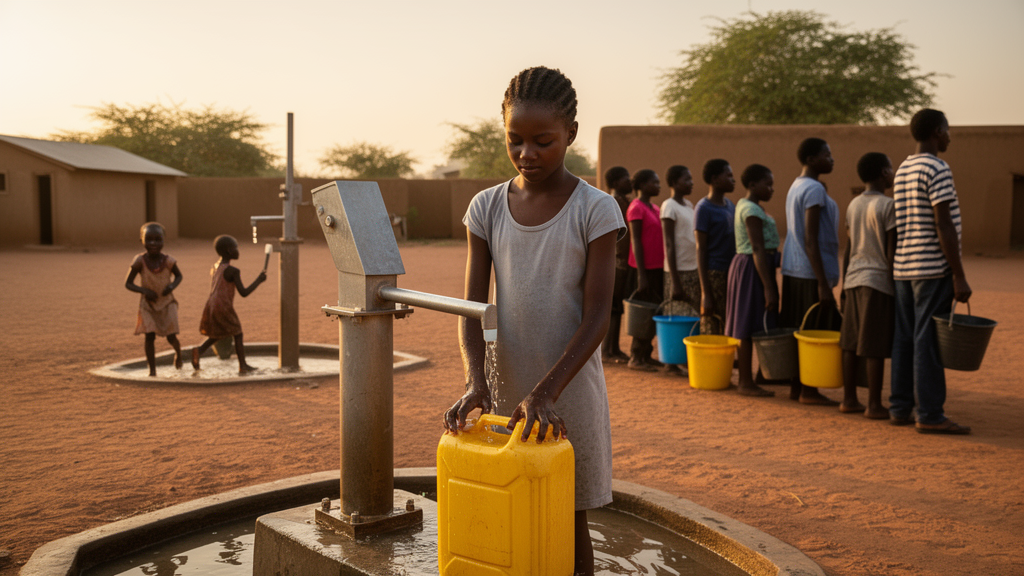
Nearly two billion people on Earth are between the ages of 10 and 24, making this the largest generation of young people in human history. How these adolescents fare over the coming decades will shape global health and development for the rest of the century, particularly in Africa and Asia, where 85 percent of the world’s adolescents are projected to live by 2100. A new opinion piece published in PLOS Water argues that this demographic reality demands a fundamental rethink of how the world studies, funds, and delivers water, sanitation, and hygiene services, known collectively as WASH. According to authors Joshua D. Miller of the University at Buffalo and Judith B. Borja of the University of San Carlos in the Philippines, adolescents have become the missing middle of the WASH sector: too old to be captured by early-childhood programs, yet too young to benefit from the infrastructure and policy attention directed at adults.
The economic and moral case for investing in young people has never been clearer, and it is increasingly framed as a triple dividend. Money spent on adolescents pays off three times over: in benefits to young people today, in benefits to the healthier and more productive adults they will become, and in benefits to the children they may eventually parent. Major global investments rightly support the first 1,000 days of life, a period of extraordinary developmental sensitivity. But development does not stop there. Later sensitive periods, including adolescence, continue to shape lifelong health trajectories, and these windows receive far less attention and far less money. The numbers are stark. Between 2016 and 2021, adolescent health received less than 3 percent of global development assistance, despite the substantial disease burden carried by this age group. As attention to adolescent wellbeing grows, the authors argue, so must efforts to expand access to the WASH services on which that wellbeing fundamentally depends.
Adolescence is a period of rapid neurological and psychosocial change, when the habits that persist into adulthood are formed. Reliable water and sanitation services are foundational during this life stage, shaping health both directly and indirectly through the behaviors they influence. The technical evidence assembled by Miller and Borja paints a detailed picture of how WASH failures cascade through adolescent lives. When water is scarce or distrusted, young people may substitute sugar-sweetened beverages for drinking water, a shift that elevates lifelong risk of noncommunicable diseases such as diabetes and cardiovascular disease. Inadequate school sanitation contributes to absenteeism and dropout, undermining the educational gains that development programs seek to protect. Barriers to menstrual hygiene management can cause stress, shame, and social withdrawal among adolescent girls, with consequences that ripple through schooling and social participation.
The psychological and social tolls extend further. Water insecurity has been linked to depression among adolescents, including refugee youth living in humanitarian contexts in Uganda. In rural Tanzania, a cross-sectional study found that water insecurity was associated with intimate partner violence among female adolescents and young women, but not among males, a gendered pattern that underscores how water stress interacts with social vulnerability. These burdens are not evenly distributed. Adolescent girls, along with young people in humanitarian settings, displacement camps, and other low-resource environments, often face the greatest risks. And today’s adolescents carry a burden no previous generation has faced: they are the first cohort to come of age in a climate-altered world, where intensifying extreme weather events, from droughts to floods, present additional and growing barriers to safe and sufficient water, sanitation, and hygiene.
Achieving universal WASH coverage, the promise embedded in the Sustainable Development Goals, requires rigorous evidence on what drives service shortfalls, who is most affected, and which strategies equitably improve outcomes. Yet, according to the authors, conventional measurement approaches systematically obscure where WASH is failing adolescents, and standard study designs often miss their perspectives entirely. The problem begins with how the world counts. The WHO/UNICEF Joint Monitoring Programme, the custodian of global WASH monitoring, primarily draws on household surveys that ask which services household members use and whether those services are accessible, available, and safe. These data are essential for tracking global progress, but they carry two key limitations when it comes to understanding the realities of adolescent life.
The first limitation is structural. Because responses are collected from a single respondent for the entire household, the data cannot be disaggregated for individual members, hiding differences by age and gender. A household survey cannot reveal whether a teenage girl’s sanitation needs differ from those of her father, or whether an adolescent boy’s water access differs from his grandmother’s. The second limitation concerns what the monitoring ladder actually measures. The JMP drinking water service ladder provides little insight into whether services are sufficient, acceptable, and reliable for the many uses beyond drinking on which young people’s health depends. A household may officially qualify as having a safely managed drinking water service, yet resident adolescents may go thirsty because they perceive the water to be unsafe, or they may be unable to bathe because the service delivers too little water for uses beyond drinking. On paper, the household is served. In lived experience, it is not.
Schools, where adolescents spend much of their time, are monitored even less rigorously. WASH in schools reporting focuses on the presence of services rather than their sufficiency, so a school may be counted as having toilets even when those facilities are unusable, unsafe, or inadequate for menstrual hygiene needs. Experiential measurement tools offer a way to close these gaps. The Water Insecurity Experiences, or WISE, Scales directly ask users whether available services are adequate for their basic needs, capturing the lived reality that infrastructure counts miss. The Individual WISE Scale enables disaggregation by age and gender, and its four-item version has been recommended by WHO and UNICEF as a priority gender-specific indicator for WASH monitoring. The scale has been validated among individuals aged 15 years and older, and evaluating its suitability for younger adolescents is an important next step. Meanwhile, the School WASH Insecurity Experiences project is developing analogous tools designed specifically for students. Together with qualitative methods, these instruments can help elevate adolescent voices by centering their lived experiences in the data that drive policy.
Beyond national monitoring, the authors argue for embedding these measures in studies that link WASH conditions to health and educational outcomes, revealing which strategies most effectively improve adolescent wellbeing. Longitudinal, mixed-methods designs are especially powerful, and the Longitudinal Cohort Study on the Filipino Child offers a working model. To understand how Filipino adolescents fare across the 2015 to 2030 Sustainable Development Goal period, the study enrolled almost 5,000 ten-year-olds in 2016 and follows them nearly every year into adulthood. It collects data at multiple levels: on individuals, including mental health, hygiene, and diets; on households, including WASH conditions; and on communities, including water supplies. The study has begun integrating the WISE Scales into its surveys and is conducting a parallel qualitative study to record young people’s experiences in their own words. Because such cohorts follow the same individuals over time, they can capture how needs shift across adolescence and how they differ by gender, geography, and household circumstances, providing exactly the kind of insight into how and where policymakers should act that one-off cross-sectional surveys cannot deliver.
The article closes with a concrete call to action aimed at three audiences. Global monitoring bodies and the national agencies that implement household surveys are urged to complement service-level indicators with individual-level experiential measures within existing survey platforms and through adolescent-focused studies, and to disaggregate findings by age and gender. Researchers and funders are asked to prioritize longitudinal, mixed-methods studies that link WASH to health, learning, and livelihoods, and that estimate intervention costs and returns, giving ministries of health, education, and water the data they need to act. Researchers, non-governmental organizations, and program implementers are called to involve young people as co-researchers and co-designers rather than passive subjects. Such engagement is demonstrably feasible: young adolescents in Kenya have already generated actionable recommendations for strengthening water and sanitation security in their own communities, and participatory approaches consistently yield interventions that are more relevant, more acceptable, and more lasting. With deliberate investment, the authors conclude, today’s adolescents could become the healthiest generation in history. Whether they do depends on choices being made now: what the world measures, which studies get funded, and whose experiences are centered when the WASH and health agenda is set.
Subject of Research: Adolescent water, sanitation, and hygiene (WASH) access, measurement, and policy
Article Title: Centering adolescents in global water, sanitation, and hygiene research and policy
Article References: Miller, J. D., & Borja, J. B. (2026). Centering adolescents in global water, sanitation, and hygiene research and policy. PLOS Water, 5(8), e0000608. https://doi.org/10.1371/journal.pwat.0000608
Image Credits: AI Generated
DOI: 10.1371/journal.pwat.0000608
Keywords: adolescent health, water security, sanitation, hygiene, WASH, global health, water insecurity, WISE Scales, menstrual hygiene, Sustainable Development Goals, public health policy, climate change
Cite Scienmag News
Phoebe Ingram. (October 9, 2026). The Missing Middle: Why Adolescents Are Being Left Behind in Global Water and Sanitation Efforts. Scienmag. https://scienmag.com/the-missing-middle-why-adolescents-are-being-left-behind-in-global-water-and-sanitation-efforts/
Phoebe Ingram. "The Missing Middle: Why Adolescents Are Being Left Behind in Global Water and Sanitation Efforts." Scienmag, 9 October 2026, https://scienmag.com/the-missing-middle-why-adolescents-are-being-left-behind-in-global-water-and-sanitation-efforts/. Accessed 9 October 2026.
Phoebe Ingram. "The Missing Middle: Why Adolescents Are Being Left Behind in Global Water and Sanitation Efforts." Scienmag. October 9, 2026. https://scienmag.com/the-missing-middle-why-adolescents-are-being-left-behind-in-global-water-and-sanitation-efforts/


